
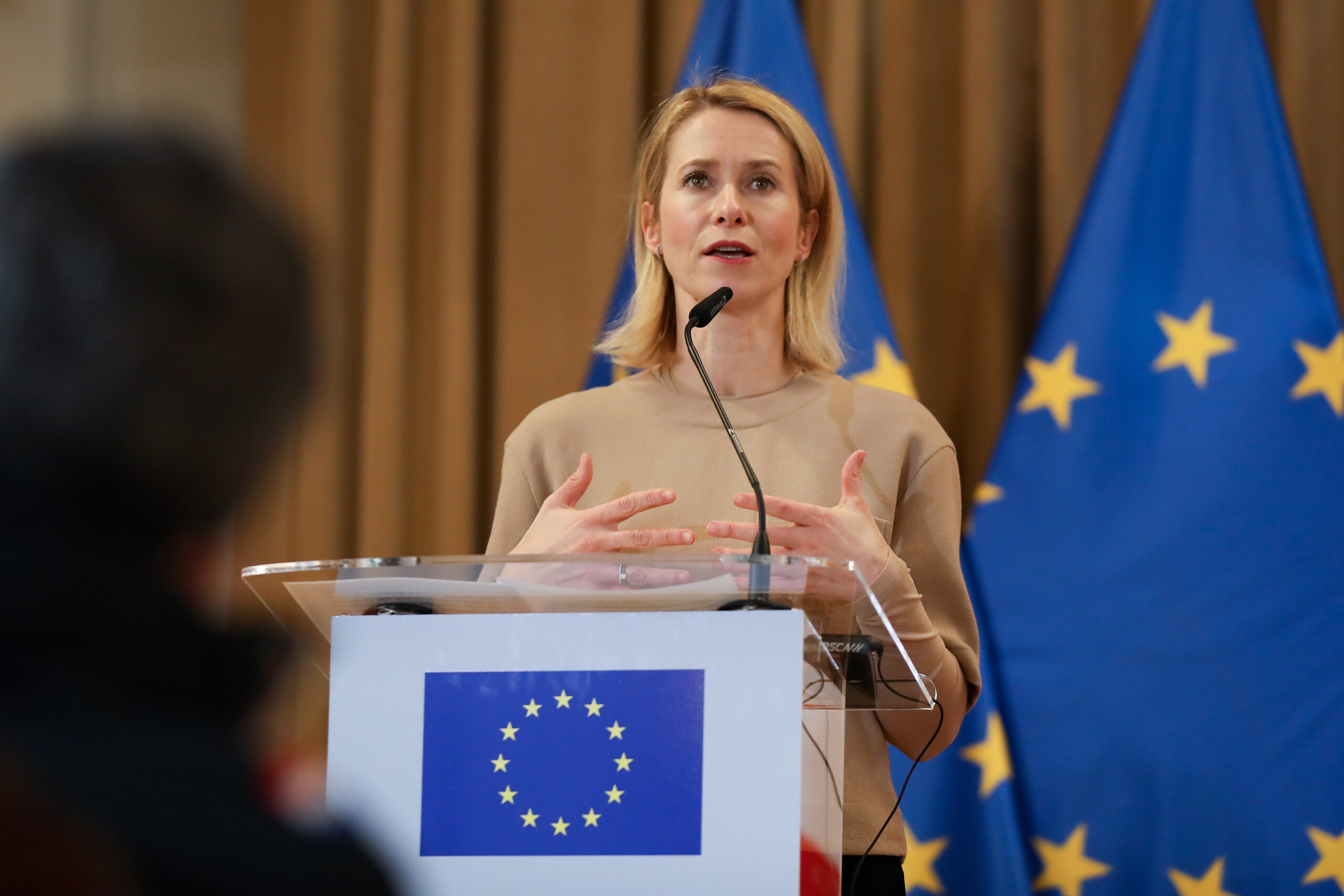
TIRANA—On Monday, European Union (EU) foreign policy chief Kaja Kallas said that enlargement of the twenty-seven-member bloc should speed up. “Enlargement is the antidote to Russian imperialism and a sign that the most ambitious multilateral project in history—the European Union—is here to stay,” she told EU ambassadors.
It is an antidote that some EU member states seem hesitant to take, however. No country has joined the EU since 2013, when Croatia was admitted. In the dozen-plus years since then, the bloc has struggled with a fundamental dilemma on further enlargement: Would admitting new members strengthen the EU? Or would the addition of poorer countries with weaker democratic institutions—including some close partners of Russia—further undermine its cohesion due to the bloc’s unanimity-based decision-making?
There have been many reasons why the EU has resisted enlargement for the past dozen-plus years. But concern over the cost to EU member state taxpayers is rarely one of the strongest concerns. The EU could without difficulty absorb the financial costs of admitting the countries of the Western Balkans (Ukraine, on the other hand, is a different matter). For many skeptics of enlargement, a bigger concern than cost is the potential for new members to take EU decision-making hostage and backslide on the rule of law once they are in. Hungary provides perhaps the biggest cautionary tale for this concern. Budapest has exploited the need for unanimous votes by vetoing accession negotiations with Ukraine on geopolitical grounds.
More generally across the EU, however, Russia’s full-scale invasion of Ukraine in 2022 softened resistance to enlargement, with EU leaders reframing the addition of new members as a security imperative. That year, the candidate pool expanded rapidly beyond the six Western Balkans countries and Turkey to also include Ukraine, Moldova, and Georgia. This year, Trump’s claim on Greenland has drawn renewed EU membership interest in other parts of Europe, such as Iceland, which will hold a referendum on pursuing membership in the coming months.
Riding this momentum, the EU’s executive wing is pushing ahead with talks with Albania and Montenegro, the two candidates facing the least resistance to accession, as they are both NATO allies without major bilateral disputes with any current member states. Montenegro may now be on the cusp of drafting an accession treaty. Last year, Montenegrin Prime Minister Milojko Spajić announced that it was his goal for Montenegro to join the EU by 2028, while Albanian Prime Minister Edi Rama has set the goal of his country joining by 2030.
Sandwiched between the geopolitical imperative of enlargement and domestic pressures from Euroskeptic parties, the European Commission is now considering solutions that would allow enlargement to move forward without weakening the EU’s decision-making capacity. The solutions reportedly being discussed in Brussels would effectively offer new member states a kind of second-class status in the bloc, effectively creating a two-tier EU.

The proposal for a two-tier EU: Pragmatic or indecisive?
In the proposals reportedly under discussion, new member states would waive their veto rights for an indefinite transition period. During this period, each new member state would have full access to EU funds, institutions, and membership in the single market, but it would not be allowed to block decisions requiring unanimity. This idea does have some precedent, as transition periods on the rights of new members have been used in previous enlargement waves. In 2004, for example, new members had limits on the free movement of workers for up to seven years. But these earlier conditions were policy-specific and clearly time-bound; they did not relate to the new members’ institutional rights.
At the same time, Brussels has emphasized the need to strengthen post-accession safeguards on the rule of law. These safeguards would embed into the accession treaties provisions that would allow the EU to retain oversight and correction mechanisms over the new members’ performance, thereby preserving some of the leverage that the EU has during the accession process. Last month, European Commission officials touted Montenegro’s upcoming accession treaty as the first of a “new generation” of treaties that give the bloc enforcement tools it can use if new members backtrack on the rule of law.
While these ideas have some benefits, they are also incurring immediate costs to the credibility of the accession process. In effect, the EU is publicly hollowing out the meaning of membership and moving the goalposts midway through accession, all while failing to make a clear political commitment on the timeline of enlargement. Thus, the EU is once again signaling indecisiveness at a critical moment, undermining accession candidates’ momentum for reforms.
The EU’s policy of conditioning accession on reforms can help candidate countries’ political transformations if there is a clear and credible offer for membership. This drives political accountability and empowers candidate countries’ civil societies to push for reforms. Ukraine, for example, has been taking steps to fight corruption, and there have been large anti-corruption protests there even as Kyiv fights a war for survival. This is largely because Ukrainians understand that the fight against corruption is tied to Ukraine’s case for EU membership.
Western Balkan leaders are exploiting the decision-making vacuum
The prolonged indecision by EU member states on the timing, scope, and structure of its enlargement policy risks further derailing the process. It is also providing leaders in the Western Balkans with opportunities to come up with distractions under the guise of strategic leadership and pragmatic solutions.
On February 28, Rama and Serbian President Aleksandar Vučić published a joint op-ed in which they called for the Western Balkans to be granted quick access to the EU single market and the Schengen area while forfeiting representation in EU institutions. This would mean even fewer institutional rights than the second-class membership proposal the EU is discussing. It would effectively make the countries of the Western Balkans members of the European Economic Area, like Norway and Iceland, without giving them the institutional rights of EU member states.
It is not a new idea. It has been circulating for almost a decade, promoted primarily by think tanks such as the Berlin-based European Stability Initiative. The argument goes that absent a clear political commitment to enlargement, the EU should offer the accession states something credible and politically feasible in the interim that would anchor them in the EU’s economic orbit and generate tangible benefits until it is ready to bring in countries as full members.
Yet there are reasons to believe that the enthusiastic endorsement of such ideas by Rama and Vučić—at a moment when both Montenegro and Albania appear to have an open path to membership—may be motivated by reasons other than pragmatism.
For one, Brussels is reportedly discussing the suspension of some or all of the EU’s conditional funding for Serbia due to its backsliding on the rule of law, at a time when the country has been roiled by an ongoing wave of anti-corruption protests that began in November 2024. Rama, for his part, has been intensifying his attacks against an empowered judiciary that is going after his party’s top brass. Rama is also facing pushback from the EU for his attack on the judiciary, a troubling sign for Albania’s accession process, since rule-of-law reform is seen as a litmus test of its membership bid.