“Energy dominance” has become a defining phrase of President Donald Trump’s second-term energy policy. The administration frequently links the concept to energy abundance, affordability, and energy freedom. Yet despite its prominence in policy rhetoric, the term itself has rarely been clearly defined.
Last year, I proposed one interpretation. Based on the administration’s emphasis on abundance, affordability and freedom, I defined energy dominance as a vision to position US energy as a source of stability, competitiveness, and international leadership, and the ability of a country to utilize its energy and mineral resources in the most efficient and strategic way, making them a central enabler of national strategy.
Recent geopolitical developments—particularly those involving the US-China race on artificial intelligence (AI), the US intervention in Venezuela, and, most recently, the US-Israel war with Iran—suggest that the concept may now be evolving into something broader. On several occasions, Trump and senior US officials have referenced the strategic importance of access to the oil and energy resources in both Venezuela and Iran within the broader objectives of these actions. Thus, energy dominance may no longer refer simply to domestic production or export strength. Increasingly, it appears to involve control over energy assets, strategic chokepoints, and the global energy flow.
In this expanded interpretation, energy dominance becomes not just an energy policy—but a geopolitical strategy.
AI race with China and the United States’ strategic counterweight
While the war in Iran and its impact on energy prices are dominating headlines, the ongoing, broader context for the shift toward an energy-as-geopolitics framework is the intensifying technological competition between the United States and China. Leadership in artificial intelligence is increasingly viewed as a core pillar of US national security, shaping economic security, military capabilities, and technological influence in the decades ahead.
Artificial intelligence requires enormous energy inputs: electricity for AI and data centers, petrochemical materials for advanced manufacturing, and industrial energy for the supply chains and minerals processing that sustain technological growth. China currently holds significant structural advantages in critical minerals across nearly every level of the supply chain, including resource ownership, production, refining and processing capacity that underpin many advanced technologies. Closing that critical mineral gap quickly would be difficult.
One possible strategic response is to focus on energy leverage instead. If China’s advantage lies in mineral supply chains, the United States’ comparative advantage lies in energy production, maritime security, the control of energy flows, and the global financial systems that govern energy trade. By shaping the cost and security of energy flows, Washington could indirectly influence the cost structure of China’s AI expansion.
Energy, in this sense, may be emerging as the strategic counterpart to mineral dominance. While China has built significant domestic energy storage capacity, it is still not energy independent and relies heavily on imported energy, particularly from the Middle East via shipments passing through the Strait of Hormuz.
Venezuela and Iran: Assets and geography
In the midst of the competition between the United States and China in which energy has become a critical lever, the more acute developments in Venezuela and Iran illustrate two different elements of the broader energy-as-geopolitics strategy.
Venezuela represents resource control. The country holds some of the largest proven oil reserves in the world. Increased US influence over Venezuelan energy assets could expand Western control over major supply capacity in the Western Hemisphere, while minimizing China and Russia’s influence over the energy resources in this country.
Iran represents something different: geography.
Its strategic importance lies not only in its oil, natural gas, and significant share of strategic minerals reserves like lithium and copper, but in its proximity and control over the Strait of Hormuz, one of the most important energy chokepoints in the world.
Roughly 20 million barrels of oil per day—about one-fifth of global petroleum consumption—pass through the Strait of Hormuz, along with roughly 20 percent of global liquefied natural gas trade. Most exports from major producers in the region—Saudi Arabia, Iraq, Kuwait, Qatar, and the United Arab Emirates—must pass through this narrow corridor.
Much of that energy ultimately flows to Asia, particularly China.
For decades the strait has been treated primarily as a security risk. But in a world shaped by geopolitical competition, its significance may be expanding.
Iran war scenarios and the strategic implications for energy dominance
The trajectory of conflict involving Iran remains uncertain. Military confrontations rarely unfold according to predictable timelines, and the political consequences of war often prove more consequential than the duration of the conflict itself.
For global energy markets, the critical variable is not only how long this conflict lasts, but what form of governance ultimately emerges in Iran and how that outcome affects regional energy flows and security.
Three broad governance outcomes illustrate how different political trajectories could reshape the global energy system.
Scenario 1: Political transformation and market reintegration
One possible outcome is a political transformation in Iran that produces a government more willing to engage with international markets. Such a shift could eventually allow Iran’s substantial oil, natural gas, and mineral resources to reenter global supply chains more fully.
In this scenario, regional energy infrastructure could stabilize relatively quickly. Market confidence would likely improve as sanctions ease and new investment enters the country’s energy sector. Access to Iran’s significant resource base could expand global supply and potentially reduce long-term supply risks in the region.
However, such a transformation, while not unlikely, would be difficult to achieve. Iran has built a complex political system around multiple centers of power, making it resilient in the face of external pressure.
Scenario 2: System continuity with managed tensions
A second possibility is that the current political structure in Iran largely survives the conflict, even if it emerges weakened or under increased pressure. In this case, tensions between Iran and Western powers would likely continue, and periodic disruptions to regional security could persist.
Even without large-scale warfare, the risk of attacks on energy infrastructure or maritime shipping could remain elevated. In such an environment, producers across the region would likely rely heavily on continued US naval presence to secure shipping lanes and protect critical infrastructure.
This dynamic would increase Washington’s influence over the security of energy transportation through the Strait of Hormuz, giving the United States greater leverage over the conditions under which energy flows to global markets.
Scenario 3: Fragmentation and persistent instability
A third potential outcome is a period of prolonged instability in which Iran’s central authority weakens and internal fragmentation leads to recurring security risks in the region.
In this scenario, maritime security threats, attacks on infrastructure or disruptions to shipping could occur intermittently. Insurance premiums, transportation risks, and price volatility would remain elevated for extended periods.
While such instability would unsettle global markets, its economic impact would fall unevenly across the international system. Major energy-importing economies—particularly those heavily dependent on Middle Eastern supply routes—would face higher transportation costs and greater supply uncertainty. Countries like China, which rely heavily on imported oil and gas passing through the Strait of Hormuz, would be especially exposed to these disruptions.
None of these outcomes are guaranteed, and war inevitably introduces significant uncertainty. But across these scenarios, the strategic consequences of disruption in the region tend to fall differently on major energy producers and major energy importers, reshaping the balance of influence in global energy markets.
Viewed this way, the conflict does not simply shape regional security. It also reshapes the structure of global energy markets. Whether through expanded access to resources, influence over the movement of energy or market dynamics that raise costs for major importers, each trajectory carries implications for how energy power is distributed in the global economy.
A new mechanism of market management
The geopolitical consequences of this war could raise an important possibility. For decades, global oil markets have been shaped significantly by OPEC and OPEC+, which manage markets by adjusting production in response to supply-demand fundamentals. But if the United States maintains influence over the transportation routes used by many of those producers, the dynamics of market power could shift.
Most major exporters in the region—and many OPEC+ members—rely on the Strait of Hormuz for their exports. If the security of that passage depends on sustained US naval presence, Washington would gain influence over the condition under which energy reaches global markets.
This leverage would come not from production quotas, but from transportation security, insurance costs, and maritime access. Through these mechanisms, the United States could shape the conditions under which energy moves through global markets and how prices are formed.
In effect, this structure of influence would resemble the leverage China holds in critical mineral markets: not by controlling production itself, but by shaping the conditions under which supply reaches global buyers. Through such market influence, Washington could counter the price power China derives from its dominance in critical mineral supply chains.
Trump’s energy price strategy: Short-term pain, long-term leverage
The Trump administration has consistently emphasized energy affordability and low energy costs for American consumers. But global energy prices are not determined by domestic production alone. They are shaped by the structure of global supply routes, geopolitical risk, and the balance between producers and large importing economies.
Periods of geopolitical tension in the Middle East tend to increase transportation risks, insurance costs, and market uncertainty. These dynamics often affect energy-importing economies more heavily than energy producers. Countries like China that rely heavily on imported oil and gas from the Middle East are particularly exposed to disruptions or rising transit costs through chokepoints such as the Strait of Hormuz.
Over time, higher energy costs can slow industrial demand in large importing economies. If demand growth weakens while production capacity in the Western Hemisphere expands, global markets could eventually move back toward lower prices—bringing the system closer to the long-term objective of affordable energy.
Energy and the emerging strategic landscape
None of these outcomes is guaranteed. Wars rarely unfold according to strategic expectations, and the risks to regional stability and global markets are real. But when viewed through the structure of the global energy system, the implications of the conflict extend beyond the battlefield.
Energy remains a foundational input of industrial power and technological development. As global competition increasingly centers on emerging technologies such as artificial intelligence, the cost and security of energy will play a critical role in shaping economic competitiveness. Countries that rely heavily on imported energy are particularly sensitive to disruptions in major supply routes.
From the perspective of energy dominance, influence is no longer determined only by who produces energy. It increasingly depends on who can shape the security, cost, and movement of energy across the global system. As competition between the United States and China expands into technology, supply chains, and artificial intelligence, control over energy flows may become one of the defining sources of leverage in that rivalry.
Sara Vakhshouri is founder and president of SVB Energy International; founding chair of the IWP Center for Energy Security and Diplomacy; a faculty member at Georgetown University School of Foreign Service; and a senior fellow at the Oxford Institute for Energy Studies.
Stay connected
Sign up for PowerPlay, the Atlantic Council’s bimonthly newsletter keeping you up to date on all facets of the energy transition
Related content
our work

The Global Energy Center develops and promotes pragmatic and nonpartisan policy solutions designed to advance global energy security, drive economic opportunity, and foster a sustainable energy future.
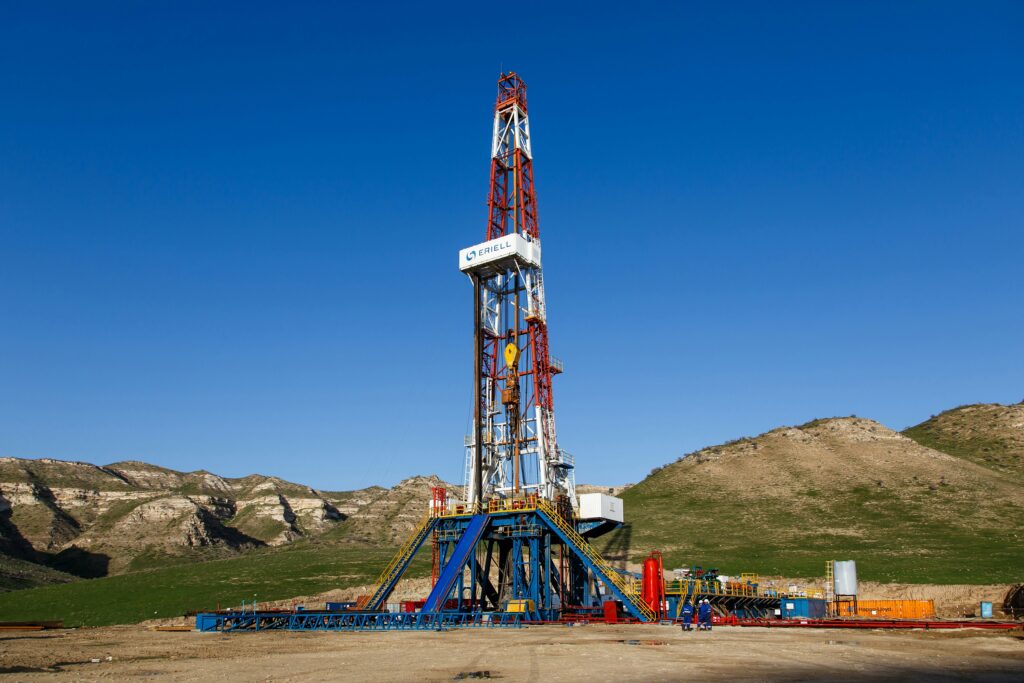
Image: (Worksite LTD, Unsplash, https://unsplash.com/photos/white-and-red-tower-during-daytime-kw9LLON5lO8)