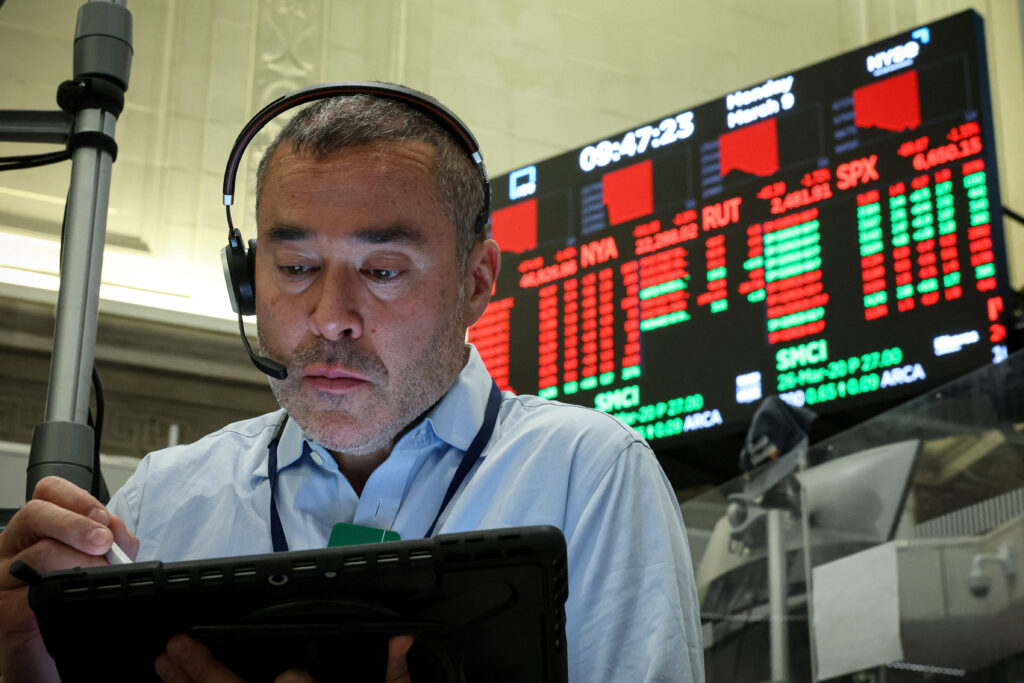
In response to the joint US and Israeli attack on Iran, financial markets have so far reacted in a relatively orderly and measured way. Risk, as measured by volatility, has increased across asset classes. However, we have not seen dramatic dislocations in core financial markets, rates, credit, and foreign exchange.
Energy markets, however, have reacted more strongly. Natural gas prices have spiked, reflecting the physical disruption and impairment of certain Gulf-based processing facilities. Oil prices briefly crossed the psychological threshold of one hundred dollars per barrel, while shipping in and out of the Strait of Hormuz slowed dramatically. Monday’s comments by President Donald Trump suggesting that the conflict may be nearing an endpoint subsequently brought oil prices back near ninety dollars per barrel, underscoring how sensitive energy markets are to perceptions about the duration of the conflict.
Predicting market movements in moments like this is extraordinarily difficult, and it would be unwise to offer precise forecasts. Instead, two variables deserve particular attention.
The first variable is time. Energy demand tends to be relatively inelastic in the short run. Homes still need heating, vehicles still require fuel, and factories must continue operating. As a result, when disruptions occur in energy supply chains, markets tend to focus less on demand destruction and more on the persistence of supply constraints.
If supply disruptions persist, prices tend to rise. Higher energy prices often feed into inflation expectations, which can ultimately influence monetary policy. Central banks may respond by tightening financial conditions, which in turn can affect interest rates, currency valuations, and economic growth. In this way, what begins as a geopolitical disruption in energy markets can gradually propagate through the broader global economy.
The second variable is uncertainty. Financial markets can absorb significant shocks when the strategic path forward is reasonably clear. What markets struggle with is ambiguity. When investors lack clarity about the trajectory of a conflict or the potential for escalation, they demand a higher premium for bearing risk. This manifests through elevated volatility, wider credit spreads, and shifts toward perceived safe-haven assets.
These same two variables, time and uncertainty, play a central role in how financial markets price geopolitical risk.
SIGN UP FOR THIS WEEK IN THE MIDEAST NEWSLETTER
Option play
One way to understand this dynamic is through the lens of options pricing. An option is a financial instrument that gives its owner the right, but not the obligation, to buy or sell an underlying asset at a predetermined price. The two most important determinants of an option’s price are time to expiration and volatility.
Consider the global economy as the underlying asset. A geopolitical shock introduces the possibility of downside outcomes. Investors respond by seeking protection against those outcomes, which conceptually resembles buying a put option. A put option allows its owner to sell an asset at a predetermined price, even if the market value falls significantly below that level.
The analogy can be framed in the following way:
Within this framework, both time and uncertainty influence how markets price risk.
From a time perspective, prolonged disruptions in energy supply shift the aggregate supply curve of energy and place upward pressure on prices. Rising energy costs can alter inflation expectations, which in turn shape monetary policy responses and influence economic growth.
From an uncertainty perspective, several variables widen the distribution of possible outcomes: disruptions in the Strait of Hormuz, escalation of military conflict, supply-chain fragmentation, regional instability across the Middle East and North Africa, and the possibility of broader social or civic disruptions.
Importantly, a put option increases in value not just because the underlying asset has already moved, but because the range of possible outcomes has widened. In other words, the probability distribution around future outcomes becomes more dispersed.
This provides a useful way to interpret current market behavior. Long-dated geopolitical options are effectively being repriced. Markets are not simply reacting to realized economic losses; they are responding to the option value of uncertainty.
What policymakers can do
In practical terms, this means that policymakers themselves can influence how markets price geopolitical risk.
First, they can reduce the duration of the disruption. If Trump sticks with his assessment from Monday, the expected timeline of the conflict shortens. In options terminology, the maturity of the geopolitical risk contract declines, which reduces the premium investors demand.
Second, policymakers can reduce uncertainty by articulating a clear strategic framework. When governments provide credible clarity regarding objectives, escalation thresholds, and pathways toward de-escalation, the volatility parameter embedded in market pricing declines.
Both mechanisms would serve to lower the effective price of what might be called a geopolitical put option on the global economy.
Ultimately, financial markets are not just reacting to the immediate shock of conflict. They are pricing the duration and uncertainty surrounding it. Understanding how these two variables interact provides a useful framework for interpreting market behavior and for understanding how policy decisions themselves can shape the financial cost of a geopolitical risk event.
Khalid Azim is the director of the MENA Futures Lab at the Atlantic Council’s Rafik Hariri Center for the Middle East.
Related Reading
Image: A futures-options trader works on the floor at the New York Stock Exchange's NYSE American (AMEX) in New York City, March 9, 2026. REUTERS/Brendan McDermid