
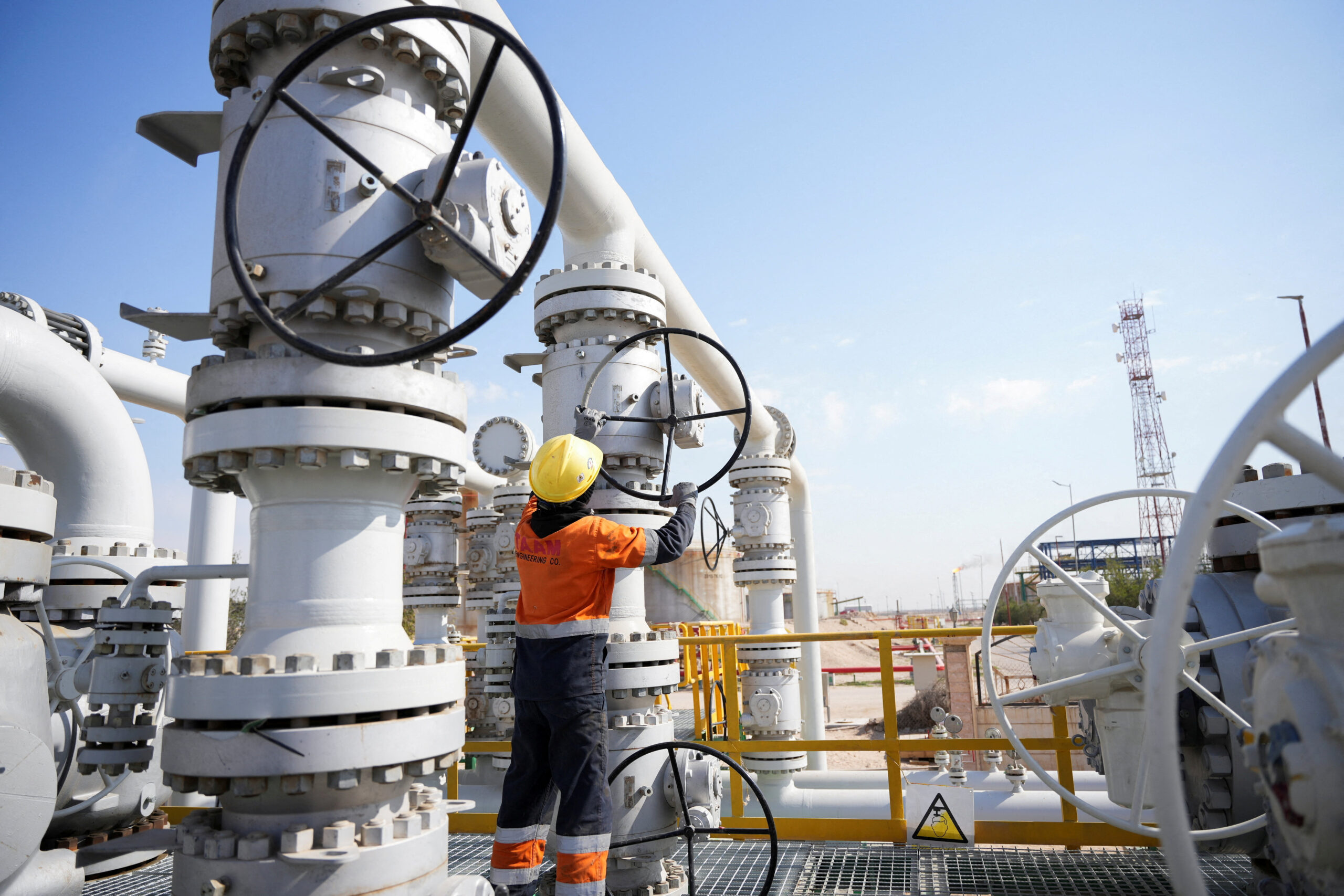
WASHINGTON—On March 2, two days after US and Israeli forces began air strikes on Iran, Iranian forces struck back by targeting energy infrastructure in Qatar’s Ras Laffan Industrial City and a Saudi oil facility in the kingdom’s Eastern Province. Just this week, Iranian drones set ablaze Oman’s Salalah port oil storage facility. The attacks offered a reminder that energy infrastructure—once treated primarily as economic assets—has become a frontline target in modern conflict.
The stakes are significant. Saudi Arabia exports roughly seven million barrels of crude per day, while Qatar accounts for about one-fifth of globally traded liquefied natural gas. Nearly 20 percent of global oil consumption passes through the Strait of Hormuz.
For decades, Gulf energy infrastructure developed in a strategic environment shaped by the US security umbrella and the assumption that major export facilities would not be deliberately targeted by state adversaries. As a result, oil terminals, pipelines, and liquefied natural gas plants were engineered primarily for scale and export efficiency.
In other words, they were not designed to be part of a battlefield.
As a result, energy security in the region has often been treated primarily as a corporate security problem managed by national oil companies, rather than as an integrated civil-military planning challenge. That assumption has come increasingly into question since the 2019 strikes on Saudi Arabia’s Abqaiq and Khurais facilities. Iran’s attacks this month only underscore the point.
How should Gulf states respond? Two recent conflicts—one involving a major energy exporter and the other a country fighting to keep its power grid running—offer useful lessons. Iraq provides lessons for maintaining export flows—pipelines, terminals, and maritime routes that allow oil to reach global markets despite persistent sabotage. Ukraine illustrates the challenge of domestic resilience: how a national electricity system can continue functioning even while large portions of the grid are repeatedly struck. For Gulf states, which are both export heavyweights and share a regional electricity network through the Gulf Cooperation Council (GCC) Interconnection Authority, the challenges that Iraq and Ukraine have faced—and their responses, both successful and not—are worth studying.
Iraq and export resiliency
Iraq provides one of the clearest examples of how an energy exporter adapts when infrastructure becomes a sustained target. Following the US invasion in 2003, insurgent groups quickly discovered the vulnerability of Iraq’s energy system. To this day, the country remains on a road to resiliency, and its path in recent years has been far from smooth. Pipeline sabotage has remained frequent, and the security forces tasked with protecting energy infrastructure—including the pipeline police—have struggled with corruption and uneven training. Yet the country still produced several practical ideas that other energy exporters may find useful. Three lessons in particular stand out:
1. Dedicated pipeline protection forces
Following the 2003 invasion, coalition authorities and Iraqi ministries created specialized units to protect energy infrastructure. These units include an Oil Protection Force comprising roughly 14,000 guards responsible for pipelines, pumping stations, and export facilities. While these units faced challenges related to corruption and the quality of their training, the institutional principle remains important: Protecting energy infrastructure requires dedicated forces organized specifically for that mission rather than general military units temporarily assigned to infrastructure protection.
2. Drone surveillance and thermal monitoring of pipeline corridors
In late 2025, Iraq’s Energy Police Directorate announced the deployment of nearly fifty drones to conduct daily reconnaissance and transmit real-time data to a central command center in Baghdad. Officials also reported the installation of thermal cameras along parts of the pipeline network in cooperation with the Military Industrialization Authority. These systems help detect abnormal heat signatures associated with leaks, fires, or potential sabotage and allow operators to identify suspicious activity along infrastructure corridors that are difficult to patrol continuously.
3. Offshore loading buoys that create alternative export pathways
Iraq has expanded its maritime export capacity through a network of buoys known as single-point moorings (SPMs), which are connected to subsea pipelines. These buoys allow large tankers to load crude oil several miles from shore without docking at fixed terminals. These floating loading points function as distributed export nodes. If major port terminals come under attack or are forced offline, tankers can still load through offshore moorings.
These adaptations did not eliminate attacks on Iraq’s energy sector. Northern export infrastructure—particularly the Kirkuk–Ceyhan pipeline to the Mediterranean—has been repeatedly sabotaged. Iraqi oil exports continued largely because both production and shipments shifted through the country’s southern maritime export system in the Gulf near Basra. Multiple terminals and offshore loading buoys allowed tankers to continue loading crude even when parts of the system were disrupted.
Ukraine’s lessons in keeping the lights on
If Iraq offers lessons in protecting energy exports, Ukraine provides a stark illustration of how governments can keep domestic energy systems running even while infrastructure is under sustained attack.
Since Russia’s full-scale invasion in 2022, Ukraine’s power grid has faced sustained missile and drone attacks against generation plants, substations, and transmission infrastructure. Yet despite widespread damage and recurring blackouts, the system has continued operating under extreme strain.
The war has produced several practical ideas about how governments can keep national energy systems operating during sustained strikes. Four lessons in particular stand out:
1. Hardening critical grid infrastructure
Ukrainian operators have reinforced substations and transformers with protective barriers and blast walls. In some locations, particularly vulnerable equipment was relocated or buried underground.
2. Rapid-repair brigades and pre-positioned spare parts
Ukrainian grid operators developed specialized teams capable of quickly restoring electricity after strikes. These brigades travel across the country replacing damaged transformers and reconnecting transmission lines—often restoring service within hours or days.
3. Cross-border grid integration and emergency electricity imports
Ukraine accelerated synchronization with the European ENTSO-E electricity network in March 2022, allowing electricity imports from neighboring countries when domestic generation capacity was damaged.
4. Cross-border gas diplomacy and reverse-flow supply routes
Ukraine has strengthened energy resilience by expanding cross-border gas connections with European partners. For decades, most pipelines in Central and Eastern Europe were designed to carry Russian gas westward through Soviet-era transit networks. After Russia’s gas disputes with Ukraine in 2006 and 2009, European countries began modifying these systems so gas could flow in the opposite direction—allowing supplies from European markets to move east toward Ukraine. Finally, a growing north–south transmission route linking liquefied natural gas (LNG) terminals in Greece with pipeline networks through Bulgaria, Romania, and Central Europe—often referred to as the Vertical Gas Corridor—is further expanding the region’s ability to move non-Russian gas to Ukraine during the war.
Ukraine’s experience highlights a harsher reality about infrastructure resilience in modern conflict. Preventing damage entirely is rarely possible. The more realistic objective is to limit disruption and restore service quickly enough for the system to keep operating.
What Gulf governments can learn
Drawing on lessons from both cases, several priorities emerge for Gulf planners, particularly in Saudi Arabia and Qatar.
1. Conduct vulnerability mapping and pursue “low-tech hardening”
Gulf governments should conduct comprehensive vulnerability assessments across oil, gas, and electricity systems to identify the most critical infrastructure nodes and the most likely points of attack. Above-ground pipeline segments, exposed substations, and single export corridors represent predictable vulnerabilities. Gulf states should prioritize simple physical protections that reduce infrastructure vulnerability at relatively low cost. Burying exposed pipeline segments, reinforcing pumping stations, and installing protective structures around substations can significantly reduce damage from drone or missile debris.
2. Institutionalize cross-ministry energy protection procedures and establish emergency operations centers
Energy protection should not rely solely on corporate security departments or temporary military deployments. Gulf governments should establish dedicated structures to coordinate defense ministries, energy agencies, and infrastructure operators. These structures should include 24/7 emergency coordination and monitoring cells focused specifically on energy infrastructure during conflict or crisis, linking civilian energy operators with military authorities, police, fire services, and other government agencies.
3. Expand monitoring of pipeline corridors and remote infrastructure
Energy infrastructure in the Gulf spans thousands of kilometers of terrain that cannot be guarded continuously. Governments should deploy drone surveillance, thermal sensors, and fixed monitoring systems along pipeline routes and critical infrastructure corridors. These systems help detect abnormal heat signatures associated with leaks, fires, or sabotage and allow operators to identify suspicious activity along infrastructure corridors that are difficult to patrol continuously.
4. Pre-position strategic spare parts and repair capacity
Gulf governments should pre-position critical spare parts—including transformers, control systems, and pipeline components—and maintain specialized repair teams capable of restoring operations under emergency conditions.
5. Expand offshore loading infrastructure to create alternative export pathways
Expanding offshore loading infrastructure—particularly SPMs connected to subsea pipelines—can create additional export pathways. Because SPMs are smaller and located offshore, they are harder to target than large terminals and allow tankers to load crude offshore—often up to ten miles away—providing additional distance and warning time from drone or missile attacks. (It is worth noting that this SPM option does not exist for LNG exports, which require specialized liquefaction plants and cryogenic infrastructure to cool gas to roughly –162°C before shipping.)
6. Pursue “grid diplomacy” through deeper regional electricity integration
Cross-border electricity interconnections should be treated as strategic infrastructure. The Gulf already possesses a regional power network through the GCC Interconnection Authority linking Saudi Arabia, the United Arab Emirates, Kuwait, Qatar, Bahrain, and Oman. Expanding contingency power-sharing agreements within this network could allow Gulf states to support one another during infrastructure disruptions.
With the norm of not attacking civilian energy infrastructure seemingly eroded in modern conflict, governments must take a proactive and whole-of-society approach to energy security.