As the war in Iran continues to impact—though not completely disrupt—global markets, much of the attention has understandably focused on energy supplies and Gulf countries, which have come under attack from Iran. However, market watchers should keep a close eye on Egypt as the proverbial canary in the coal mine.
A financial disruption in Egypt would reverberate not only across the Middle East and North Africa but potentially across global markets as well. Egypt’s economy is large, systemically important within the region, and interconnected with global financial flows. In addition, for the United States in particular, Egypt holds significant geopolitical importance as a partner for stability in an already volatile region.
Egypt’s macroeconomic fundamentals illustrate why investors are watching closely. The country carries a substantial external debt burden while simultaneously managing significant domestic fiscal pressures. This combination makes the sustainability of financing conditions particularly important during periods of heightened geopolitical risk and market uncertainty. History shows that financial crises rarely remain contained. The Mexican peso crisis of 1994 and the Thai baht devaluation of 1997, which triggered the Asian financial crisis, both began as localized currency events but quickly propagated across markets, asset classes, and national economies.
In the event of a financial crisis, Egypt may be forced to weaken its currency to preserve its reserves and maintain creditworthiness. However, a weaker currency would increase debt servicing costs in local currency terms and likely push inflation (already at 13 percent) even higher. This could create a negative feedback loop between currency weakness, inflation, and fiscal pressure.
The Executive Board of the International Monetary Fund (IMF) completed the fifth and sixth reviews of Egypt’s Extended Fund Facility arrangement and the first review under the Resilience and Sustainability Facility, allowing authorities to draw the equivalent of about $2.3 billion on February 25, right before the conflict in Iran began.
The IMF’s advocacy and support for Egypt should be augmented by policymakers in the United States and other nations such as the United Arab Emirates and Qatar. It is important to signal confidence to the marketplace for Egypt now, before market forces begin to cascade into a more challenging outcome.
“Egypt is a resilient society with highly entrepreneurial and talented people,” James Harmon, chairman of the US Egypt Enterprise Fund and former chairman of the US Export-Import Bank, told me. “Just a week before the current conflict in the Gulf, the IMF expressed confidence in the progress being made in Egypt’s economy. Egyptian policymakers are implementing the right reforms and executing them effectively. That said, current events, largely outside Egypt’s control, are creating unexpected economic pressures that warrant careful monitoring. Given Egypt’s significance to the region and to the United States, it is important to support Egypt now.”
Below are several key macroeconomic indicators that highlight Egypt’s current financial position. These figures are sourced from the IMF and the Institute of International Finance and are estimates or forecasts.
External position
• Total external debt: $169 billion (approximately 40 percent of GDP)
• External debt service due in 2026: $27 billion
• Projected current account deficit (baseline assumption): $15 billion
• International reserves: $53 billion (approximately five months of import cover)
Domestic and fiscal position
• 2026 fiscal deficit: 1.427 trillion Egyptian pounds ($27.2 billion, or 6.8 percent of GDP)
• Total government expenditures: 4.396 trillion pounds
• Interest payments: 2.3 trillion pounds (more than half of total expenditures)
Egypt’s balance of payments outlook is driven largely by three variables: oil prices, tourism revenue, and remittances from Egyptians working abroad. The interaction of these variables will ultimately determine the trajectory of Egypt’s current account deficit and therefore its need for external financing.
To assess the uncertainty surrounding these variables, I performed a Pearson–Tukey analysis for each. This technique uses a three-point approximation, typically the fifth, fiftieth, and ninety-fifth percentiles, to estimate the expected value of a variable. In practical terms, this method combines pessimistic, baseline, and optimistic scenarios to estimate the most likely outcome. The accuracy of this approximation is measured in standard deviation units.
In reality, Egypt’s external balance is influenced by a much wider set of factors, including several offsetting dynamics. For example, while this framework considers the impact of higher energy prices on Egypt’s import bill, it does not incorporate the potential benefits of higher energy prices on Egyptian energy exports. The objective here is not to produce a precise forecast but rather to frame key uncertainties and illustrate how shifts in a few critical variables could affect Egypt’s external position.
The results suggest that under current market conditions, Egypt’s external position has become increasingly sensitive to global oil prices. While tourism and remittances traditionally act as stabilizing inflows, the magnitude of the oil shock now dominates the balance of payments outlook. In periods of geopolitical stress, when oil prices tend to rise and tourism tends to fall, these dynamics can reinforce one another.
Oil prices have a direct effect on Egypt’s external balance because the country remains a net importer of energy products. For the purposes of this analysis, I assume a baseline oil price of $75 per barrel. The Pearson–Tukey estimate produces an expected oil price of approximately $108 per barrel, implying an increase of roughly $33. As a rule of thumb, each $10 increase in oil prices raises Egypt’s energy import bill and worsens the current account balance by approximately $2.5 billion. Thus, the expected oil price shock would deteriorate Egypt’s external balance by roughly $8 billion.
The projections indicate that Egypt’s current account deficit will increase from roughly $15 billion to $24 billion. This analysis suggests that Egypt’s external position is correlated to regional instability. Small shocks are manageable, but simultaneous shocks across remittances, tourism, and oil prices can create exponential stress.
A current account deficit widening from a projected $15 billion to approximately $24 billion suggests that Egypt retains the capacity to manage its external balances, though with limited margin for error. This is particularly notable in the context of Egypt’s approximately $54 billion in international reserves and the $27 billion in external debt service due in 2026.
The chart below illustrates how Egypt’s current account balance responds to changes in oil prices and tourism revenues.
Taken together, these figures highlight the structural pressures facing Egypt’s fiscal and financial system. While the country is not currently in crisis, its reliance on continued market confidence and external financing leaves it exposed to shifts in investor sentiment.
In periods of geopolitical stress, markets often look for the first point where macroeconomic vulnerabilities begin to surface. Given its scale, financial linkages, and sensitivity to oil prices, tourism, and remittance flows, Egypt occupies a unique position in the regional economy. Should financing conditions tighten or external shocks intensify, stress in Egypt could serve as an early signal that broader financial instability is beginning to emerge across the region.
Khalid Azim is the director of the MENA Futures Lab at the Atlantic Council’s Rafik Hariri Center for the Middle East.
Related Reading
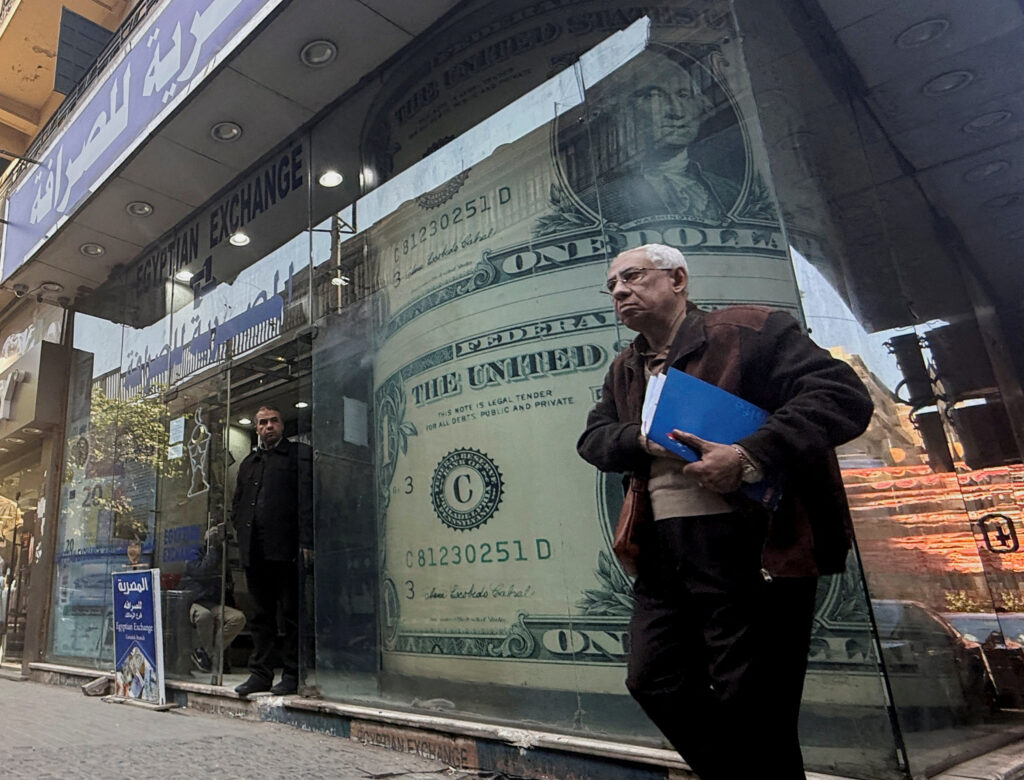
Image: An Egyptian man walks past a currency exchange display showing images of the US dollar, as exchange rates continue to rise against the pound, which climbed above 50 pounds amid the expanding US-Israeli conflict with Iran, in Cairo, Egypt, March 9, 2026. REUTERS/Amr Abdallah Dalsh