

WASHINGTON—Since Operations Epic Fury and Roaring Lion began on February 28, the US and Israeli militaries have demonstrated unparalleled military coordination and precision. Strikes by US Central Command forces and the Israeli Air Force (IAF) on more than 15,000 targets in Iran have resulted in the decapitation of the Iranian regime and the severe degradation of the Iranian navy, air defense, air force, and military-industrial base, including Tehran’s drone and missile manufacturing apparatus. US intelligence estimates that nearly two-thirds of Iranian missiles and drones have been destroyed or damaged, and US forces and the IAF continue to work through targeting lists of additional Iranian assets.
As the war moves into its second month, the United States can seek an off-ramp in the near term, adopt a strategy of attrition, or attempt to escalate to de-escalate. As US President Donald Trump assesses these options, he must contend with the reality of significant alignment, but not a total convergence of US and Israeli interests and objectives. Each ally in this fight will approach important decisions differently. The United States should be attentive to the interests of its partner, but only insofar as those considerations contribute to broader US interests.
The war to today
The decision to launch this war was based on a convergence of US and Israeli interests and a shared understanding of the Iranian threat. Both Washington and Jerusalem have vowed to prevent Iran from ever developing a nuclear weapon, view Iran’s ballistic missile program as a serious threat, and have long battled Iran’s terrorist proxies in the Middle East. They also saw a moment of opportunity: Iran’s miscalculations following the October 7, 2023, terrorist attacks, the weakening of its proxy network in the past two years, the successful Israeli and US strikes against Iran’s nuclear program in the twelve-day war in June 2025, and the intense protests in Iran in January laid bare the regime’s fundamental vulnerabilities.
However, this US-Israeli alignment exists alongside fundamental differences in the two countries’ strategic outlooks, especially as the war has progressed. Israel’s physical proximity to Iran makes the destruction of the Iranian ballistic missile program a much higher priority for Jerusalem than for Washington. Israel’s status as the Iranian regime’s principal ideological obsession also leads it to prioritize maximalist objectives for the conflict, chief among them an end to the regime in Tehran, or at least an end to its ability to project power beyond Iranian borders.
While sympathetic to these goals, which are increasingly echoed by Gulf partners, US policymakers confront a more complex calculus of second- and third-order global effects. This list includes the roiling of global energy markets and supply chains, the spreading economic crisis, and the impact on sustained military operations in the Middle East on US readiness for contingencies in the Indo-Pacific and Europe. Moreover, in the event of regime collapse and internal chaos in Iran, there could be cascading ramifications. For example, there is the potential for civil war and a humanitarian crisis. Spillover instability could run throughout the Middle East and South Asia. Migration flows, too, could far outstrip those occasioned by the Syrian civil war. These outcomes would likely pose an enduring challenge to US interests. Israel, by contrast, may be content with the destruction of its most lethal security threat, irrespective of the effects on global markets, chaos affecting Iran and its neighbors, or strategic considerations relating to competition with China and Russia.
Despite a far greater disruption to Israeli daily life than to that of Americans, support for the war is 38 percentage points higher in Israel than in the United States. Israeli Prime Minister Benjamin Netanyahu has long made security the foundation of his political credibility and sought US participation in strikes on Iran. With high support for the war coupled with stable polling numbers, Netanyahu may claim a popular mandate with minimal constraints from public opinion. Even Netanyahu’s domestic opponents’ efforts to outflank him on security issues ahead of national elections later this year may encourage him to continue fighting. Trump, on the other hand, campaigned on promises of no new foreign wars and low gas prices, both now undercut. With November’s midterm election approaching, American public opinion may be a far greater consideration for Trump than his Israeli counterpart.
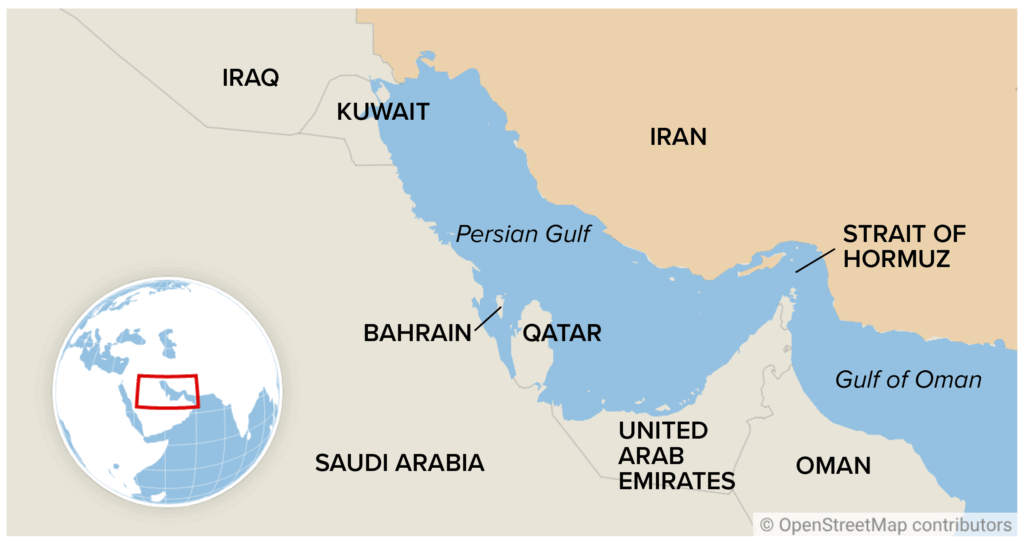
After important successes in the first two weeks of the war pursuing the military objective presented by US commanders—degrading Iran’s missile and drone production and launch capability, air defenses, air force, and navy, as well as striking Iranian nuclear sites—Trump had an opportunity to claim victory and end the conflict, fitting the narrative to his chosen off-ramp. With the closure of the Strait of Hormuz, however, that opportunity has passed. Trump can no longer single-handedly define victory when the paralysis of the global energy markets will prevent the president from credibly declaring mission accomplished as long as the strait remains closed.
Option one: Off-ramp
If Trump’s objectives have shifted from the collection of goals presented at the outset of the war to focus on reopening the Strait of Hormuz, then he could try to seek an off-ramp swiftly. A relatively quick exit seems increasingly unlikely, however, considering Iran’s swift, wholesale rejection of the administration’s fifteen-point plan. Over several weeks, however, the administration could seek an end to the conflict by easing its demands of Iran in exchange for a resumption of normal traffic through the Strait of Hormuz, which it could do while highlighting the military success in degrading Iranian military capabilities. However, by easing oil sanctions on Iran earlier in March to try to bring relief to market pressures, the administration may have proven to Iran that it has leverage, raising the price on whatever concession the United States would need to make. As Iran blocks thousands of ships from passing through the Strait and can now sell its oil around the world, the administration confronts a scenario in which (modest) oil market stabilization depends on the very actor most responsible for its disruption.
As in the case of the October cease-fire deal reached with Hamas, any near-term deal reached to end the Iran war would likely only superficially address the most challenging strategic dilemmas facing Washington and Jerusalem. The fifteen-point plan reportedly presented to the Iranians last week, for instance, mandated limitations on Iran’s missile program, but the details of specific constraints on missile range and quantity, let alone compliance verification mechanisms, were left to be “determined at a later stage.”
Seeking an off-ramp in the short term likely represents the path on which Israeli and US leaders’ calculus of their respective interests would most significantly diverge. Trump could claim a victory should the Strait of Hormuz reopen, markets calm, retaliatory attacks against the Gulf cease, and the regime emerges from the conflict severely weakened. However, neither Netanyahu nor the Israeli public may be satisfied with a badly wounded but still dangerous regime left intact, able to start reorganizing itself in the near term, and emboldened by its narrative of having successfully forced the United States and Israel to blink first.
Option two: Attrition
Whether deliberately or by default, the administration could alternatively adopt a strategy of attrition. If Trump is unwilling to make significant enough concessions in exchange for resumption of traffic through the Strait of Hormuz, or if Tehran believes its bargaining position is only strengthened with time, then this path becomes increasingly likely. As Trump claims that Iran wants “so badly” to make a deal, and Iran both watches oil prices climb and has secured the lifting of US sanctions on its own oil, each side projects confidence in its ability to withstand the other’s attacks and eventually emerge victorious. If coupled with renewed internal challenges to the regime, an attrition strategy may favor the United States and Israel over time, but without the opening of a domestic front, it is unlikely to succeed, as the regime would need only survive to claim victory.
For Israel, a strategy of attrition brings tempting potential gains but raises questions of continued capacity. Far less constrained by their own public in comparison to the domestic backlash in the United States, Israeli leaders would likely be more willing to adopt attrition as an express strategy. A joint decision to extend the war and attempt to outlast the Iranian regime’s resolve would provide more time to weaken the regime and attack more targets and avoid a rush to finish target lists before a cease-fire. However, considering the Iranian regime has given no indication that it is prepared to capitulate, even under immense military pressure, a US-Israeli strategy of attrition would likely bring protracted conflict, in which case Israel would face its own challenges of diminished interceptor stockpiles and deep economic costs. Even if the Trump administration could ignore the growing backlash against a war with no end, and even if Israelis could withstand the economic impacts and more frequent and devastating missile impacts that would likely penetrate air defenses with fewer interceptors, then the pressures from the wider region and the global community may be enough to tip the scales against a shift to an attrition strategy.
Option three: Escalation
The final path available to Trump is escalation, likely entailing some combination of embracing regime change as an explicit objective, deploying boots on the ground in a sustained or extensive way, and jointly striking Iranian energy infrastructure. This path would be an extension of the logic that might lead the administration to adopt a strategy of attrition: a continued belief that the United States can sufficiently wear down Iranian resolve and capability to force either regime collapse or a cease-fire on terms favorable to Washington.
However, rather than seeking to erode Iran’s will and ability with time, this approach would attempt to do so with intensified military pressure, whether aimed at securing highly enriched uranium, seizing Kharg Island to control Iran’s oil exports, or holding Iranian islands or shoreline to secure the strait. Doing so would likely provoke a commensurate Iranian escalation against the Gulf and Israel based on Iran’s response pattern thus far, in which case the Israeli public’s resolve could be tested, and public opinion might be of heightened importance to Netanyahu.
Should this so-called “escalate to de-escalate” strategy work as intended, the United States and Israel would bring the regime expeditiously to the point of full capitulation on all terms. The prospect of a decisive strike might temporarily enable Trump to weather public backlash against climbing gas prices, stave off congressional restraint, and secure Gulf states’ support. If boots on the ground successfully extracted the 440 kilograms of highly enriched uranium, the single most important component of Iran’s ability to pursue a nuclear weapon after the war, Trump would then have a clear achievement on which to declare victory.
However, even in the event that Trump felt he could declare victory and sought to walk away, there is no guarantee that Iran would cease its own attacks, putting Trump between an American public who has been assured its objectives have been met and a region still under siege. An escalatory spiral is possible in which Iran does not capitulate, the United States takes additional casualties, the economic crisis deepens, and US strategic interests in the Indo-Pacific and Europe are threatened. Such a cycle would entrench this strategic dilemma and serve Iranian interests far more than it would serve those of the United States and Israel.
