
The United States is experiencing a nuclear energy renaissance, driven by surging electricity demand from artificial intelligence, data centers, electrification, and advanced manufacturing. Nuclear power—already providing 19 percent of US electricity and 55 percent of its carbon‑free generation with ninety-four reactors in twenty-eight states—remains the nation’s most reliable source of firm, clean power at scale.
The United States has accelerated efforts toward new nuclear deployment and expanding the nuclear supply chain capacity even further. Yet states cannot rely solely on these actions to enable this expansion. As electricity demand grows, states must proactively shape the policy, economic, and regulatory environment necessary to build new nuclear reactors and their supply chains.
States have started this process with different approaches. In 2025, forty-five states introduced more than 350 nuclear‑related bills and enacted sixty, following a comparable record from the previous year across forty-three states. These legislative initiatives have focused on enabling financial incentives, cost recovery, generation/off-taker co-location, feasibility studies, and the classification of nuclear as a clean energy priority. However, these measures will remain merely symbolic if states don’t appropriate funding to bring them to fruition.
Key levers in state energy planning and funding
The federal government retains exclusive authority over radiological safety and reactor licensing, but states have purview over various processes, such as cost recovery, siting, public consent, and workforce development. How a state manages these components, while navigating the interests of businesses and the public within state-specific frameworks, will determine its success in deploying new nuclear reactors. Additionally, recognizing and supporting the synergy between the large capacity off-takers and nuclear development requires foresight, nuance, and consistency in policymaking.
The key will be to plan strategically across these levers to not only address generation and transmission needs for meeting rising electricity demand, but also encourage academia, government, and industry cooperation and coordination to build infrastructure that will work within the existing state-specific frameworks.
As state policymakers work toward accelerating nuclear deployment in their states, they must take into consideration these four levers.
Encouraging investment and enabling cost recovery
Funding is cited as the major factor in a competitive environment for nuclear deployment. Policymakers can encourage private investment through a variety of mechanisms, such as direct grants, initial site readiness, cost-recovery mechanisms, tax incentives, and sound business policies.
As an example, many states have already adopted technology‑inclusive clean energy standards frameworks, allowing nuclear to compete for clean‑energy credits previously limited to renewable portfolio standards. Allowing credits to be tradable across technologies with appropriate cost‑recovery reform facilitates innovation and consistency in legislation and regulation.
States should work closely with the federal government on available financing and provide feedback on what programs are working and in demand. For example, to reduce first-of-a-kind risk, many states, including Texas and Tennessee, have successfully established dedicated nuclear development funds and clear cost‑recovery rules—such as those set by construction work in progress (CWIP) authority and pre‑approval mechanisms. These actions support market flexibility, keeping projects affordable and allowing industry-led development to flourish.
Public engagement is essential
Nuclear power favorability is polling at an all-time high in the United States, with 77 percent of Americans in favor and 58 percent in favor of having a nuclear power plant near their home. Communications and public relations play a vital role in maintaining public support from the earliest stages of a project. Opposition that surfaces at a later stage can add years to a project and endanger its viability. For states standing up nuclear programs now, building a public engagement function inside the lead agency is as important as the technical siting study.
Providing guidance for sitting and consistent, expedited permitting
Several states have repealed or loosened moratoriums on nuclear energy in recent legislative sessions, paving the way for deployment. Now, they must go further by addressing siting guidance, utility procurement authority, and restrictions tied to federal used fuel storage. Early in the permitting process, states should work closely with localities, where permitting often occurs, to identify sites and address issues that can derail projects.
States must also expedite permitting by allowing for concurrent review and statutory review‑clock limits. Businesses that invest capital for energy projects struggle with the unnecessary, protracted delays that have come to define projecttimelines. To streamline the permitting process for building nuclear reactors, several states have created working groups or more efficient regulatory pathways. Virginia, for example, underwent a historic regulatory reduction that focused on efficiencies and transparency. This overhaul improved state permitting times by as much as 70 percent, highlighting the necessity of clarity and consistency in permitting processes.
Identifying energy sites that are suitable for co-locating new nuclear reactors with off-takers has become a necessity, particularly as hyperscalers turn to small modular reactors to power data center growth. States that have quickly identified sites with those flexibilities will be more likely to attract partners that are ready to invest private capital. Coordination among state economic development and energy teams is thus essential to a successful strategic plan.
Building workforce and innovation ecosystems
States with national labs have been engaged in nuclear research and public/private cooperation in the sector for many years. However, public support, federal enthusiasm, and pressing energy needs have accelerated the urgency for all states to support the industry through dedicated workforce and research programs. States should survey their workforce programs with a focus on the full-cycle energy supply chain, in conjunction with higher education, trade schools, and industry in the state. Virginia serves as a case study. It has established several support systems for nuclear power, including a nuclear innovation hub, to coordinate universities, industry, and government. Appropriating funding for applied training and expanded programs at universities, such as research reactors and control room simulators, will further strengthen the research and operator pipeline.
Long-term energy security and resilience
What separates the states leading the race to construct new nuclear energy reactors and restart deployments from the rest is not how many reforms they institute but a comprehensive calibration of the broader ecosystem. Those that have made the most progress toward deployment have pursued a comprehensive analysis of a state’s entire energy and policy infrastructure, taking into account the many components that lead up to deployment, prioritizing strategic improvements to the process, and making needed investments.
States can share these strategies and amplify influence through coalitions such as the National Governors Association’s energy permitting initiatives, the National Association of State Energy Officials Advanced Nuclear First Mover Initiative, or similar initiatives to coordinate on projects and multiply their efforts across the aforementioned levers. Such cooperation and multi‑year commitments will empower agencies, provide assurance for private capital, and gain the confidence of the state and community support—all of which are required to accelerate the momentum of the US nuclear energy renaissance.
Julianne Szyper is a nonresident senior fellow with the Nuclear Energy Policy Initiative of the Atlantic Council Global Energy Center. She previously served as the deputy director of the Virginia Department of Energy.
about the author

stay connected
Sign up for PowerPlay, the Atlantic Council’s bimonthly newsletter keeping you up to date on all facets of the energy transition.
related work


our work
The Global Energy Center develops and promotes pragmatic and nonpartisan policy solutions designed to advance global energy security, drive economic opportunity, and foster a sustainable energy future.
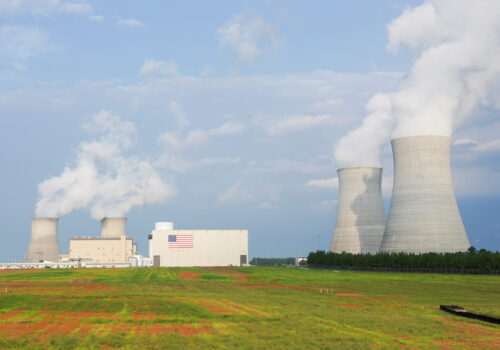
Image: St. Lucie Plant, Unit 2, Jensen Beach, Florida (NRC).