
The disruption of the world’s most significant maritime chokepoint, the Strait of Hormuz, is propelling a surge of support for new, overland trade and energy corridors connecting the Gulf to the Mediterranean. Middle East governments are fast-tracking investments in new infrastructure, streamlining customs and regulatory processes, and exploring new rail and pipeline projects that mitigate dependence on the Strait of Hormuz.
The strategic and economic potential of these corridors extend beyond Hormuz: new cross-border corridors have the potential to strengthen cooperation in a region that continues to suffer from low economic integration and high political fragmentation. They could also provide much-needed economic opportunity for places like Jordan and Syria, strengthen Syria’s integration into the region during a pivotal period, and establish new regional hubs amid a shifting trade landscape.
Realizing the potential of these projects demands close coordination across multiple countries: the efficiency of overland trade depends on an entire connectivity ecosystem that leverages digital customs integration, digital payment systems, and mitigation of non-tariff barriers. Ensuring that trade corridors fuel economic growth and integration inside the Middle East, rather than serving solely as a pass-through for trade between Europe and Asia, requires coordinated industrial efforts. Additionally, governments must signal their clear, durable political support to mobilize private sector investment in these alternative corridors: major infrastructure projects can take a generation to generate returns, and the private sector is wary of investing in projects that traverse difficult political and security environments and rely on overland routes that are largely seen as back-ups to maritime routes.
The Atlantic Council recently convened dozens of senior public and private sector representatives from the United States and the Middle East to discuss solutions to these coordination challenges and how to maximize the strategic and economic benefits of new Middle East corridors. This article captures the recommendations from that dialogue, including how initiatives like the India-Middle East-Europe Economic Corridor (IMEC) must evolve to provide an effective platform for facilitating new Middle East corridors, a more disciplined approach to new pipeline projects, and the potential of a Middle East compute corridor.
The emerging landscape of new Middle East corridors
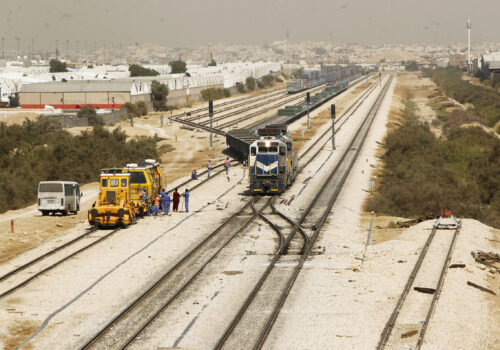
A patchwork of projects are providing the building blocks for more efficient overland trade across the Middle East: Saudi Arabia is building up the Port of NEOM as a new logistics hub, expanding rail networks to both the Red Sea and Jordan, and establishing a series of new logistics corridors. Saudi Arabia and Turkey are also reportedly exploring efforts to revive a rail connecting Jordan to Syria, which could complement emerging World Bank support for Syrian rail development and Emirati investment in Syrian ports, opening up new access points to the Mediterranean. Additionally, the United Arab Emirates (UAE) and Oman are completing a new rail line that will boost the potential of Oman’s ports, which sit outside both the Strait of Hormuz and the Bab al-Mandab, the two Middle East maritime chokepoints.
SIGN UP FOR THIS WEEK IN THE MIDEAST NEWSLETTER
In some cases there are structures in place to ensure a base level of technical and regulatory alignment between these various projects: the rail project between Oman and UAE is part of the GCC Railway project that seeks to link all six countries of the Gulf Cooperation Council (GCC), building on the GCC’s broader trade coordination efforts. The new rail line connecting Saudi Arabia to the Jordanian border was also a key piece of the IMEC initiative announced at the Group of Twenty (G20) summit in 2023. While the war in Gaza impeded momentum on IMEC, most of the signatory governments continue to coordinate through a sherpa process that has the potential to ensure alignment between projects along the corridor.
The urgency of the energy crisis created by the Iran war also left countries scrambling for new pipeline routes bypassing Hormuz. The UAE is constructing a new pipeline that will double its ability to export oil outside the strait. There are also early discussions around dusting off a proposal for a pipeline connecting Iraq to Jordan’s port of Aqaba and other projects that could provide Kuwait, Qatar, and Bahrain alternative outlets for oil and gas exports. While the UAE pipeline—which does not need to cross borders and benefits from the UAE’s ample access to capital—is progressing rapidly, other projects face significant financial and political hurdles. The Middle East is already littered with the skeletons of abandoned pipelines like the Trans-Arabian Pipeline. Both governments and the private sector are wary of projects that may be upended by insecurity, cross-border disputes, or waning economic viability.
Uncertainty over the future of the Strait of Hormuz looms over all these projects: if the strait returns to its pre-war status in the coming months or years, some of these pipelines would be obsolete as oil and gas exports revert to more flexible, cost-effective maritime routes. However, Iran’s insistence on asserting continued control over Hormuz and the example of Red Sea traffic, which has still not rebounded after the Houthi campaign against shipping, suggest that commercial confidence in the strait will be difficult to restore. Higher insurance rates combined with fears of being held captive by the latest flare-up in regional tensions will likely continue to drive an interest in alternative routes—but only if those routes are sufficiently resilient and efficient.
Can IMEC enable a new era of Middle East connectivity?
While IMEC has faced serious headwinds in recent years, the imperative of a coordination platform that can help new corridors realize their potential and provide consistent political signaling is reviving interest in the initiative. But IMEC will need to evolve if it is to remain relevant amid a new regional landscape.
First, IMEC must embrace a network approach in the Middle East, rather than a single corridor. The original IMEC trade corridor embraced the idea of multiple European ports but envisioned a single overland route through the UAE, Saudi Arabia, Jordan, and Israel. Only a network of trade corridors can adapt to shifting disruptions—whether in the Red Sea, Hormuz, or within or between corridor countries—and provide the capacity necessary to ensure real resilience. A recent Atlantic Council report finds that by integrating new routes through Oman, Egypt, and Syria, IMEC could absorb over 60 percent of the container traffic that transited Hormuz pre-war, increasing the capacity of the corridor ten-fold.
Second, IMEC governments must reconvene at a senior level to reaffirm their support for IMEC and bless an updated vision for both the initiative as a whole and the sherpa process. It was announced during the Atlantic Council’s Middle East Corridors Conference that an IMEC ministerial would convene this year. This ministerial could provide a valuable opportunity to announce an updated IMEC vision, but only if key players like Saudi Arabia, the United States, the European Union, and India can build consensus on an effective new approach in advance.
Third, IMEC signatory governments must clarify the purpose of the IMEC coordination process and embrace a more modular approach. Currently, some IMEC governments fear that adding new countries and routes could bog the IMEC coordination process down with additional bureaucracy, fragment its focus, and generate new political tensions between competing segments of the corridor. These risks stem not from the scope of the corridor but instead from a lack of clarity on the role of the IMEC sherpa process. The purpose of the IMEC sherpa process was never to oversee the construction of new infrastructure: those projects are happening independently via a variety of national, bilateral, and private sector-led projects. The value of the IMEC sherpa process is as a platform for coordinating on this patchwork of projects and harmonizing the policy and regulatory environments to enable more efficient trade.
To prevent fragmentation and inertia, IMEC country ministers should both affirm the purpose of the sherpa process and identify a few discrete, time-bound objectives. One such objective could be expanding digital trade integration, building on the platform already adopted by the UAE and India and models like the Association of Southeast Asian Nations Single Window, which can significantly lower costs and improve efficiency of trade along the corridor for all countries. Not all countries may be prepared to sign onto a similar platform for the Middle East, but a modular approach should enable progress across some parts of the corridor even as others face political or technical hurdles.
The East Mediterranean Gas Forum (EMGF) provides a useful example of a regional intergovernmental coordination platform enabling similar public-private, cross-border projects. EMGF has proven effective even amid a difficult political environment because it benefits from a strong regional champion—Egypt—and has focused on tangible projects that deliver value to multiple countries.
Embracing a hybrid energy corridor and a “compute corridor”
One of the benefits of IMEC was that it did not just focus on a trade corridor: it sought to facilitate layered trade, energy, and digital infrastructure. But the nature of that energy and digital infrastructure must also evolve. The 2023 IMEC Memorandum of Understanding focused on hydrogen exports and electricity interconnection, as well as fiber-optic cables. But the imperative of building resilience of hydrocarbon exports demands a hybrid approach that includes both renewables and a limited number of pipeline projects that can mitigate the greatest economic and humanitarian consequences of future disruptions. IMEC could provide a platform for a more disciplined approach to new pipeline projects that provide the execution certainty and cross-border accountability the private sector is seeking.
The Middle East also has the potential to become a central player in the global digital economy, leveraging its geography, major investments in compute power, and cost-effective energy supplies. Realizing this role demands far more than constructing more cable infrastructure, however. The Gulf is already teed up to become the third largest source of compute power in the world, behind the United States and China. But an effective compute corridor also demands strong governance frameworks that create trust and facilitate cross-border data flows as well as resilience against both cyber and kinetic attacks. The Middle East still needs to make progress on both these fronts. The work of the Digital Cooperation Organization, a multilateral body established in 2020 in Riyadh, provides a useful foundation for the former, and Iranian attacks on Gulf data centers is fueling momentum on the latter.
This dynamic moment in the Middle East has the potential to usher in a new era of regional connectivity, but only if countries across the region can come together to embrace a more coordinated, strategic approach to new infrastructure.
Allison Minor is the director of the Atlantic Council’s Project for Middle East Integration. Previously she served as director for Arabian Peninsula affairs at the US National Security Council.
Further reading

Fri, Apr 10, 2026
Operation Overflow: How to break Iran’s grip over the Strait of Hormuz
Dispatches By Landon Derentz
The US and its Gulf partners need an infrastructure strategy to bypass the strait entirely, on the scale of projects undertaken during World War II.
Tue, Aug 26, 2025
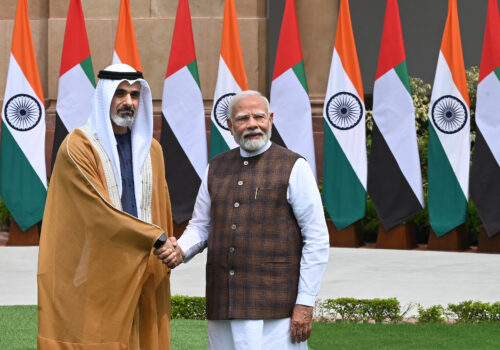
IMEC must be more than a trade route. Digital integration should be a priority.
New Atlanticist By Afaq Hussain
The India-UAE virtual trade corridor should be the starting point for an expanded digital trade ecosystem among India-Middle East-Europe Economic Corridor partner countries.
Wed, Aug 27, 2025
The India-Middle East-Europe Economic Corridor: Connectivity in an era of geopolitical uncertainty
Report By
Weeks before the war in Gaza broke out, India, Europe, the US, and Gulf nations announced plans for an economic corridor linking the EU and India through the Gulf via rail, fiber optic cable, and pipelines. We ran the cost-benefit numbers and they’re clear: Washington should put the IMEC back on the global agenda this year.
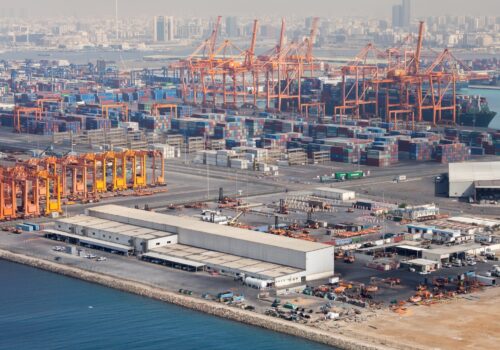
Image: A man sits on the waterfront as a vessel sits at anchor inside Sultan Qaboos Port, amid the U.S.-Israeli conflict with Iran, in Muscat, Oman, March 20, 2026. REUTERS/Stelios Misinas