
What to know about Trump’s newest global tariffs
GET UP TO SPEED
They’re built to last. The Trump administration on Thursday announced tariffs between 10 percent and 12.5 percent on sixty trading partners around the world. These new tariffs under Section 301 of the Trade Act of 1974 will replace the global tariffs struck down earlier this year by the US Supreme Court—and are designed to be much more legally durable. To dig into the reasoning behind these tariffs and what they mean for the global economy, we turned to our leading tariff watchers.
TODAY’S EXPERT REACTION BROUGHT TO YOU BY
- Barbara Matthews: Nonresident senior fellow at the GeoEconomics Center and former US Treasury attaché to the European Union
- Josh Lipsky (@joshualipsky): Vice president and chair of international economics at the Atlantic Council and former International Monetary Fund advisor
- L. Daniel Mullaney: Nonresident senior fellow with the Europe Center and GeoEconomics Center, and former assistant US trade representative
- Madeline Chalecki: Assistant director at the GeoEconomics Center and lead on the center’s tariff work
The big picture
- Barbara tells us that these new tariffs “are not likely to roil markets or materially disrupt global economic trade.”
- That’s because they are close to the global 10 percent baseline tariff the US had in place since last year, just under new legal authority. Barbara points out that there are “broad exemptions” for imports such as critical minerals and that “the new Section 301 tariffs will not be additive” to other tariffs.
- The US Trade Representative indicated that the US would preserve individual deals struck with a slew of countries following the “Liberation Day” tariffs last year. But Josh warns that those deals, such as with the EU and Japan, “could come into question” with future tariff announcements, which are likely to “raise [rates] above the 10-12 percent level.”
The details
- Dan calls Thursday’s announcement “a more careful and nuanced implementation of tariffs” that “consolidate—and add to—a year’s worth of carve-outs and adjustments” to Trump’s ever-evolving tariff regime.
- “The long list of country-specific exemptions also makes it more difficult to piece out who are the winners and losers,” Madeline tells us. “The blanket rate of 10 percent or 12.5 percent may mean far less than the exemptions, and it will take time to quantify the value of these exclusions for each country.”
- The EU appears to be a winner, as Dan points out that many of its products could see a decline to 10 percent from the 15 percent tariffs agreed to in Turnberry, Scotland last year. With “relative tariff stability” now in place, Dan says, “the focus now shifts to the difficult implementation of the many nontariff issues identified in the agreement, as well as additional tariff reductions in specific sectors, such as steel and wine/spirits.”
Sign up to receive rapid insight in your inbox from Atlantic Council experts on global events as they unfold.
The China factor
- The stated reasoning for the tariffs was to push countries to stop importing goods made with forced labor. Barbara says this “could easily be seen as a mechanism to ratchet up trade pressure globally against doing business with China.”
- China’s use of forced labor, particularly targeting members of the Uyghur minority, is well documented. ”The main target of the Section 301 tariffs, therefore, could easily reflect an indirect and surprisingly subtle effort to constrain China’s export revenues,” Barbara adds, “creating economic incentives to reorient trade away from China in order to enhance access to US consumer markets.”
- In many ways, Barbara says, it’s a throwback “to traditional, morality-based trade policy asserted periodically by the United States for over one hundred years.”
The legal stakes
- But there are holes in that approach that could be exposed in court, even though courts have never struck down a Section 301 tariff before. “If friendly countries are facing reduced rates because of earlier deals, rather than their forced labor bans, it could be used in an argument that the investigations weren’t about forced labor to begin with,” Madeline says.
- For example, under this announcement, Switzerland, which has what Josh describes as “strict rules” against importing goods made with forced labor, comes away with a higher tariff than Cambodia, which is deeply intertwined with China’s economy.
- The US Trade Representative, Josh says, will likely argue that Switzerland’s rules aren’t strong enough, but “a court may not find that argument legitimate.”
Further reading

Wed, Jul 22, 2026
The US just threatened new tariffs on Canada. Here’s why they may not work.
Econographics By Madeline Chalecki
The latest escalation in the US-Canadian tariff standoff highlights the limits of using trade restrictions as a negotiating tool—and the risks of getting trapped in a cycle of retaliation.
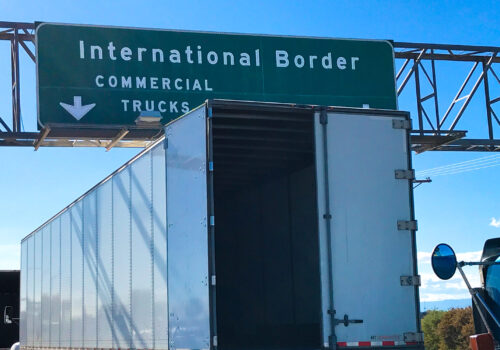
Thu, Jul 23, 2026
Mexico can turn USMCA pressure into an industrial opportunity
Econographics By
Mexico’s record exports mask an uncomfortable reality: its fastest-growing industry—data processing machines—relies overwhelmingly on Asian inputs. A carefully redesigned USMCA could help the country move up the value chain.

Thu, May 28, 2026
As China’s surpluses become unbearable, the EU is edging toward its own Section 301
Econographics By Charles Lichfield, L. Daniel Mullaney, Jessie Yin
With Chinese industrial surpluses flooding global markets, the EU is quietly debating whether it should borrow from the US tariff toolkit—marking a potential shift toward a more assertive approach to Beijing.
Image: Shipping containers are stacked on a cargo ship at the port of Oakland following the Supreme Court's ruling that Trump had exceeded his authority when he imposed tariffs, in Oakland, California, on February 24, 2026. Photo via REUTERS/Carlos Barria.