
A decade ago, the International Monetary Fund (IMF) agreed to include China’s renminbi in the basket of currencies that underlie its special drawing rights (SDRs).
What may sound like a monetary technicality to some was a milestone event: by elevating China’s currency to a status accorded only to the US dollar, euro, British pound, and yen, the international community gave China a unique seal of approval.
In terms of its long-term consequences, however, that decision was dubious and hotly debated even in 2016. And today, there is a growing sense that it may have planted the seeds for a more fragmented global monetary system.
Keeping a lid on
Despite China’s place as an emerging trading power, the renminbi in 2016 was no more important in government reserves than the Canadian and Australian dollars. Among tradable currencies, it had only a minor presence.
That was largely because Beijing kept a tight lid on the flow of capital into and out of the country—and exercised even tighter control over the renminbi’s movements on foreign-exchange markets. Not surprisingly, the decision to make the renminbi one of the IMF’s workhorse currencies was met with considerable skepticism.
Since then, China has become the world’s largest exporter of manufactured goods, and the use of its currency in the financing and settlement of trade has exploded. In 2024, the renminbi accounted for 27 percent of China’s trade in goods and 32 percent of trade in services. Still, Beijing’s control of the country’s capital account is little changed, and the integration of the renminbi into global foreign-exchange markets remains rigidly circumscribed.
Under its leader Xi Jinping, China has used these restrictions to keep domestic resources “captive” to finance investment priorities like advanced technology and limit exposure to the dollar-based global economy, thereby reducing the country’s vulnerability to economic sanctions. But Beijing’s approach has also stoked international tensions. After all, a consistently undervalued renminbi has helped sustain China’s massive trade surplus with the world.
The IMF’s decision to add the renminbi to the SDR basket was intended to strengthen the Fund’s ties with one of the world’s most important economies. But the renminbi was brought in while China continued operating under a monetary system fundamentally at odds with the more open regimes underpinning the other SDR currencies. Nonetheless, the IMF accepted the renminbi by applying a generous interpretation of how “usable” the Chinese currency was in international transactions. But that decision rested on the assumption that China would eventually loosen its grip on the currency.
Limited progress
Since 2016, the Chinese government has taken some steps to reform its system of capital controls. It allows foreign investment in China’s stock and bond markets and has enabled limited flows of Chinese investors’ funds into foreign assets—mostly via Hong Kong. It also has encouraged offshore renminbi deposits, expanded yuan lending, and overseen yuan-denominated bond issuance outside of China. Moreover, Beijing has started to promote renminbi-based cross-border payments systems. Yet all of these reforms, undertaken in the name of promoting “internationalization,” have remained firmly under Beijing’s control.
At the end of 2024, only 3.8 percent of all international payments—a broader category than trade finance and settlement—were in renminbi. And in terms of government foreign-exchange reserves—a true measure of a currency’s place in the global financial firmament—China’s currency was only the sixth-largest reserve holding as of July. At 2 percent of all reserves, it trails not only the other four SDR currencies, but also the Canadian dollar, which is not in the SDR basket. And that share has barely budged since 2016.
What this adds up to is a renminbi that is far less integrated into the global economy than other SDR currencies. Bastian von Beschwitz, chief of global financial markets at the US Federal Reserve Board, wrote in 2024 that Beijing’s exchange rate management and capital controls “continue to limit the renminbi’s more widespread use and the attractiveness of renminbi assets” to the extent that it “remains a niche currency” for international usage.
That has left the renminbi in an unusual position: it’s a currency with growing international reach, but one whose cross-border role is still tightly controlled by China. In a note last month, Alicia Garcia Herrero, chief Asia-Pacific economist at Natixis, wrote that what China is pursuing “looks less like the internationalization of a currency but more like the construction of an alternative monetary system for the renminbi’s cross-border use.”
Debatable definitions
This, of course, is a far cry from what the IMF envisioned when it decided to include the renminbi in the SDR basket. When the IMF Executive Board announced the decision in September 2016, it cited China’s progress in reforming its “monetary, foreign exchange, and financial systems,” arguing that continued reform efforts would “bring about a more robust international monetary and financial system.” Two senior IMF staff members went even further, stating that the institution had determined that the renminbi was “freely usable,” a judgment they tied to its growing role in global trade and a “substantial increase in the international use and trading” of the currency.
Looking back, however, that framing did not hold up—and the use of “freely usable” was not as straightforward as it appeared. What was presented to the public as a sweeping endorsement of China’s policies was, in fact, a much narrower technical judgment. In a 2015 paper laying out the roadmap for the renminbi’s inclusion, the IMF stated that a finding of “freely usable” would be based on whether a currency could be used to “meet a balance of payments need.” The IMF interpretation would be “guided exclusively” by a purpose established under the organization’s Articles of Agreement: whether the currency could function as an “integral element of the framework” that enables the IMF to provide “temporary balance of payments assistance.” The same standard applied to the SDR basket’s other currencies. But unlike China’s, those currencies already had open capital accounts and were widely traded in financial markets by the time they were included.
Simply put, the IMF decision turned on one narrow question: whether the renminbi, like the US dollar, euro, yen, and British pound, could be readily drawn on to fund the IMF’s crisis loans—and obtained by borrowing countries to repay them. As to the broader, global use of the currency, the IMF voiced the expectation that inclusion would eventually “further support the already increasing use and trading of the renminbi internationally.”
The fragmentation threat
But renminbi-denominated financing by foreign governments and companies—including Chinese corporates based outside China—has seen only modest growth. The value of yuan bonds and loans issued in China and abroad by these entities tripled in the five years through March 2026, reaching a record high of nearly $150bn this year. Yet the yuan total remains a fraction of the $14 trillion of dollar credit outstanding beyond US borders at year-end 2025.
While over-the-counter trading of the renminbi rose to nearly 9 percent of all currency trades last year, the currency’s share of official foreign-exchange reserves remained largely unchanged. In its most recent review of the Chinese economy, the IMF acknowledged this gap, stating that “impediments remain to the widespread adoption” of the renminbi and that “offshore RMB markets lack depth and liquidity, while a shortage of globally accessible safe RMB assets hinders the RMB’s function as a store of value.”
This is particularly important because Beijing still restrains the renminbi’s movements on currency markets. The IMF recently estimated that the currency was undervalued by between 17.3 percent and 25.3 percent. That has, in turn, helped drive China’s massive export surge, providing a crucial source of growth as the Chinese economy faces severe pressure from a real estate collapse, an investment slowdown, and plummeting consumer confidence. China’s approach to the renminbi is therefore not just a domestic policy choice, but a contributing factor in the ongoing process of global economic fragmentation.
If this fragmentation continues, the next financial crisis could pose an unprecedented challenge to the global order. Should a US government be unable—or unwilling—to provide the dollar liquidity needed to help alleviate such a crisis, China could gain considerable leverage. And a surge in demand for renminbi resources could give Beijing a new chokepoint to exploit, just as it has done with critical minerals. Countries facing financial distress could find themselves paying a political or economic price for access to the currency.
Ramping up the pressure
There is no simple way out of this predicament.
Whatever governments may think of the way Beijing has gamed the international system, there likely would be little support for removing the renminbi from the SDR basket, particularly at a time of growing economic uncertainty.
What remains is the bully pulpit. The IMF reassesses the currency weightings in the basket every five years, with the next review expected to be completed by July 2027. The Fund should use that opportunity to set out a road map for China to meet its international obligations—especially by opening its capital account. The IMF should also strengthen the language in its Articles of Agreement regarding the requirements for a “freely usable” currency. The Group of Seven (G7), which the US is chairing next year, should reinforce those calls.
Xi is currently on one of his busiest trips abroad in years—including a summit with US President Donald Trump this month—as he seeks to signal China’s commitment to the global order. Now would be the moment for Beijing to demonstrate its resolve to safeguard global financial stability.
Jeremy Mark is a nonresident senior fellow with the Atlantic Council’s GeoEconomics Center. He previously worked for the International Monetary Fund and the Asian Wall Street Journal.
Related Reading
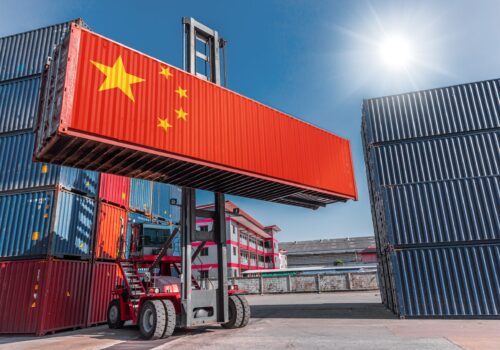
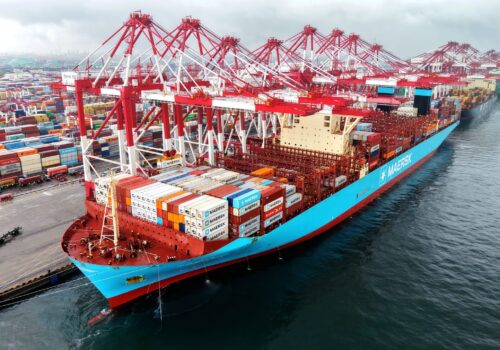
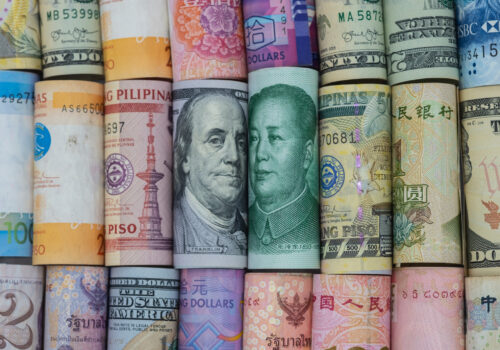
Image: International Monetary Fund press conference in Beijing, China, on December 10, 2025. Source: REUTERS/Tingshu Wang.