
Transmission, or moving electrons from one place to another, is stultifyingly boring. US policymakers need to pay attention anyway as they consider how to ensure a reliable energy system that supports economic growth, emissions reductions, and is affordable for everyday Americans.
Recent energy legislation has ignored it. The Biden administration’s signature policies shaping the sector—the Infrastructure Investment and Jobs Act (IIJA) and the Inflation Reduction Act (IRA)—largely neglected highly consequential transmission enablers, focusing instead on more glamorous technologies, especially generation. Perhaps because transmission is unglamorous and a largely mature segment of the electricity industry, the laws recognized the importance of externalities and the perceived social rate of return for generation—but not the grid. This too-narrow focus impeded deployment of the wind and solar generation it sought to build. The One Big Beautiful Bill Act under President Donald Trump also included energy provisions, but primarily to restrict clean energy incentives, and none aimed to fix the transmission bottleneck. The Trump administration has gone a step further by cancelling several transmission projects.
Future legislation should recognize the importance of the grid and capture its social rate of return, including by paying above market rates for rights-of-way. Going forward, policymakers must prioritize building transmission lines.
The IRA emphasized the wrong energy technologies
The IRA did not deliver its promised decarbonization benefits, largely because it prioritized generation without complementing it with transmission. Princeton’s REPEAT study found that over 80 percent of IRA’s potential emissions reductions by 2030 would be lost if transmission expansion remained at one percent per year. While the legislation undertook needed investments in generation, it overprioritized new technologies with a low or speculative social rate of return.
The IRA and the IIJA were virtually silent on transmission. It devoted less than 0.3 percent of its energy spending to expanding the grid and failed to invest in important grid enablers, especially wires. The IRA did not include an investment tax credit for large transmission lines or other vital grid upgrades, such as reconductoring and dynamic-line rating. IRA included only $2.9 billion in direct funding for transmission even as its energy provisions were estimated to cost more than $1 trillion from 2022 to 2031.
IRA’s lack of fiscal incentives for grid expansion, however, might reflect the reality that transmission’s key constraints are political and regulatory, not financial or technological. Indeed, permitting reform and easing regulatory burdens are undoubtedly necessary. But financial and regulatory fixes can be complementary, not mutually exclusive. If expanding and upgrading transmission is the key to alleviating the electricity affordability and reliability crunch and lower emissions, it is worth incentivizing homeowners and communities to host new lines. Paying above market value for rights-of-way would not only speed grid expansion, but also account for the value a new line delivers in the form of a more reliable, cleaner, and often cheaper grid. IRA recognized the logic of pricing externalities when setting incentives for generation. It did not do the same for less-glamorous transmission.
Perhaps even more important than transmission’s omission from IRA was the failure to make it easier to build long-distance transmission lines. High-voltage direct current lines connecting power generation and consumer demand are extraordinarily difficult to build. At each step of the process, developers must obtain permission from every jurisdiction the lines cross, enabling a single actor to torpedo a project with major social benefits. Yet Congress and the executive branch moved slowly to overhaul transmission rules and never advanced serious permitting reform legislation. FERC Order 1920 enabling long-term planning requirements wasn’t issued until May 2024.
With key grid technologies facing limited funding support, and with no meaningful new permitting authorities, the US transmission buildout continued to deteriorate and the interconnection queue exploded. The United States constructed fewer than 500 miles of high-voltage transmission lines each year from from 2021 to 2023, down from nearly 4,000 miles built in 2013 alone. Some of the decline in transmission line-miles was due to COVID snarling supply chains, but moving slowly and prioritizing secondary or tertiary technologies over transmission harmed progress on affordability and climate.
Where IRA and IIJA did fund transmission, projects faced years-long delays. IIJA included a $10.5 billion Grid Resilience and Innovation Partnerships (GRIP) Program, but the Department of Energy was slow to disburse these funds. Indeed, one GRIP investment announcement occurred in October 2024—nearly three full years after IIJA’s passage. Transmission planning was overcooked; actual construction was underdone.
Indeed, the former Loans Program Office issued a $3.5 billion conditional loan guarantee to build new transmission lines—but only in January 2025, just days before the Trump administration returned to the Oval Office and promptly paused the project. The Trump administration also recently cancelled three more proposed National Interest Electric Transmission Corridors, but around the same time announced a new initiative, the Corridors of Commerce, to enable the construction of long-distance transmission lines, though how effective it will be remains to be seen.
Lessons going forward
It’s admittedly far easier to second-guess decisions in 2021 and 2022 from the distance of 2026. Many energy analysts were admittedly wrong-footed by energy dislocations from Russia’s full-scale invasion of Ukraine, the post-COVID demand snapback, artificial intelligence’s impact on electricity demand, and other factors. Still, the technical mistake of underprioritizing the grid proved immensely costly.
In order to tackle the affordability crisis and climate risks, policymakers need to embrace building wires, including by clearing red tape via permitting reform, and potentially by incentivizing an investment tax credit for grid enablers covering reconductoring, dynamic line ratings, and grid-enhancing technologies.
A new incentive program for building new transmission lines in alignment with the public interest may also be needed. Rights-of-way are largely determined by local and state jurisdictions. To incentivize new line builds, the next federal affordability and climate legislation should prioritize direct payment programs for landowners and communities and be willing to pay above-market rates for rights-of-way to expedite development. IRA’s fundamental problem was accounting for social rates of return for generation, but not transmission. This mistake proved costly and, in the case of green hydrogen, wasteful, and should be avoided.
Transmission is boring but important. Moving electrons from one place to another is the building block for affordability and decarbonization. It may determine if the US energy system fails or succeeds. Instead of dismissing transmission as a tertiary priority, energy policymakers need to dive into the weeds.
Joseph Webster is a senior fellow at the Atlantic Council’s Global Energy Center and Indo-Pacific Security Initiative. This article represents his own personal opinion.
About the author

stay connected
Sign up for PowerPlay, the Atlantic Council’s bimonthly newsletter keeping you up to date on all facets of the energy transition.
Related work


our work

The Global Energy Center develops and promotes pragmatic and nonpartisan policy solutions designed to advance global energy security, drive economic opportunity, and foster a sustainable energy future.
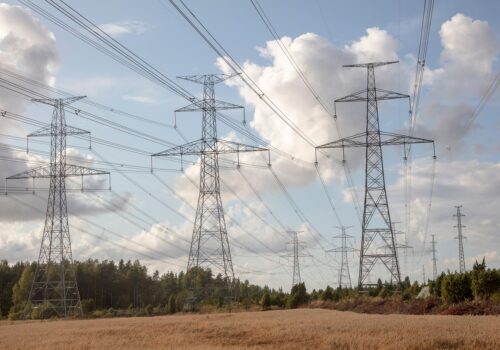
Image: A scenic wide shot of multiple high voltage electricity pylons and transmission towers lined up across a vibrant green grass field. The industrial steel lattice structures stand in contrast with the natural rural landscape under a clear blue sky with soft (REUTERS, 2026).