
On November 1, 2024, the canopy of Novi Sad’s railway station collapsed, killing sixteen people and triggering a student-led anticorruption protest that brought down Prime Minister Miloš Vučević in January 2025. The protests grew into a national political movement and, under sustained pressure, led President Aleksandar Vučić to resign on September 27, 2026. Following Vučić’s resignation, an early election was called for October 25, where this new movement, called the Student List, won 52.6 percent of the vote and an outright majority in parliament, ending fourteen years of Serbian Progressive Party rule.
Since its victory, the Student List’s position on EU and Russian alignment has been ambiguous, with different representatives offering different messages. Speaking to Russian media, some have signaled contentment with the existing gas arrangement between Moscow and Belgrade and said the new government does not envisage sanctions on Russia. Speaking to European audiences, prominent List figure Ilija Srdanović emphasized Serbia’s shared European values and its path to EU membership, while arguing that citizens should ultimately decide accession. Grounded first in the rule of law, the movement’s approach appears to be less about sharp geopolitical realignment than about reassessing existing commitments, leaving important questions open. Energy is one question the new government cannot leave open for long.
For Serbia, confronting its energy issues requires navigating a political and economic tightrope between Brussels and Moscow. On one side, Russia’s Gazprom is Serbia’s chief supplier of natural gas, providing roughly 2.2 billion cubic meters (bcm) a year at below-market rates. On the other, close energy ties to Russia carry a cost. Gazprom Neft is the majority owner of NIS, Serbia’s only oil refinery, which has been under US sanctions since January 2025. Crude continues to flow on US waivers while NIS’s sale to Hungarian oil and gas company MOL is pending, but the episode shows how energy dependence on a sanctioned owner can quickly become a geopolitical problem. Serbia’s gas carries the same risk of exposure. As the new government takes shape, one commitment risks getting lost in transition: Serbia’s September agreement to join the Vertical Gas Corridor, a project designed to diversify the region’s gas supply. Given the critical importance of Serbia’s energy security and resilience, Belgrade must not let this commitment lapse or lose steam.
Like some of its neighbors, Serbia has a fragile energy system. Lignite generates about 60 percent of Serbia’s electricity, mostly from aging plants that struggle to quickly ramp up to service evening demand peaks. Serbia’s Energy Community commitments and the costs associated with the EU’s carbon border tax have also seen coal fall out of favor as an energy source. Hydropower, the country’s second-largest source of electricity, has proven to be rather unreliable as output ebbs and flows with the water levels of key river systems. Although it makes up only 5 percent of generation, natural gas is central to heating and industry in Serbia, and nearly 90 percent is imported, almost all from Russia via TurkStream. Reliance on outdated lignite, unreliable water, and single-sourced gas has kept the cost of supplying electricity and gas high and volatile. To shield households, Belgrade caps retail prices, and those losses fall on state-owned utilities and, ultimately, the state’s budget.
The Vertical Gas Corridor offers a way out. The initiative carries liquefied natural gas (LNG) from Greece and Azerbaijani gas from the Trans Adriatic Pipeline north through Bulgaria and Romania to Moldova and Ukraine. The expanded western branch, which will connect Serbia to the corridor through North Macedonia, would add around 1.5 bcm a year of import capacity when completed in 2028. Together with the existing Bulgaria-Serbia interconnector, Serbia would have the capacity to satisfy its 2.7 bcm a year gas demand from non-Russian sources. By increasing its capacity to import diversified gas, Serbia can open the door to multiple suppliers whose prices are set by competition rather than by a single political contract, replacing risky dependencies with healthy redundancies.
More than that, the Vertical Gas Corridor is an example of how cross-border projects can support domestic political objectives. The corridor aligns with “The Student Plan,” Student List’s platform outlining its core political objectives.
- “Serbia or the mafia.” Serbia’s gas supply has long been arranged through deals negotiated out of public view. The plan pledges to publish every state contract and to audit classified agreements and special decrees that bypass normal procurement. Gas bought from competing suppliers, through pipeline capacity sold at public auction, is transparent by design. State-owned Srbijagas will build the €153 million Serbian section of the new link, and the tendering processes will allow the government to test its new procurement reforms.
- “Knowledge is power.” The plan seeks a “modern, high-value economy” built on innovation rather than cheap labor. In that kind of economy, reliable and affordable energy is critical both to growing domestic businesses and to attracting foreign direct investment. The corridor is a crucial step towards energy reliability and predictability.
- “Serbia grows with us.” Currently, state-owned enterprises dominate both gas and electricity. Without competition, prices are set by contracts and politics, and Belgrade caps them to protect households. In turn, these caps deter the private investment that new infrastructure needs. The plan pledges to break the dominance of import lobbies that distort prices and to move away from state-financed infrastructure. Competing gas suppliers can break that cycle by putting downward pressure on market prices, weakening the justification for price caps and creating room for private capital to enter. The corridor is a catalyst for larger private sector involvement across all types of infrastructure.
The Vertical Gas Corridor provides the new Serbian government with an opportunity to turn its political objectives into action without forcing a choice between Brussels and Moscow. The project directly aligns with the party’s core tenets of public sector transparency, economic growth and innovation, and unlocking private sector investment. In the rush to form a government, the corridor should not become an inherited project left to drift. Upcoming tests, such as the corridor’s first capacity auction, the tendering process, and 2028 completion deadline, will demonstrate whether the Student List can put Serbia’s energy future in its own hands.
About the author

stay connected
Sign up for PowerPlay, the Atlantic Council’s bimonthly newsletter keeping you up to date on all facets of the energy transition.
related content
our work
The Global Energy Center develops and promotes pragmatic and nonpartisan policy solutions designed to advance global energy security, drive economic opportunity, and foster a sustainable energy future.
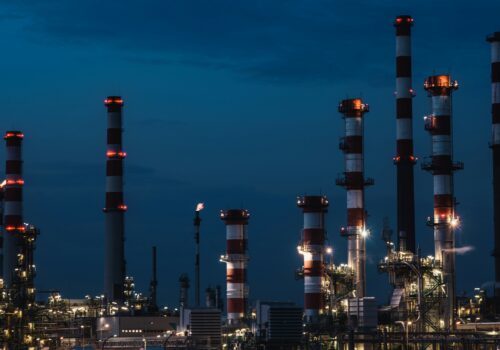
Image: Picture shows the installations of a oil refinery NIS in Serbian town of Pancevo, some 20km from Belgrade December 5, 2008. REUTERS/Ivan Milutinovic