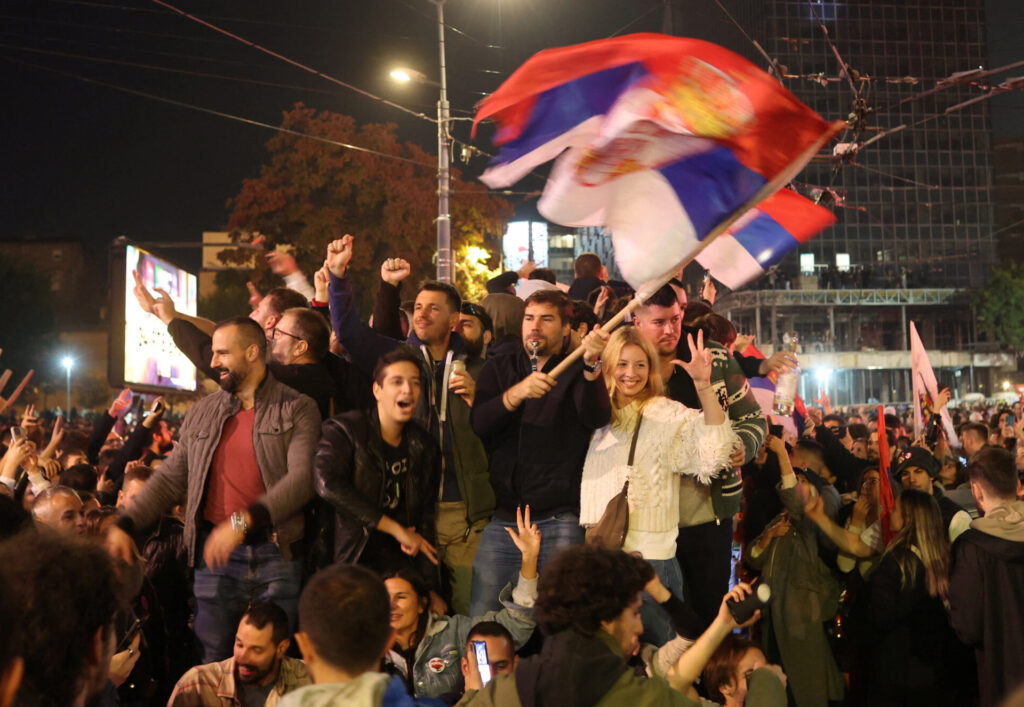
A student-led Serbian protest movement recorded a stunning election victory over the country’s long-serving President Aleksandar Vucic in late October in a vote that was widely interpreted as a landmark moment for the Balkan nation. The change in government in Belgrade was another foreign policy blow for Russian President Vladimir Putin as he struggles to maintain Moscow’s international influence amid the ongoing invasion of Ukraine.
Vucic had led Serbia for nine years and was consistently a pro-Russian voice in European politics. While the new Serbian government’s position on Ukraine is unlikely to be overly supportive of Kyiv, the election result means Russia has lost an important ally in a region where Moscow has traditionally enjoyed strong ties. This is expected to force Putin further onto the defensive in the Balkans.
Days earlier, nearby Romania’s parliament approved a new pro-EU government and prime minister, ending a five-month deadlock. The vote came less than a week after Romanian military aircraft shot down Russian drones over Romanian territorial waters in the Black Sea. This tough response by Bucharest helped consolidate the country’s democratic forces and led to the formation of a new coalition government.
If the Romanian parliament had failed to elect a new government, this would have resulted in snap elections, leading to further political uncertainty that Moscow could exploit. In recent years, Romania has been the target of large-scale Kremlin election interference, leading to the cancellation of a 2024 presidential ballot by the country’s Constitutional Court. The formation of a new government now promises a period of relative political stability that will likely also mean solid Romanian backing for Ukraine, including logistical support in terms of military aid and energy supplies.
Stay updated
As the world watches the Russian invasion of Ukraine unfold, UkraineAlert delivers the best Atlantic Council expert insight and analysis on Ukraine twice a week directly to your inbox.
The fall of Vucic in Belgrade and the emergence of a new pro-European government in Bucharest came half a year after the defeat of another key pro-Kremlin figure in the region. In April 2026, Hungarian Prime Minister Viktor Orban was voted out of office after sixteen years in power. Throughout his reign, Orban had been widely regarded as Moscow’s unofficial representative within NATO and the EU. He was often accused of promoting Russian interests while obstructing Ukraine’s integration and blocking European support for Kyiv.
Orban’s successor has not completely reversed his predecessor’s hard line stance toward Ukraine, but Budapest is no longer a reliable partner for the Kremlin. Instead, the incoming Hungarian authorities have sought to strike a more pragmatic note in their relations with Kyiv, while adopting a firmer approach to Russia. This has undermined Putin’s ability to exert political influence in Brussels.
Eurasia Center events

Southeastern Europe is not the only region where Russian influence is in retreat. Across the Atlantic, the capture of Venezuelan President Nicolas Maduro in January 2026 robbed the Kremlin of an important partner. Meanwhile, the fall of Syria’s Assad regime on December 2024 left Moscow scrambling to retain a strategic foothold in the Middle East.
Closer to home, Russia has also seen its once dominant position in the southern Caucasus region dramatically undermined in recent years following Moscow’s failure to intervene effectively during renewed fighting between Azerbaijan and Armenia. This has led to a sharp deterioration in relations with Yerevan in particular, with Armenia looking to turn away from decades of dependence on Russia.
Russia’s international outlook is not entirely gloomy, of course. Ties with China, Iran, and North Korea are arguably stronger than ever. Neighboring Belarus remains closely tied to the Kremlin, while the pro-Russian authorities in Georgia appear to have weathered an extended period of public protests. Meanwhile, upcoming elections in a number of key European countries including France and Germany could potentially bring Kremlin-friendly forces to power. It remains far too early to write off Putin.
Russia’s recent setbacks in the Balkans are a reminder of the foreign policy challenges facing the Kremlin as the full-scale invasion of Ukraine approaches a sixth year with no end in sight. Putin had hoped the war in Ukraine would reverse modern Russia’s geopolitical retreat and revive the country’s great power status. Instead, the invasion has exposed the limitations of Russian military might and reduced Moscow’s ability to project power on the global stage.
Michael Getto is a public affairs consultant who has worked in Ukraine, Moldova, and Lithuania for the International Republican Institute and in Armenia, Georgia, and Tajikistan for the International Foundation for Electoral Systems. He is Chairman of the Board of the Committee for Open Democracy, an international election observation organization.
Further reading


The views expressed in UkraineAlert are solely those of the authors and do not necessarily reflect the views of the Atlantic Council, its staff, or its supporters.

The Eurasia Center’s mission is to enhance transatlantic cooperation in promoting stability, democratic values, and prosperity in Eurasia, from Eastern Europe and Turkey in the West to the Caucasus, Russia, and Central Asia in the East.
Follow us on social media
and support our work
Image: Supporters of the electoral list "Student List - Students Win" celebrate after long-time ruler Aleksandar Vucic conceded defeat in the parliamentary election in Belgrade. October 26, 2026. (REUTERS/Djordje Kojadinovic)