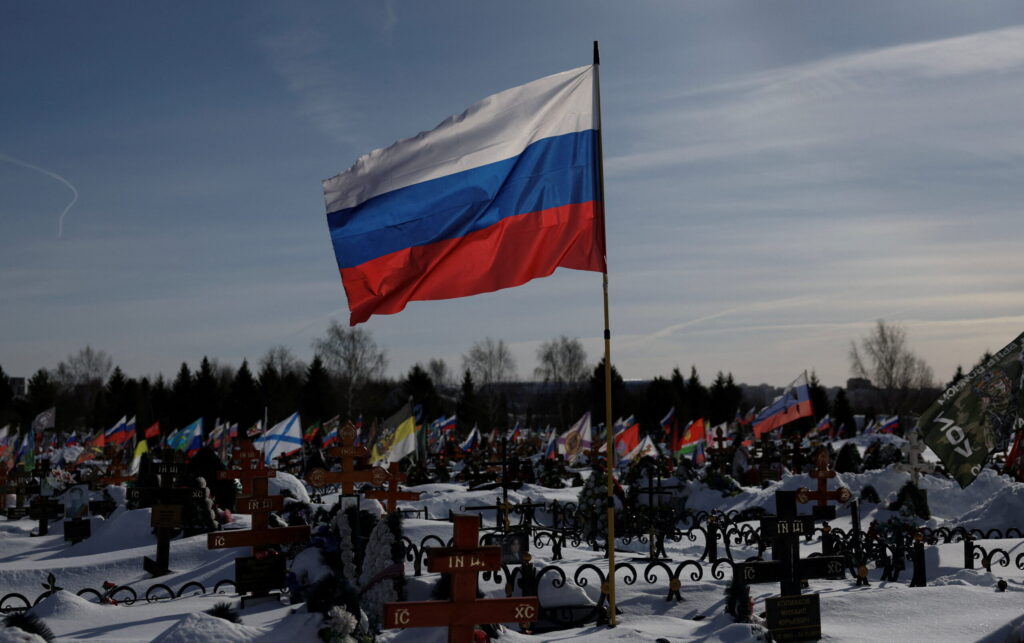
Recently leaked data from Russia’s state statistics agency Rosstat indicates that the Russian army has lost more than 450,000 soldiers in Ukraine since the start of the full-scale invasion. These casualty figures dwarf anything suffered by a major power since World War II and highlight the staggering cost of Russia’s invasion.
While many observers have been shocked by the number of Russian soldiers killed in Ukraine, Russian President Vladimir Putin seems unmoved and currently shows no sign of seeking to end the war. Instead, he continues to pursue maximalist goals that will likely lead to many more battlefield deaths.
Some have speculated that Putin’s determination to fight on is linked to the exaggerated reports of Russian gains he receives from his military commanders. During recent peace talks in Abu Dhabi, the Kremlin delegation brought battlefield maps that showed large areas of Ukrainian-controlled territory under Russian occupation. “This is a problem because Putin lives in a completely different information space, in a different reality,” commented Ukrainian President Volodymyr Zelenskyy.
While Putin is being fed fake battlefield reports and AI-generated footage of new Russian victories, the facts on the ground tell a very different story. Independent open source analysts assess that Russia has barely advanced at all throughout 2026. During the same period, Ukrainian forces have regained significant territory through a series of successful localized counteroffensives. While it is premature to claim that the tide of the war has turned decisively in Ukraine’s favor, any talk of inevitable Russian victory is clearly misplaced.
Stay updated
As the world watches the Russian invasion of Ukraine unfold, UkraineAlert delivers the best Atlantic Council expert insight and analysis on Ukraine twice a week directly to your inbox.
Delusions of imminent Russian victory are not the only reason why Putin seems so ready to accept high casualty rates in Ukraine. The Russian ruler has also been careful to insulate the Kremlin against any potential public backlash over his army’s heavy losses. He has done so by deliberately recruiting soldiers from the fringes of Russian society.
A partial mobilization in September 2022 was highly unpopular, leading to vocal complaints and an exodus of military-age Russian males. This proved a valuable lesson for Putin. Since then, Russia’s military recruitment strategy has focused on ethnic minorities, prisoners, and volunteers enticed by the promise of generous salaries.
This approach seems to have been highly effective, with no significant backlash across Russia despite hundreds of thousands of military deaths. There certainly appears to be little Russian public sympathy for convict soldiers or for men who choose to join the war in Ukraine for money. Meanwhile, families of the deceased have received large payouts from the state, further discouraging any dissent.
Eurasia Center events

With little prospect of domestic destabilization over the mounting death toll in Ukraine, Putin’s biggest challenge is maintaining the flow of volunteers prepared to join his invasion. Alarmingly for the Kremlin, there are signs that the pool of potential candidates is finally beginning to shrink, with a drop of around 10 percent in 2026 compared to the previous year.
In August, Western officials estimated that the Kremlin was losing six thousand more troops per month than it was able to enlist. This is leading to reports of forced recruitment and the targeting of vulnerable people who may not be fit for military service.
With the Russian economy facing rising wartime pressures, it is also becoming increasingly difficult to maintain the cash incentives that have convinced so many Russians to sign up for the invasion. Over the past year, a number of Russian regions have dramatically cut payments to the families of fallen soldiers. In Saratov Oblast, for example, compensation for the relatives of men killed while fighting in Ukraine has been slashed by 90 percent.
Russia’s heavy losses and mounting recruitment difficulties are fueling speculation that Putin could be forced to gamble on another round of mobilization. This would be politically risky, but it may become unavoidable if he wishes to continue the war into 2027 and beyond. A recent raid in Moscow that saw hundreds of young people detained and issued with military enlistment documents has added to fears that some form of broader mobilization might be coming soon.
Ultimately, Putin may feel that he has no choice but to continue. Having sacrificed so many lives and placed Russian society of a war footing, he is now under enormous pressure to deliver a victory that matches the huge costs of the invasion. Finding enough men to fill the ranks of his depleted army will prove more and more challenging, but this may be easier than attempting to justify a compromise peace without first completing the conquest of Ukraine.
The sheer scale of Russia’s losses in Ukraine would be more than enough to bring down most governments, but Putin shows no sign of changing course. He appears ready to accept high casualty rates as the price of victory in Ukraine, and has adopted military recruitment policies that are specifically tailored to minimize any public outcry over the catastrophic death toll. Heavy Russian losses may hamper Putin’s invasion, but they will not push him toward the negotiating table.
David Kirichenko is an associate research fellow at the Henry Jackson Society.
Further reading
The views expressed in UkraineAlert are solely those of the authors and do not necessarily reflect the views of the Atlantic Council, its staff, or its supporters.

The Eurasia Center’s mission is to enhance transatlantic cooperation in promoting stability, democratic values, and prosperity in Eurasia, from Eastern Europe and Turkey in the West to the Caucasus, Russia, and Central Asia in the East.
Follow us on social media
and support our work
Image: Flags fly over graves of Russian soldiers killed during the invasion of Ukraine, on the eve of the fourth anniversary of the start of Russia’s military campaign, at Lemeshovo cemetery in the Moscow region, Russia, February 23, 2026. (REUTERS/Ramil Sitdikov)