When US President Donald Trump recognized Moroccan sovereignty over Western Sahara and Morocco joined the Abraham Accords, normalizing relations with Israel, in 2020, it solidified the division of the Maghreb into competing blocs. Those rival blocs continue to define the security challenges the region faces today—with threats that extend far beyond the region itself, including to Europe.
The Moroccan bloc is stronger and more outward-looking. Rabat has reinforced its alliance with the United States, obtained French recognition of its autonomy plan, and deepened defense ties with Israel and the United Arab Emirates. It also promotes its Jewish and Hassani heritage as part of a multireligious identity. The Algerian bloc is more inward-looking and defensive. Algiers severed diplomatic relations with Rabat in 2021, citing hostile actions, and has recentered its narrative on Western Sahara and Palestine. Feeling encircled, it has raised military spending to nearly 9 percent of gross domestic product (over $25 billion, Africa’s highest) and amended the constitution to allow operations beyond its borders when vital interests are threatened. That’s not to say Algeria does not have external priorities. Its main partner is Tunisia; it seeks closer ties with Libya while prioritizing Italy and, more recently, Spain and keeping its distance from France.
The rivalry extends into the Sahel. Morocco offers Atlantic port access and promotes the Nigeria–Morocco gas pipeline, while Algeria supports military juntas, restores ties with Mali and Burkina Faso, and presents itself as an energy and security partner.
The stakes of that competition were a central feature of a conversation in Rome hosted by the Atlantic Council’s North Africa Project on October 19, featuring Italian policymakers, international experts, and analysts. They examined interconnected security dynamics across North Africa, the Sahel, and the Red Sea, and explored the implications for transatlantic policy and regional stability of what we’re calling the Greater North African Security Complex.
The reconfiguration of the Sahel
Nowhere is that security complex more challenged than in the Sahel. Militancy in the Sahel is often framed too narrowly as purely “jihadist” or “terrorist”. The main drivers for joining these groups are political: exclusion, predatory state practices, limited access to land and water, and ethnic tensions. Religion plays a role but is secondary. Participants argued that these actors are not permanently beyond dialogue, with one expert pointing to Syria and Afghanistan as examples where onetime militants became national leaders engaging with the outside world.
European involvement between 2012 and 2021, led by France, poured substantial resources into an ambitious stabilization and quasi-state-building agenda. The more money and weapons were committed, the worse the security situation became. This fueled popular discontent with civilian governments seen as too close to the West and paved the way for military coups in Mali, Burkina Faso, and Niger. These sovereignty-focused regimes now show varying degrees of alignment with Russia. Europe, and the United States.
For the West, there may be a problem, participants said, of having moved from doing too much to doing too little. A more transactional phase is emerging in which the juntas clearly state demands for economic sovereignty, opening space for partnerships on more equal terms. Europe nevertheless retains a distinctive moral and political role—especially on human rights—that China or Turkey will not fill in the same way and that many local actors still value.
Turkey’s rise as a military power
Turkey has emerged as a major arms exporter, including to NATO members. It leads the Alliance in drone warfare integration, exporting systems and operational concepts for robotic warfare. Turkish drones (strategic, tactical, and medium altitude long endurance platforms such as the TB2) appear in nearly every regional conflict—from Mali and Sudan to Libya (where Turkish forces intervened directly) and the lucrative Gulf market. These weapons are combat-proven, supplying real battlefield data rather than laboratory results, and Turkey imposes few restrictions on their use.
The Turkish Armed Forces have become a regional power capable of external projection. The navy is evolving into a blue-water force: the light carrier TCG Anadolu is already operational, a full aircraft carrier is under development, and the submarine fleet is shifting to air-independent propulsion, with possible future nuclear boats. Missile systems such as the KST offer long-range strike capabilities comparable to Russia’s Kalibr or the US Tomahawk. In Somalia, Turkish forces are training 16,000 soldiers—many of whom speak Turkish and swear dual-language oaths—outnumbering the land armies of several European NATO states.
Participants saw no contradiction between the Mecca Joint Defense Agreement—signed by Turkey, Saudi Arabia, and Pakistan—and Turkey’s NATO membership, rejecting the notion on three grounds. First, NATO, they pointed out, remains essential for Turkey’s nuclear umbrella and sets the military “gold standard”; partners such as Azerbaijan benefit by aligning with those standards. Second, the Mecca pact addresses regional ambitions, while NATO focuses on European collective defense, so the two operate on different planes. Third, the Turkish presence in Africa serves as a valuable counterweight to Russian and Chinese influence, since it brings a NATO member into the theatre.
Cairo as a strategic pivot
Egypt is emerging as a pivotal actor for North African and Mediterranean security, yet participants noted how it risks lacking the economic, political, and military resources to manage the multiple crises around it. The traditional transatlantic focus on the Mediterranean coastline (migration, counter-terrorism, energy) is giving way to more acute threats from the south and east: Houthi control of Yemen’s entire Red Sea coast, the war in Sudan along Egypt’s southern border, and renewed tensions in Ethiopia that pull the Horn of Africa into the same security dynamics.
Middle powers are filling the vacuum left by limited transatlantic engagement, described by participants as “strategic absenteeism.” Egypt pursues a hedging strategy, maintaining relations with all sides, but it is under growing pressure to move from reactive to decisive action. Washington, Brussels, the Gulf states, and the wider region all have a stake in Egypt’s stability, yet the country faces greater strain than partners often acknowledge: simultaneous external crises, domestic economic pressures, and an International Monetary Fund program expiring in December.
Some of the recommendations and insights for Western policymakers that came out of the event include:
- The rivalry between Morocco and Algeria has thus evolved into two increasingly well-defined blocs, driven by national security considerations and a strong emphasis on sovereignty. This makes genuine regional cooperation within the Maghreb almost impossible and, consequently, complicates efforts to maintain balanced relations between the two shores of the Mediterranean.
- From another perspective, Algeria exercises largely uncontested influence in the Sahel through decades of mediation, military and intelligence presence, deep regional knowledge and direct security interests tied to southern Algeria’s stability. Its experience managing a civil war involving jihadists further strengthens this role, as shown by recent contacts with Malian authorities. Any renewed negotiations over the Sahel should center on Algeria rather than Morocco, which is still consolidating influence and lacks comparable on-the-ground engagement. The key issue will be who sits at the table; after former militants took charge of Syria and Afghanistan, including armed groups is no longer ruled out.
- A broader opportunity now exists to treat Egypt once again as an indispensable partner, anchor it in maritime and regional security frameworks, and link international support to reforms that strengthen its capacity for sustainable contributions to regional stability.
Sveva Cristina Pontiroli is a researcher for the Atlantic Council’s North Africa Program, based in Rome.
Emma Torresi is a researcher for Geopolitica.info Research Center.
Related Reading

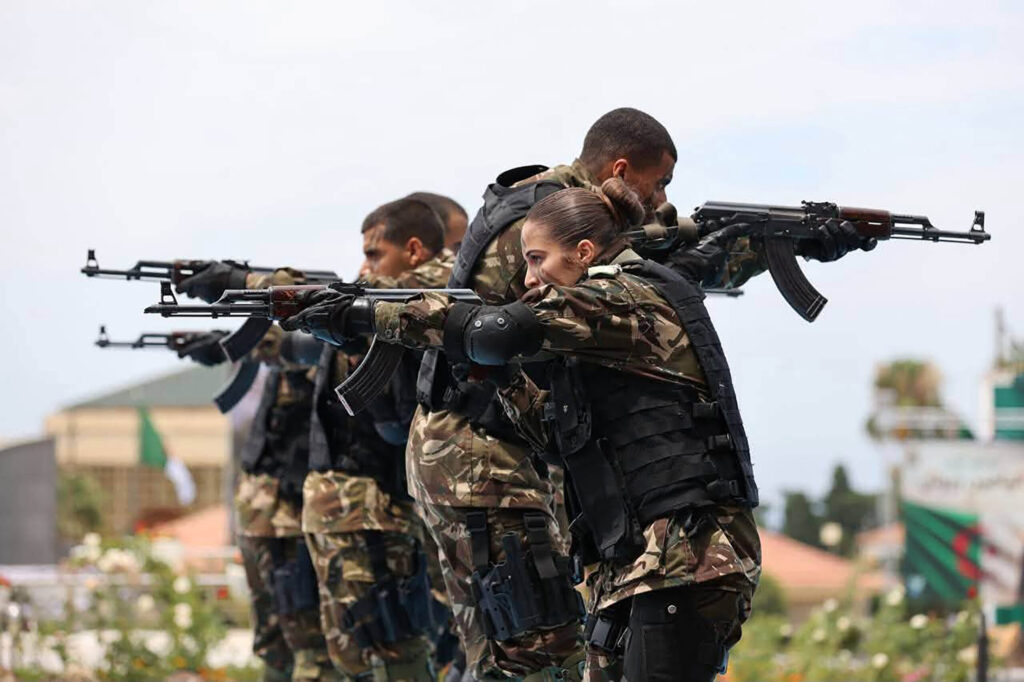
Image: A military parade takes place during the graduation ceremony for the class of 2026 at the Houari-Boumediene Military Academy in Cherchell (Tipasa), Algeria, on July 9, 2026. The class is named after the late President Liamine Zeroual. (Photo by APP/Presidence Algerienne/NurPhoto)