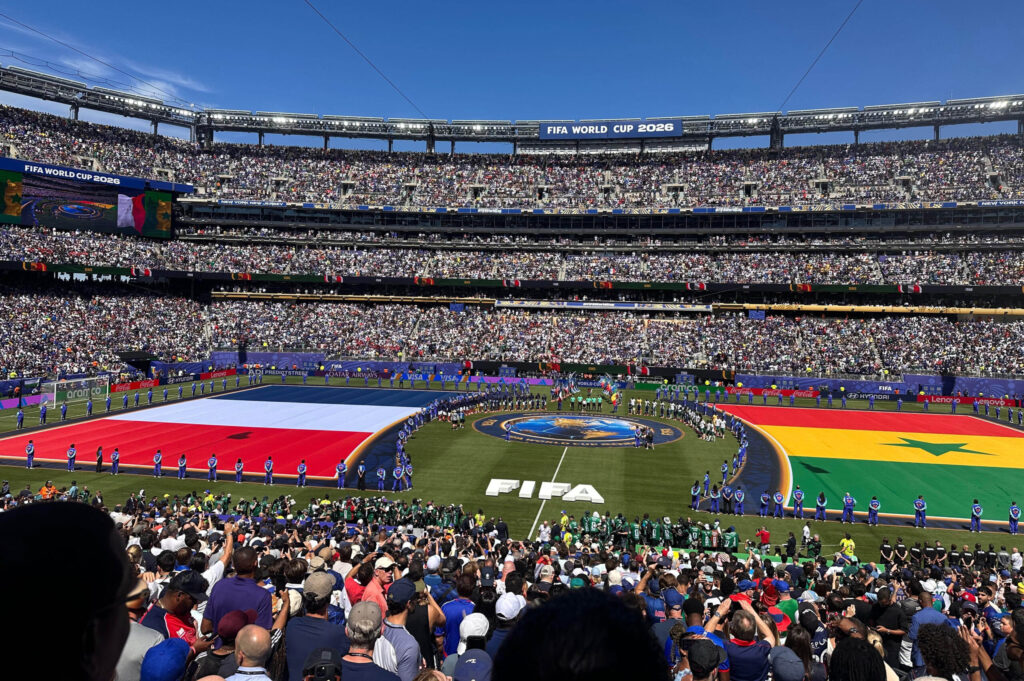
Last week, I was among the eighty thousand fans packing the New York New Jersey Stadium for the FIFA World Cup match between France and Senegal. There, I witnessed yet again the power of sports—something that governments around the world have yet to take advantage of.
When France and Senegal played each other on June 16, it was the first time these two teams faced off since 2002. Then, in Seoul, Senegal had defeated France, the reigning world champion. The match—and, therefore, Senegal’s win—carried much symbolism, since it saw a former colony and its former colonial ruler go head-to-head.
As soon as I arrived in New York, I could see the city was in a sports frenzy. A few days earlier, the Knicks had won the National Basketball Association (NBA) championship for the first time in fifty-three years. I saw a sea of people wearing Jalen Brunson jerseys, but also plenty of fans sporting the jerseys of Kylian Mbappé and Sadio Mané, the French and Senegalese captains, respectively. Fans have argued that France and Senegal’s World Cup group is the toughest in the tournament, labeling it the “Group of Death” based on expectations that Senegal’s team (following a strong performance in the Africa Cup of Nations) is now stronger than the 2002 team, and on France’s formidable appearance in the 2022 World Cup finals. Thus, tensions were high.
We fans streamed into the stadium, which itself has a long record of gathering fans from across the country and the world, having hosted Copa América matches, Club World Cup matches, and a Super Bowl—and, of course, countless Giants and Jets games. Among the fans were legends including Patrick Vieira and Khalilou Fadiga, who respectively played for France and Senegal in the 2002 match. Also attending were Confederation of African Football President Patrice Motsepe; French Football Federation President Philippe Diallo; and French Minister of Sports, Youth, and Community Life Marina Ferrari. Diallo is Franco-Senegalese like me, and we often joke about journalists who constantly ask us which team we prefer. The match also brought together figures from across sports, as demonstrated by NBA Deputy Commissioner Mark Tatum’s attendance.
There is no human activity that brings people together as football does. As a former French deputy minister of sports, I find it surprising that policymakers have not treated sports as a high priority for policy. Ministers in charge of sports remain largely overlooked on the national and global stages. When policymakers discuss sports, they often focus too squarely on the entertainment the games bring. At best, they hope to benefit from athletes’ much greater popularity. Only a few leaders, such as Nelson Mandela, have used sports to achieve wider policy aims, as he did during the 1995 Rugby World Cup in South Africa.
Governments that have recognized sports’ power beyond entertainment have used it as a geopolitical tool—sometimes using it in a way that has increased tensions. For example, Adolf Hitler’s regime promoted Nazi propaganda at the 1936 Berlin Olympics. Additionally, after the Soviet Union invaded Afghanistan, the United States boycotted the 1980 Moscow Olympics. Then, the Soviet Union boycotted the 1984 Los Angeles Olympics, citing Washington’s refusal to ban anti-Soviet demonstrations planned to take place during the event, although many viewed it as retaliation for the US boycott.
It is difficult to ignore the role that sports can play in ratcheting up global tensions. For example, the 1969 World Cup qualifiers exacerbated already existing tensions between El Salvador and Honduras, which led to a four-day armed war that, according to official estimates, killed up to 1,500 people. And in Central Europe, a riot that broke out before kickoff at a match between Dinamo Zagreb and Red Star Belgrade in 1990 is often considered a symbolic starting point of war in Yugoslavia.
Governments should instead harness the power of sports for their economic development strategies.
As I witnessed at the France-Senegal game, sports attract massive audiences and fan bases. With that comes economic opportunity, as all those fans need stadiums to convene in, transportation to get them there, and housing to use as a home base if they’re traveling. With games come sponsorships and broadcasting rights. Sports franchises, therefore, stimulate serious investment for the countries hosting them.
Thus, governments should introduce policies that harness the sports ecosystem to attract institutional capital and develop sports as an asset class, alongside infrastructure, technology, and real estate.
With this, however, governments should ensure that the investments coming into their sports ecosystems are fair and safe for their countries. National security implications may arise from foreign ownership of sports assets, requiring policy interventions. Additionally, policymakers should set standards for sports federations and investments, ensuring transparency, preventing corruption, and protecting environmental, social, and governance principles.
Women’s soccer in the United States demonstrates how public policy focused on sports can change populations and economies. Title IX of the Education Amendments Act of 1972 prohibits sex-based discrimination in any program at a school that is federally funded, which includes athletic opportunities. The impact was transformative. In 1972, only seven hundred girls played high school soccer across the country. But today, nearly 400,000 girls play. That has translated to the expansion of women’s soccer at professional levels, which has also brought additional economic activity: The fourteen teams across the National Women’s Soccer League, for example, generated $262 million in revenue last year. This extraordinary expansion illustrates how targeted policy interventions can unlock talent, broaden participation, and drive lasting social and economic change.
Across the world, sports have major economic power. Governments must not overlook it.
Rama Yade is the senior director of the Atlantic Council’s Africa Center.
Related Reading


Image: France and Senegal face off at the 2026 FIFA World Cup. Photo courtesy of Rama Yade.