
Last week, the Office of the US Trade Representative (USTR) determined that several of Brazil’s trade policies and practices are actionable under Section 301 of the Trade Act of 1974. For the most part, the notice of determination cites familiar concerns: unfair trade practices—including Brazil’s ethanol tariffs—alleged discrimination against US social media companies, and illegal deforestation.
But the document makes one more complaint: according to USTR, Brazil’s domestic instant payment system Pix—mentioned more than twenty times throughout the determination—“unfairly disadvantaged US companies.” That makes it perhaps the first Section 301 case to treat a country’s domestic payment system as a US trade enforcement issue.
It’s a development that will not only ring the alarm bells in Brasilia, which may soon face new tariffs of up to 25 percent, but reverberate across the Atlantic, where the European Central Bank (ECB) is developing the digital euro.
If Washington starts targeting foreign payment systems, does Europe’s push for payment sovereignty risk becoming another source of transatlantic tension? That question is now likely front of mind in Brussels.
A payment system in the trade crosshairs
The US probe into Brazil’s trade practices was launched in July 2025—and though it did not mention Pix by name, the platform was implicitly referenced, as the USTR announcement singled out “digital trade and electronic payment services.” Pix lets individuals, businesses, and government entities send and receive money in seconds, and it has become one of the most widely used payment tools in Brazil. In 2025, the platform’s total transaction volume reached $6.7 trillion. According to a recent study, Pix is likely to also account for half the nation’s e-commerce transactions by 2028.
USTR’s concern was not that Pix succeeded, but how. The US administration argued that Brazil’s central bank plays a dual role—as both regulator of the payments market and owner-operator of Pix—and that this creates a conflict of interest that lets the state favor Pix over competing providers, including US companies operating in Brazil.
In particular, USTR pointed to four allegedly unfair features of Brazil’s payments model: mandatory participation by large financial institutions, prominent placement of Pix alongside other payment options in banking apps, free access for individual users, and capped fees for businesses. At the same time, private companies are also expected to shoulder responsibilities for fraud prevention, operational oversight, and compliance within a system built on public infrastructure, adding another layer to concerns over competitive neutrality.
From the central bank’s perspective, these rules drive adoption, lower costs, and expand financial inclusion. From USTR’s perspective, they tilt the playing field in favor of a government-backed system and disadvantage private competitors.
Pix pushback is part of a wider pattern
Although this is the first time that a Section 301 investigation has put a domestic payment system at the center of a US trade action, it’s not the first time that payments have been invoked as a trade issue before.
In 2010, the US brought a WTO case challenging China’s restrictions on foreign electronic payment suppliers. US representatives argued that China funneled card-based payments denominated and settled in renminbi through China UnionPay, while foreign providers were limited largely to foreign-currency transactions. Although the US won parts of the case in 2012, the ruling had limited practical effect: foreign providers still faced years of licensing delays and regulatory barriers.
Though no such action has been taken against India’s domestic payment system yet, its Unified Payments Interface (UPI)—which, like Pix, is fast, low-cost, and built around account-to-account transfers—has also drawn scrutiny from US officials. USTR’s 2026 National Trade Estimate Report raised concerns that India’s electronic payment policies appear to favor domestic suppliers over foreign ones, including through rules affecting participation in the UPI ecosystem and the treatment of RuPay cards.
Europe’s quest for payments sovereignty
Europe, in the meantime, has pursued payments sovereignty without much external pushback. When the euro launched in 1999, the euro area gained monetary sovereignty over its currency but not over the infrastructure that moves it. Retail payments remained fragmented, and card transactions still depended heavily on international companies. According to the ECB, international card schemes accounted for roughly 61 percent of euro-area card payments in 2022, and thirteen euro-area countries relied entirely on these schemes for card transactions.
The ECB began invoking “payments sovereignty” around 2019, when the Eurosystem launched a retail payments strategy focused on pan-European solutions and instant payments. The ECB later described that strategy as a response to “rising challenges to European sovereignty in the retail payments market.”
The flagship of that effort is the digital euro, a central bank digital currency. The project, currently in its pilot phase, is explicitly framed as a way to protect payments sovereignty and the international role of the euro. ECB executive board member Piero Cipollone has described the digital euro as “a digital equivalent of cash” and as “essentially a public infrastructure” that firms can use to provide services without relying on proprietary systems. He has also warned that Europe is significantly reliant on non-European payment systems—and that this dependence will deepen if Europe does not act.
The digital euro is not Pix
But with USTR now citing Pix as grounds for potential punitive tariffs against Brazil, Europe’s calculus around payments sovereignty may become considerably more complex.
The digital euro is not Pix. Pix is an instant payment system, while the digital euro would be central bank money in digital form. But the policy logic overlaps: both are framed as public infrastructure, both seek to reduce dependence on private or foreign payment rails, and both promise lower costs, broader access, and a more integrated domestic payments market.
Those parallels help explain why the USTR action against Brazil matters for Brussels. The ECB can still argue that Europe needs resilient, pan-European payment infrastructure. But framing will matter. If the digital euro is perceived as a tool to displace foreign payment companies, it could invite trade scrutiny.
The broader lesson is that payments and trade can no longer be treated as separate policy worlds. Payment systems are now part of national economic strategy: they shape market access, competition, data flows, financial inclusion, and geopolitics. And as the Trump administration continues to deploy trade tools more aggressively, policies that once seemed insulated from trade disputes—including payments—may no longer be off limits.
Alisha Chhangani is the associate director for future of money at the Atlantic Council’s GeoEconomics Center.
Related Reading

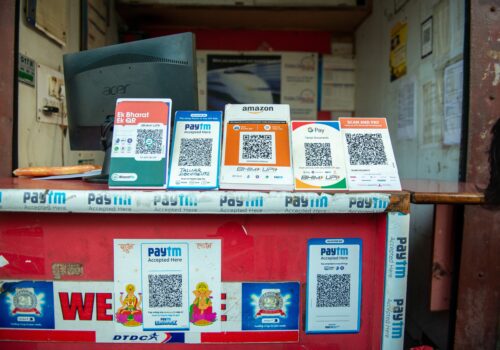

Image: A QR code displayed at a business in São Paulo allows customers to pay instantly via Pix. Source: Shutterstock.