
The world’s finance ministers and central bank governors are gathering in Bangkok, Thailand this week for the Annual Meetings of the International Monetary Fund (IMF) and World Bank. Our experts are on the ground talking to leaders and getting the behind-the-scenes scoop on how the Bretton Woods institutions are taking on the most urgent challenges in the global economy, including conflicts in the Middle East and Ukraine, soaring public debt, and the impact of artificial intelligence (AI).
Check back for expert reactions to breaking news, updates from our events with high-level policymakers, and more.
day one
The IMF just reviewed some of its key policies. What will change?
Three shocks are pushing up long-term interest rates and threatening the stock market
The new geoeconomics of Bretton Woods
OCTOBER 12 | 1:00 AM ET
The IMF just reviewed some of its key policies. What will change?

Four major reviews published in recent days offer a candid account of the International Monetary Fund’s core work. They cover debt sustainability in low-income countries, program design and conditionality, the financial sector assessment program (FSAP), and economic surveillance. Taken together, the reports call for more realistic analysis, greater selectivity, better integration across policy areas, and stronger follow-through. Here’s a quick rundown:
- In the past, the low-income debt sustainability framework has concentrated on external debt in foreign currency. Domestic borrowing in local currency has grown in importance, however, opening up new avenues for shocks and risk transmission. The review proposes new indicators for gross financing needs and interest payments, a domestic-debt module, and a stress test for domestic financing. This matters because an incomplete diagnosis can delay debt restructuring, encourage additional lending into an unsustainable situation, and eventually impose larger costs on citizens and creditors alike.
- The review of IMF program conditionality calls for more credible assumptions underlying programs’ macroeconomic frameworks, stronger contingency planning, and better sequencing of structural reforms. For the latter, it suggests that programs develop a medium-term reform strategy centered on measures critical for program success. This is an implicit acknowledgment that programs can become overloaded: excess conditionality can consume scarce administrative capacity and distract from the reforms on which recovery actually depends.
- The surveillance review seeks sharper prioritization for the IMF’s country work, clearer tests of macroeconomic relevance for topics that are being covered, stronger macrofinancial analysis, and more contingent policy advice. At the same time, it also asks staff to deepen work on external spillovers, AI, structural policies, and emerging risks. These are legitimate subjects but, without clear prioritization, Article IV consultations may fail to convey the fund’s most consequential advice. Indeed, the question of how the IMF should communicate its advice was not a subject of the review, an important shortcoming that hampers the traction of IMF policy advice.
- The FSAP review responds to an increasingly complex global financial system by proposing more modular and risk-based assessments, closer integration with Article IV consultations, and more prioritized, actionable recommendations. Indeed, the program’s remit now extends well beyond its initial bank focus to include nonbank institutions, digital finance, cyber threats, climate risks, and cross-border interconnections. Again, the risk is dilution of resources and weak follow-up that can leave material vulnerabilities unresolved between assessments.
These are sound recommendations, but they are also familiar from earlier reviews. This creates grounds for skepticism about whether IMF management and the Executive Board will heed their own advice this time.
The ultimate test for the IMF to operate differently will arise in everyday program decisions, especially in cases involving large exposures and surveillance outcomes of shareholders that pose risks for the global economy. Those are precisely the cases where politically influenced judgments can carry the greatest costs.
To assess whether these recommendations gain traction, the IMF could publish an annual implementation scorecard. For major deviations, the institution should explain the reasons for departing from the new guidance. This would preserve the discretion required for country work while making review outcomes more transparent. Review departments would remain responsible for consistency, and management and the Executive Board would be placed on the record for the institutional choices that follow.
Without such visible accountability, the next review cycle five years from now is likely to return to many of the same questions about realism, selectivity, integration, and follow-through. By then, the IMF may again look back on program failures or surveillance misses that could have been avoided by applying the lessons so convincingly presented by its own staff over the past few weeks.
OCTOBER 12 | 12:12 AM ET
Three shocks are pushing up long-term interest rates and threatening the stock market

The world economy is undergoing three concurrent shocks—the energy supply shock, the AI demand shock, and the public sector debt shock. They interact to push up long term interest rates—which could pose economic and financial risks.
Conflict in the Middle East has disrupted the supply of oil and gas—raising crude oil prices to more than one hundred dollars a barrel, which is fueling median one-year global percent, the highest since May 2023. This has forced major central banks to tighten their monetary policy stances, pushing up bond yields. Ten-year US Treasury yields have reached their highest levels since 2002.
AI companies have significantly stepped up their borrowing to fund their investment in AI infrastructures. Goldman Sachs has estimated that global AI investment expenditure would exceed one trillion dollars in 2026—or 0.9 percent of global gross domestic product (GDP). This is projected to rise to 1.3 percent in 2027 and 1.4 percent in 2028, boosting global GDP growth by between 0.5 percent and 1.5 percent in the period ahead.
At the same time, public debt of advanced economies has reached a new high of $102 trillion or 91 percent of global GDP. Driving the rising public debt level in advanced economies has been persistently high fiscal deficits of 5-6 percent of global GDP, generating substantial interest payments.
The three shocks mentioned above appear to impact the three key components making up long-term nominal interest rates. The AI funding need has triggered a rise in the equilibrium real interest rate r*, estimated to be 2.95 percent as measured by the Treasury Inflation Protected Securities (TIPS) yields. The energy supply shock has driven the inflation premium—the price investors demand to compensate for the risk of inflation increases—estimated at 2.36 percent. These make up the ten-year nominal Treasury yield at 5.31 percent as of October 5. The term premium—to compensate investors for holding long maturity securities—which is embedded in the real rates and inflation premium, has been estimated at 1.08 percent.
IMF Managing Director Kristalina Georgieva noted in her curtain-raiser speech for the meetings that high rates are likely to remain over the long term, with negative implications for economic growth prospects and equity valuation. Stocks in the S&P 500 index are richly valued at around 26.6 in price-to-earnings (P/E) ratios—well above the long-term average of 16.2. More concerning is the fact that the ten-year Shiller CAPE (Cyclically Adjusted P/E) ratio has exceeded 41, about 2.3 standard deviations above the modern age average—putting stocks in strongly overvalued territory. Moreover, there exists an extreme concentration risk in AI and high-tech sectors—with ten top companies approaching 40 percent of the S&P 500 index. This could give any market correction a wider systemic spill-over impact than otherwise would be the case.
Economic growth drivers have also been concentrated in the AI/high-tech sector, whose capital expenditures account for 1.8-2.5 percent of US GDP, but has contributed about half of US GDP growth in recent quarters.
In short, persistently high interest rates, driven by a variety of factors, pose a threat to currently overvalued US equity markets burdened by extreme concentration risk; the materialization of these risks would negatively impact economic growth prospects. Policymakers can ameliorate this challenging situation by putting their fiscal houses in order—reducing budget deficits to relieve some pressure on interest rates and hoping that all the AI investment will soon produce productivity improvement and stronger growth, which could make the economy and financial markets more resilient to high rates and equity valuation.
OCTOBER 6 | 9:00 AM ET
The new geoeconomics of Bretton Woods

When government officials, investors, policymakers, and academics gather in Bangkok on October 12 for the 2026 Annual Meetings of the International Monetary Fund (IMF) and World Bank, they will confront a global economy markedly changed since their 2023 meeting in Marrakesh. Heightened by geoeconomic competition, protectionism, tariffs, and economic and military conflict, the global trade, investment, and supply chain maps are being redrawn, and a new global order is in the making. Against this backdrop of increasing global fragmentation, the main challenge facing the Bretton Woods Institutions (BWIs) is preserving international economic cooperation and coordination as the issues facing member economies and their populations become ever more global and transnational in scope.
Trade, investment, technology, finance, energy, and critical minerals are increasingly intertwined with national security. The United States, China, the European Union, and a growing number of middle powers are using tariffs, subsidies, export controls, investment restrictions, industrial policy, and supply-chain strategies to protect domestic industries and secure strategic advantage. Production networks are being reorganized around resilience and political alignment, while global imbalances are widening. At the same time, developing countries are facing extraordinary pressure from conflict, high debt, fiscal strain, climate risks, demographic change, and rapid technological transformation (namely AI and datacenters). Globalization is not ending—it is becoming more contested and fragmented.
Figure 1. Number of new harmful trade policy interventions
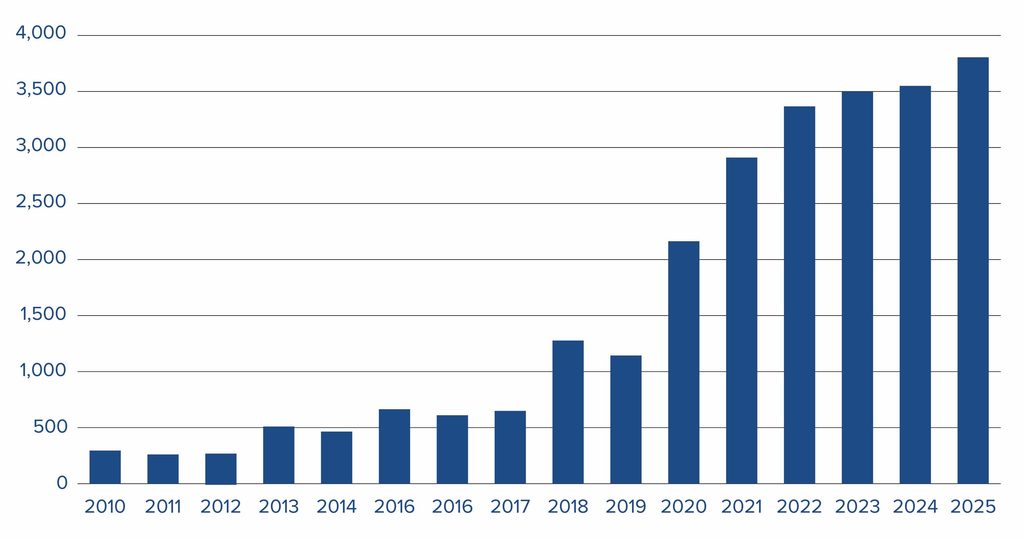
This shift presents a fundamental challenge for the IMF and World Bank. Both institutions were established on the belief that international economic integration, backed by major powers, could generate shared benefits when accompanied by macroeconomic stability, development finance, and international rules. That consensus has largely frayed. The institutions’ largest shareholders increasingly pursue economic policies shaped as much by strategic competition as by growth, while developing countries often bear the consequences of decisions over which they have limited influence and responsibility, such as climate change, trade disruptions, high interest rates, and rapid AI developments.
Read more from our collection of essays on the future of Bretton Woods, and watch our experts discuss the paper at today’s event.
Image: October 10, 2026, Bangkok, Thailand:: Promotional displays and banners for the 2026 Annual Meetings of the International Monetary Fund (IMF) and the World Bank Group are seen at the Queen Sirikit National Convention Center (QSNCC) in Bangkok, ahead of the meetings scheduled for October 12-18. (Watsawat Koktabtim/JNA via ZUMA Press Wire)