
China is exporting electric vehicles of all types in staggering numbers. Export volumes of battery electric vehicles (BEVs), plug-in hybrids (PHEVs), and hybrid electric vehicles (HEVs) all reached highs in 2025, with 2026 data through March indicating continued growth. If oil disruptions persist due to the war in Iran, it may provide an additional, powerful tailwind for Chinese EV exports.
Democracies around the world, however, face an uneasy and complicated dilemma when it comes to importing Chinese-made “connected vehicles,” or vehicles that are internet-connected and subject to potential cyber threats. Countries that refuse to import Chinese vehicles, especially electric vehicles, risk compounding economic damages from an extended oil crisis and stalling progress against other security threats, including climate change. On the other hand, large-scale imports could undermine domestic industries, lead to consolidation of yet another supply chain node in China, and expose cyber vulnerabilities to exploitation by a powerful adversary.
Today’s oil shock may accelerate global dependence on Chinese connected vehicles, forcing democracies into a tradeoff between short-term relief and long-term cybersecurity and industrial risks. When it comes to grappling with Chinese automotive exports, there is no easy answer, but countries can put measures in place to mitigate risks.
Charting Chinese EV exports
Chinese EV and battery investment overseas
Chinese automakers are not only exporting abroad but expanding their influence via investments in manufacturing facilities and partnerships abroad. The Chinese auto giant Geely intends to enter the US market despite trade barriers, and Beijing’s recent deal with Canada will allow the entry of 49,000 Chinese EVs to the Canadian market at a tariff rate of 6.1 percent. According to the Rhodium group, Chinese firms that make zero-emission vehicles—which are overwhelmingly BEVs rather than hydrogen fuel cell—invested more abroad than domestically in 2024 at around $16 billion, primarily in battery production. Chinese automakers currently maintain factories in Brazil and Thailand, while additional ones are planned for Turkey and Indonesia. If oil prices remain persistently high due to the war in Iran, many countries and regions are likelier to continue setting aside trade and security concerns about Chinese EVs.
Cyber dangers from Chinese connected vehicles and mitigation steps
That approach would bring dangers. As with other technology products, Chinese connected vehicles have existing or latent cyber vulnerabilities that could be exploited by Chinese security services or used as leverage in a crisis. Additionally, China’s intelligence law requires the country’s citizens and companies to assist in intelligence activities. In a Taiwan contingency, for example, Beijing could pressure third-party countries by implicitly threatening to disable portions of their vehicle fleets, paralyzing their economies. This is not merely a theoretical possibility. Norway and Denmark recently found that the Chinese bus company Yutong included a backdoor capable of remotely disabling vehicles.
In the face of these cyber dangers, risk mitigation steps are practical. Some democracies face greater risks from Chinese connected vehicles. The United States, Japan, and Taiwan will bear the brunt of Beijing’s cyber and potential kinetic attacks. Accordingly, Washington, Tokyo, and Taipei should continue to eschew imports of Chinese connected vehicles. Other democracies can limit risks by ensuring there are no such vehicles in government fleets, or around sensitive infrastructure, such as military facilities.
Democracies should approach Chinese connected vehicles with eyes wide open
Democracies facing a potential energy crisis may increasingly turn to electric vehicles, including imports from China, the world’s largest exporter. These imports pose both risks and opportunities. While there are short-term economic and energy benefits from importing Chinese connected vehicles, they may pose dangers over the longer term by increasing cyber risks and weakening the Western industrial base, including in the automotive sector.
Democracies should offset the potential cyber risks of Chinese connected vehicles by further revitalizing its industrial base for next-generation automobile manufacturing, taking precautionary defensive measures, and building offensive means to respond symmetrically and proportionately. If democracies, especially the United States, continue to outpace China’s artificial intelligence efforts, including by preventing its adversary from accessing powerful semiconductors, they may be able to build enduring cybersecurity advantages, decreasing the risks from Chinese connected vehicles over time.
Joseph Webster is senior fellow at the Atlantic Council’s Global Energy Center, a nonresident senior fellow at the Atlantic Council’s Indo-Pacific Security Initiative, and editor of the independent China-Russia Report.
Tony Jing is an undergraduate student at the University of Wisconsin-Madison and a researcher at the independent China-Russia Report.
This article reflects the authors’ own personal opinions.
stay connected
Sign up for PowerPlay, the Atlantic Council’s bimonthly newsletter keeping you up to date on all facets of the energy transition
related work

our work

The Global Energy Center develops and promotes pragmatic and nonpartisan policy solutions designed to advance global energy security, drive economic opportunity, and foster a sustainable energy future.
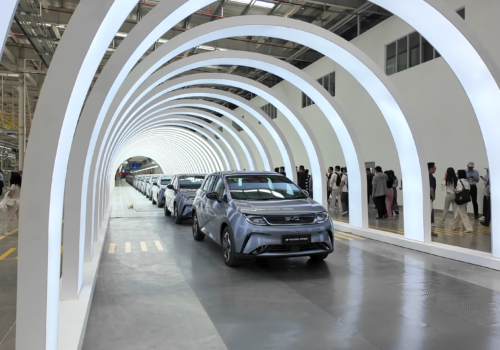
Image: JINHUA, CHINA - JANUARY 13: Workers assemble new energy vehicles at an intelligent factory of electric vehicle enterprise Leapmotor on January 13, 2026 in Jinhua, Zhejiang Province of China. (Photo by VCG/VCG )No Use China.