
There is little debate about the need for more diversified trade corridors connecting India, the Middle East, and Europe. Recent disruptions in the Strait of Hormuz, the Red Sea, and the Suez Canal, combined with increasing competition over critical trade infrastructure, have underscored the importance of building multiple routes that reduce dependence on maritime chokepoints. Beyond trade, these corridors can deepen economic integration across the Middle East, strengthen partnerships, and create new opportunities for growth.
This was largely the logic behind the India-Middle East-Europe Economic Corridor (IMEC) when it was announced at the Group of Twenty Summit in 2023. As originally conceived, IMEC envisioned India and Israel as the corridor’s two principal anchors, connected through the Gulf at a moment when Saudi-Israeli normalization appeared within reach. The objective was not simply to build another transportation route but to reshape global trade around a more resilient and distributed network.
Increasingly, however, policymakers are exploring options to bypass Israel, looking instead to options that would route through Egypt, Iraq, Turkey, Syria, and other countries in the region. A networked approach is both sensible and desirable: resilient supply chains should never depend on a single route. But as governments invest in alternative ports, railways, and logistics hubs, Israel can no longer assume it will remain central simply because that was the original vision. The next Israeli government faces a strategic imperative to demonstrate that Israel is the fastest, most reliable, and commercially attractive gateway between the Gulf and the Mediterranean. Doing so will not only reap economic benefit. It will more broadly help determine Israel’s place in the region’s emerging economic and strategic architecture.
Politics cannot be ignored, but ultimately goods follow the most efficient routes. Here, Israel begins with a significant advantage. Much of the necessary infrastructure and plans already exist, particularly around Haifa and the Jordan Gateway, while competing routes require hundreds of kilometers of new railways and billions of dollars in investment. This is not to overstate Israel’s readiness. Significant work remains. But the greatest constraint is not infrastructure, it is political will and prioritization.
Israel has a head start
Unlike alternative routes through Syria and Iraq, Israel is not starting from scratch.
Haifa is Israel’s principal Mediterranean gateway and one of the region’s most modern ports. According to the Gadot Group (an Israeli logistics company), Israel’s ports have more than five times the capacity of those in Lebanon or Syria. While Israeli ports cannot compete with Egypt’s Port Said as a transshipment hub, they are well positioned to serve as an intermodal gateway linking maritime shipping with overland transport into Jordan and the Gulf. Across Haifa’s three ports and Ashdod’s two ports, Israel currently has capacity to handle roughly five million twenty-foot equivalent units (or TEUs, the standard unit of cargo capacity) annually, with expansion plans that could double the capacity.
Beyond physical infrastructure, Israel already possesses one of the region’s most advanced maritime logistics ecosystems. Port operations are managed through a centralized digital platform, terminals are integrated into the world’s major liner shipping networks, and all major ports connect to national rail and highway infrastructure. This existing logistics system provides a foundation that can be expanded far more rapidly than building an entirely new corridor from scratch.
Israel’s rail infrastructure offers a similar advantage. The rail line from Haifa to Beit She’an is already operational. Only a short extension (twelve kilometers) to the Jordanian border remains. In comparison, competing proposals envision constructing hundreds of kilometers of entirely new rail infrastructure across multiple countries.
Haifa’s strategic importance is further reinforced by ownership. Haifa port’s majority operator, India’s Adani Group, gives India a direct commercial stake in the Mediterranean terminus of the corridor, creating a rare alignment between India’s overseas infrastructure investments and its broader strategic interests.
The Jordan Gateway
The primary bottleneck shaping Israel’s potential as an IMEC hub is not capacity at Haifa but how efficiently cargo can move across the Israel-Jordan border.
Commercial traffic currently relies on the Sheikh Hussein (Jordan River) crossing, which today processes roughly 140 trucks per day, down from approximately 250 before October 7, 2023. According to a logistics firm operating in the region, cargo can travel from Gulf ports to the Israel-Jordan border in approximately four days, yet spend as many as ten additional days waiting at Sheikh Hussein to cross into Israel. These delays reflect a combination of physical and operational constraints, including limited truck lanes and inspection capabilities, back-to-back cargo transfers, unsynchronized operating hours, next-day backlogs, and labor and documentation bottlenecks. The result is a crossing that lacks the capacity, speed, and reliability required to support a major regional trade corridor.
These constraints are not merely operational inefficiencies—they are strategic liabilities. If goods cannot move reliably and predictably between Jordan and Haifa, international logistics providers will increasingly favor alternative corridors, even if those routes require substantially greater investment.
The Jordan Gateway offers the most promising long-term solution. Located approximately ten kilometers south of the Sheikh Hussein crossing, the project was first envisioned as part of the 1994 Israel-Jordan peace treaty as a joint industrial and logistics hub designed to expand bilateral trade, create employment, and strengthen practical economic cooperation. Israeli and Jordanian negotiators conceived the gateway as a hub that would link industrial activity on the Jordanian side with logistics, commercial, and supporting infrastructure on the Israeli side. The gateway has the potential to handle up to one thousand trucks per day within its first year of operation, with capacity to increase significantly.
Progress has been uneven. In 2022, the Bennett-Lapid government approved a package of measures to accelerate the project, including advancing planning, allocating funding for supporting infrastructure, and directing government agencies to expedite implementation of the crossing. The government changed hands before it could implement many of these measures. In March this year the Israeli government reaffirmed its commitment to establishing a fully integrated Israeli-Jordanian industrial and employment zone and allocated approximately seventy million shekels to advance the project. These decisions demonstrate that, when political leaders prioritize the project, implementation can move forward, but that momentum has yet to be sustained.
Development remains incomplete on the Israeli side, despite the recent decision and funding. The Jordanian industrial park also continues to operate well below its intended capacity. Nevertheless, the fundamental framework already exists. Unlike competing regional corridors that would require building entirely new cross-border infrastructure, the Jordan Gateway can build upon an established bilateral agreement and decades of planning.
Strategy, not just trade
Many supporters of Israel’s inclusion in IMEC argue that economic integration in the region should be Israel’s priority and if Israel proceeds down this path, political cooperation will follow. There is considerable truth to that. A functioning corridor would strengthen one of Israel’s most important, and increasingly fragile, relationships with Jordan, stimulate economic development in northern Israel and the Jordan Valley, reinforce partnerships with India and the Gulf states, and make future regional integration more likely. More broadly, as the Atlantic Council’s Afaq Hussain and Maisoon Kafafy argue, a networked approach to IMEC could unlock more than $330 billion in additional trade.
Yet, many Israeli supporters of IMEC continue to view it as a project for a later stage, something that can wait until the regional political environment stabilizes. That logic is increasingly flawed. Governments across the region are already investing in alternative ports, railways, logistics hubs, and trade corridors. Israel enjoys a meaningful advantage today, but that advantage will not last indefinitely. By the time geopolitical conditions improve, Israel’s comparative advantage may have narrowed and alternative corridors may already be established. If the Israel-bypassing trade routes that governments are proposing become commercially viable, they will become increasingly difficult to compete with.
A practical agenda
The next Israeli government should treat IMEC as a national strategic priority. That effort should begin with significantly expanding capacity at the Sheikh Hussein crossing, streamlining border procedures, accelerating development of the Jordan Gateway industrial park, modernizing trade infrastructure, and completing the remaining rail connection to Jordan.
Over time, Israel should also recognize that IMEC’s full potential will ultimately require greater Palestinian economic participation. Integrating Palestinian industry and labor into regional supply chains would strengthen the corridor’s commercial viability while supporting economic development and regional stability. That objective would be consistent with Israel’s long-term strategic interest in creating a more integrated regional economy.
As alternative corridors advance across the region, Israel faces a narrowing window to demonstrate that it remains the most efficient gateway between the Gulf and the Mediterranean.
The infrastructure largely exists. The commercial logic is compelling. The strategic case is even stronger.
The next Israeli government should decide that the economic gains of investing in the corridor are worth the political costs and ensure the corridor is built through Israel instead of around it.
Samantha Sutton is a nonresident senior fellow with the Project for Middle East Integration within the Atlantic Council’s Middle East programs and the associate director of policy with the Institute of Global Politics at Columbia University’s School of International and Public Affairs. She served most recently in the National Security Council under the Biden administration as the director for Israel and Palestinian affairs.
Related Reading

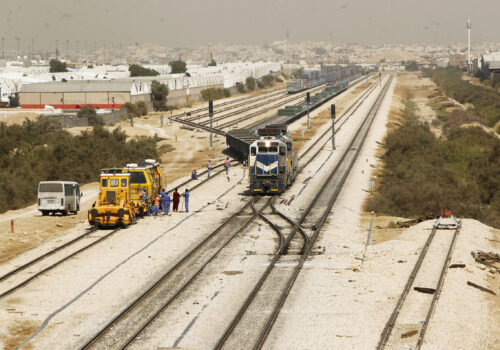

Image: Haifa harbor and city skyline, Israel. Photo by IMAGO/Christian Offenberg via Reuters Connect.