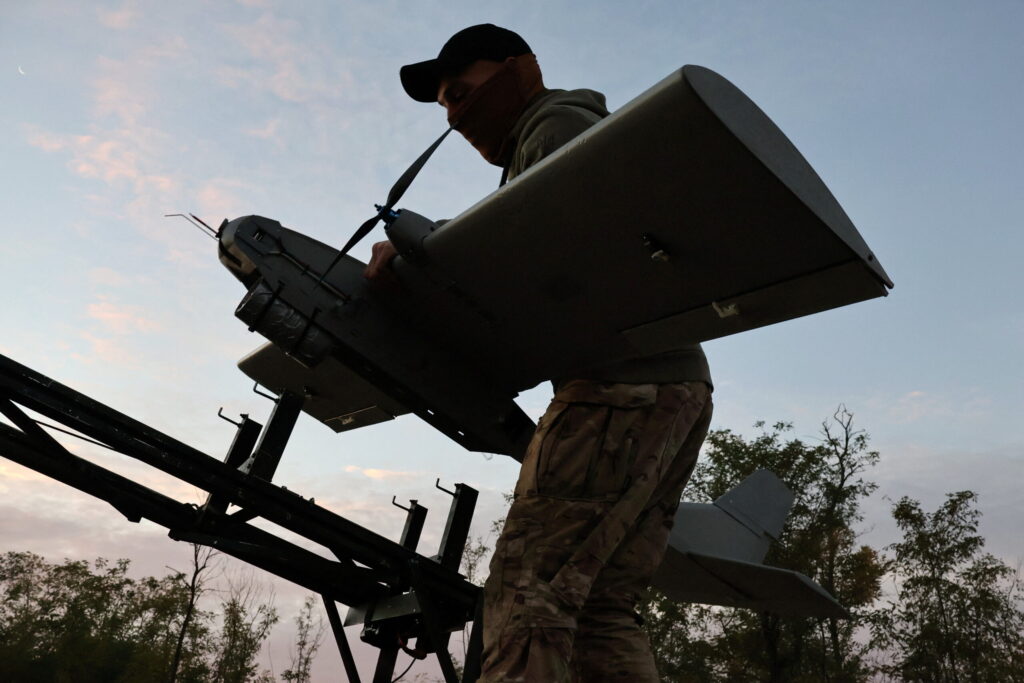
Ukraine has a world-class defense industry, spare production capacity, and prospective foreign customers. What it lacks is a state-backed way to turn that potential into funded, multi-year orders without jeopardizing its own national security.
In July 2026, wartime Ukraine announced it would begin exporting arms. To date, Ukraine has granted few export permissions. The obstacle is not demand; it is the absence of a wartime contracting system that protects Ukrainian interests while providing a clear understanding to foreign governments of what they may buy, when it will be delivered, and what happens if Ukraine suddenly needs that production capacity for its own defense.
Since the launch of Russia’s full-scale invasion in 2022, Ukraine has financed its defense through a combination of budget funds, donations, loans, and partner-funded procurement. This approach has kept weapons flowing to the front and sustained domestic manufacturers, but it has not created a standing market for Ukraine’s defense industry to export. Nor has it provided Ukrainian defense sector companies with the predictable order flow needed to retain workers, buy components, and invest in research and development.
Ukraine needs more than an export permit process. It requires a government-to-government defense sales channel that accepts advance payments, enables multi-year orders, controls exports, and preserves Kyiv’s right to redirect production as needed during the war.
Stay updated
As the world watches the Russian invasion of Ukraine unfold, UkraineAlert delivers the best Atlantic Council expert insight and analysis on Ukraine twice a week directly to your inbox.
Ukrainian President Volodymyr Zelenskyy has said Ukraine is operating at only about 60 percent of its roughly $30 billion annual weapons production capacity, which means roughly $12 billion in unused capacity. That figure does not include the markup Ukraine could charge foreign buyers or the export taxes the state could collect on those sales, so the true forgone revenue is larger still.
In order to address the issue of unused excess capacity, Ukraine has opened the door to controlled wartime exports. The government has issued a resolution to create a faster process for registered manufacturers to sell approved surplus products to approved foreign customers. That is an important policy opening, but it is not yet a complete defense sales system.
An export license only determines if a company may sell a specific item to a specific customer. The system still requires a clear structure for export. Some products should remain unavailable for export because Ukrainian forces require them for immediate operations. That category may include strategic strike systems, advanced air defense capabilities, and other scarce technologies whose export would create an unacceptable readiness risk.
The objective should not be to create an unrestricted wartime arms market, but to establish a disciplined process that separates surplus production capacity from critical Ukrainian military requirements. A foreign buyer would know what it may purchase, Ukraine would retain control over what it releases, and domestic manufacturers would gain a more predictable way to convert available capacity into funded production.
Eurasia Center events

The central objection to wartime exports is clear: No Ukrainian official should divert equipment designated for the front to a foreign customer. That objection is correct. It is also solvable.
The US Foreign Military Sales framework provides a useful precedent. The Arms Export Control Act permits the United States to cancel or suspend a foreign military sale under unusual or compelling circumstances when the national interest requires it. US guidelines also provide for the diversion of materiel to meet higher priority requirements. These tools show how a sales system can protect the buyer by stating when deliveries may change and what remedy applies.
Ukraine should adopt the same underlying principle in a way that works best for them. Every Ukrainian government-to-government defense sales case should state clearly that the Defense Ministry may suspend, reduce, or redirect production when Ukrainian operational requirements demand it. Foreign buyers should understand that Ukraine’s armed forces come first.
The contract must also tell the buyer what happens next. If Ukraine invokes that authority, the buyer should receive a defined remedy. Depending on the agreement, that could mean a refund, credit toward a later delivery, priority in a future production slot, substitution with an approved system, or another option negotiated in advance.
This balance is essential. Foreign governments may accept wartime delivery risks if terms are explicit, prices are attractive, and remedies are credible. Clear buyer protections make those risks easier to accept. The priority clause is therefore not an obstacle to sales; it is actually a feature that makes wartime sales politically and operationally defensible.
Consider a European government seeking to purchase a large quantity of short-range interceptor drones. Under a Ukrainian government-to-government arrangement, the buyer could place a three-year order and make an advance payment tied to production milestones. Kyiv could designate the system as exportable, verify that the manufacturer has capacity beyond Ukraine’s planned requirement, and place a contract with the company.
The advance payment would allow the firm to buy components, retain workers, and expand production. Ukrainian forces could receive priority allocation from the same line. The foreign buyer would receive scheduled deliveries from the remaining capacity. If the battlefield situation changed sharply, the Defense Ministry could redirect future lots to Ukrainian units. The buyer would then receive the remedy specified in the contract, whether that means a refund, a replacement delivery window, or credit toward another production run.
For Ukraine, the value of this arrangement goes beyond the generation of export revenues. It helps finance the workforce, supplier relationships, and production capacity that Ukraine may require later in order to surge output for its own security needs.
Since 2022, Ukraine has developed a defense industry under conditions few others have experienced. The country’s defense sector companies have adapted a wide range of weapons systems rapidly, shortened development cycles, and learned directly from battlefield use. That experience has great value, but it will not automatically translate into a resilient export position after the war.
Other governments and companies are already studying Ukrainian designs, building their own drone capacity, and incorporating lessons from the Russia-Ukraine War into domestic production. If Ukraine waits until peacetime to develop a sales architecture, foreign buyers may already have committed to suppliers elsewhere. The risk is not simply in terms of lost export income. Ukraine also risks losing an industrial advantage earned through almost five years of war.
A government-to-government sales channel would not replace grants, loans, partner-funded procurement, or reconstruction investment. Those tools will remain important, but they serve a different purpose. A sales channel enables partners to purchase systems for their own forces while supporting Ukrainian production. This complements assistance by adding demand, working capital, and industrial resilience.
Ukraine does not need to choose between arming its own forces and building an export market. It needs a system that openly ranks those priorities and makes the trade-off clear.
Colonel Rachael Hoagland is a US Army acquisition corps officer with more than thirty years of service. She most recently served as Science and Technology Division chief and director of the Joint Capabilities Acquisition Cell. She has spent time in Ukraine working directly with operational units, the Defense Ministry, Defense Procurement Agency, and domestic defense industry. The views expressed are those of the author and do not reflect the official position of the Department of the Army or Department of Defense.
Further reading


The views expressed in UkraineAlert are solely those of the authors and do not necessarily reflect the views of the Atlantic Council, its staff, or its supporters.


The Eurasia Center’s mission is to enhance transatlantic cooperation in promoting stability, democratic values, and prosperity in Eurasia, from Eastern Europe and Turkey in the West to the Caucasus, Russia, and Central Asia in the East.
Follow us on social media
and support our work
Image: A serviceman of the 65th Separate Mechanized Brigade of the Ukrainian Armed Forces sets up a Darts middle range strike unmanned aerial vehicle before launching it near a frontline, amid Russia's attack on Ukraine, in Zaporizhzhia region, Ukraine. October 7, 2026. (Andriy Andriyenko/Press Service of the 65th Separate Mechanized Brigade of the Ukrainian Armed Forces/Handout via REUTERS)