Featured analysis

Latest analysis

Econographics

Aug 14, 2024

Get ready for a volatile fall in the financial markets—but not necessarily a downturn

By <span class="gta-embed–tax–expert gta-post-embed–tax–expert">Josh Lipsky</span>, <span class="gta-embed–tax–expert gta-post-embed–tax–expert">Alisha Chhangani</span>

Between an election, the threat of conflict, and a slowing economy, there is likely to be more volatility in the months ahead. But volatility doesn’t mean a downturn—it just means there’s more uncertainty than usual. 

Economy & Business Macroeconomics

Econographics

Aug 12, 2024

Tech regulation requires balancing security, privacy, and usability 

By <span class="gta-embed–tax–expert gta-post-embed–tax–expert" >Karen Sowon, Giulia Fanti, JP Schnapper-Casteras</span>

Good policy intentions can lead to unintended consequences when usability, privacy, and security are not balanced—policymakers must think like product designers to avoid these challenges.

Digital Policy East Africa

Econographics

Aug 8, 2024

What exactly is a strategic bitcoin reserve?

By <span class="gta-embed–tax–expert gta-post-embed–tax–expert">Ananya Kumar</span>

Bringing bitcoin into mainstream use is not reason enough to create a strategic bitcoin reserve. 

Digital Currencies Economy & Business
French National Assembly with Olympic statues

Econographics

Jul 26, 2024

What French economic policy may look like after the Olympics

By <span class="gta-embed–tax–expert gta-post-embed–tax–expert" >Charles Lichfield and Gustavo Romero</span>

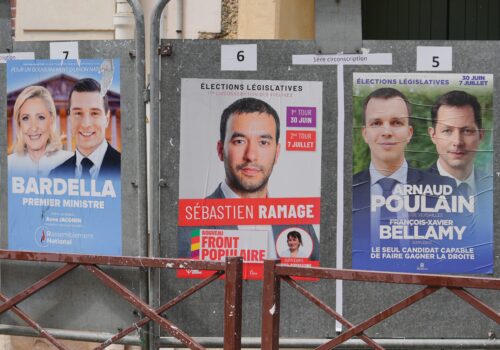
The snap parliamentary election in France produced no absolute majority, and negotiations on government formation have begun. As Macron’s centrists attempt to construct a broad coalition, what economic policies can they suggest to bring the center-left and center-right onside?

Economy & Business Elections

Econographics

Jul 23, 2024

Key takeaways from China’s Third Plenum 2024

By <span class="gta-embed–tax–expert gta-post-embed–tax–expert">Hung Tran</span>

The communiqué of the Third Plenum of the CCP Central Committee lacks major policy initiatives to address the country’s near-term growth challenges.

China Economy & Business

Econographics

Jul 18, 2024

The Bretton Woods institutions need revitalizing. Luckily, they are no strangers to reform.

By <span class="gta-embed–tax–expert gta-post-embed–tax–expert">Amin Mohseni-Cheraghlou</span>

The changing nature of the global economy is forcing these institutions to take a renewed look at their governance structure and mandates. This is not the first time they have had to do so.

Economy & Business Fiscal and Structural Reform

Econographics

Jul 8, 2024

Who’s at 2 percent? Look how NATO allies have increased their defense spending since Russia’s invasion of Ukraine.

By <span class="gta-embed–tax–expert gta-post-embed–tax–expert" >Clara Falkenek</span>

As NATO gathers for its summit in Washington, 23 of 32 allies now meet the 2 percent GDP defense spending target, highlighting a collective effort to strengthen the Alliance and support Ukraine.

Economy & Business Europe & Eurasia
French snap election

Econographics

Jul 3, 2024

How are markets reacting to the French snap election?

By <span class="gta-embed–tax–expert gta-post-embed–tax–expert">Sophia Busch</span>, <span class="gta-embed–tax–expert gta-post-embed–tax–expert">Charles Lichfield</span>

The results of the first round of the French snap election led to diverging reactions in bond yields and stock prices.

Elections Eurozone

Econographics

Jun 26, 2024

China and the US both want to ‘friendshore’ in Vietnam

By <span class="gta-embed–tax–expert gta-post-embed–tax–expert" >Stanley Zhengxi Wu</span>

As a “connector economy” bridging the supply chains between United States and China, Vietnam is being courted by both powers. How can the US pull Vietnam closer to its side?

China East Asia

Econographics

Jun 20, 2024

Is the end of the petrodollar near? 

By <span class="gta-embed–tax–expert gta-post-embed–tax–expert">Hung Tran</span>

Saudi Arabia approaches the petrodollar remains an important harbinger of the financial future to come.

Economy & Business Macroeconomics

Content

EconoGraphics

Jul 6, 2017

The Big Chill(ing effect)

By <span class="gta-embed--tax--expert gta-post-embed--tax--expert" >Samuel Weitzman</span>

In March 2014, the United States and the European Union (EU) issued the first in a series of sanctions against the Russian Federation for its destabilization of Ukraine and annexation of Crimea. These restrictions, which initially focused on senior Russian government officials and private individuals, have expanded to include large corporations, financial institutions, and even entire economic sectors. In retaliation, Russia has adopted counter-sanctions of its own.

Economy & Business European Union

EconoGraphics

Jun 20, 2017

Balancing Act

By <span class="gta-embed--tax--expert gta-post-embed--tax--expert" >Samuel Weitzman</span>

On June 12, in US President Donald J. Trump’s first full cabinet meeting, the new US Trade Representative Robert Lighthizer briefly encapsulated the young administration’s philosophy on international trade: “Deficits do matter, and ours are coming down.” This is not a particularly partisan view; Trump’s opponent in the 2016 presidential election, former Secretary of State Hillary Clinton, spoke out against the Trans-Pacific Partnership (TPP) during her campaign despite supporting it previously.

Economy & Business Trade and tariffs

EconoGraphics

Jun 9, 2017

A Vital Foreign Policy Tool

By <span class="gta-embed--tax--expert gta-post-embed--tax--expert" >Ole Moehr</span>

This is the first EconoGraphic as part of our recently launched Economic Sanctions Initiative. The initiative aims to promote dialogue between the public and the private sector to investigate how to improve the design and implementation process of economic sanctions.

Economy & Business European Union

EconoGraphics

Apr 19, 2017

The European Stability Mechanism

By <span class="gta-embed--tax--expert gta-post-embed--tax--expert" >Lu Ding & Ole Moehr</span>

The global economic and financial crisis, which originated in the United States in 2008, ultimately triggered a sovereign debt crisis in Europe in 2010. As a result of sky high debts, economies lacking in competitiveness, and over lenient banking regulations, the credit ratings of the Eurozone members Cyprus, Greece, Ireland, Portugal, and Spain plummeted. These countries began facing prohibitively high interest rates when they attempted to borrow from international credit markets.

Economy & Business European Union

EconoGraphics

Mar 17, 2017

The United States Needs Europe And Vice Versa (Pt. 3)

By <span class="gta-embed--tax--expert gta-post-embed--tax--expert" >Lu Ding & Ole Moehr</span>

This EconoGraphic is the final edition of a three-part series on why the United States and Europe need each other. The series highlights excerpts from the EuroGrowth Task Force’s inaugural report on European economic growth and why it matters for US prosperity.

Economy & Business Europe & Eurasia

EconoGraphics

Mar 7, 2017

The United States Needs Europe And Vice Versa (Pt. 2)

By <span class="gta-embed--tax--expert gta-post-embed--tax--expert" >Lu Ding & Ole Moehr</span>

US economic ties with the European Union (27) generate the largest global bilateral trade flows, worth an estimated $2.4 billion per day. The massive volume of US-EU (27) bilateral trade promotes prosperity on both sides of the Atlantic.

Economy & Business Europe & Eurasia

EconoGraphics

Feb 22, 2017

The United States Needs Europe and Vice-Versa

By <span class="gta-embed--tax--expert gta-post-embed--tax--expert" >Lu Ding & Ole Moehr</span>

The United States is the world’s largest recipient of global foreign direct investment (FDI). On a current-cost basis, the US FDI stock was more than three times larger than that of the second largest destination country in 2014, the most recent year from which statistics are available. Despite the current fragile global economy and great political uncertainty, foreign investment in the United States remains strong.

Economy & Business European Union

EconoGraphics

Dec 12, 2016

Refer-Ending Renzi’s Government

By <span class="gta-embed--tax--expert gta-post-embed--tax--expert" >Filippos Letsas</span>

On December 4, Italian voters rejected former Prime Minister Renzi’s constitutional reform referendum. The result of the referendum renewed concerns about the economic recovery in Italy, stability of the Euro, broader European economic integration, and rising populism across Europe. In the week following the referendum, global markets have focused their attention on the ailing Italian banking sector.

Economy & Business Europe & Eurasia

EconoGraphics

Nov 29, 2016

The United States Needs China and Vice-Versa

By <span class="gta-embed--tax--expert gta-post-embed--tax--expert" >Filippos Letsas</span>

Over the last decade, China’s large holdings of US debt have helped the Bank of China keep the value of the renminbi artificially low. This strengthened China’s competitive position in the global markets, allowing for cheaper Chinese exports and contributed significantly to China’s large trade surplus, which now accounts for about half of the total US trade deficit.

China Economy & Business

EconoGraphics

Oct 25, 2016

CETA: Why “Comprehensive” Matters

By <span class="gta-embed--tax--expert gta-post-embed--tax--expert" >Filippos Letsas</span>

On October 14th, the regional parliament of Wallonia, a French-speaking region of 3.6 million people in Belgium, voted to block the Comprehensive Economic and Trade Agreement (CETA), a proposed trade agreement between the European Union (EU) and Canada, which has been negotiated for over 7 years.

Economy & Business European Union