Econographics

Econographics is the GeoEconomics Center’s in-depth look at key trends in the global economy utilizing state-of-the-art data visualization tools.

Featured analysis

Latest analysis

Econographics

Mar 12, 2026

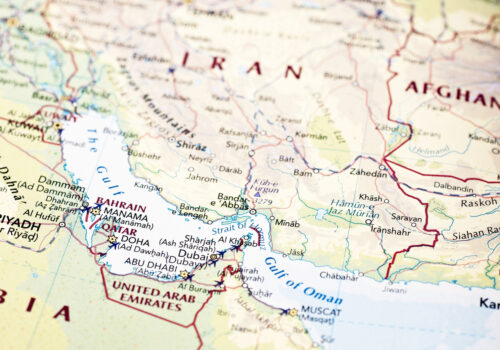
By threatening the Strait of Hormuz, Iran turns geography into a global economic weapon

By Alex Mills

Iran’s threat to attack vessels in the Strait of Hormuz has effectively shut down one of the world’s most critical energy shipping routes, turning geography into a powerful economic weapon.

Economy & Business Energy & Environment

Econographics

Mar 10, 2026

The renminbi is winning over Africa—but can it rival the dollar?

By Lize de Kruijf

In recent years, African governments have taken steps to reduce reliance on the dollar, but progress on their regional payment system has been slow—and in the meantime, China’s renminbi is quietly making inroads across Africa’s trade and finance networks.

Africa China

Econographics

Mar 9, 2026

Middle powers are rewriting the playbook for gender‑equal growth

By Nicole Goldin

Middle powers are advancing gender-equal growth by pairing domestic economic reforms with coalition leadership in global institutions.

Economy & Business Inclusive Growth

Econographics

Feb 25, 2026

The US and Mexico need stronger financial cooperation to disrupt illicit financial flows

By Phil Lovegren

Killing cartel leaders grabs headlines, but lasting progress in curbing the illicit drug trade requires following the money. If the United States and Mexico truly want to tackle organized crime, they must deepen cooperation to disrupt the financial flows that sustain it.

Economy & Business Financial Crimes & Illicit Trade

Econographics

Feb 24, 2026

In Munich, a reminder that economic security is national security

By Kimberly Donovan, Lize de Kruijf

Policymakers at this year's MSC raised economic security as an issue that they cannot cordon off separately from traditional security issues.

Economy & Business European Union

Econographics

Feb 24, 2026

The European Central Bank’s next president may decide the fate of the digital euro

By Alisha Chhangani, Jacopo Pastorelli

The four frontrunners don't oppose the digital euro, but their positions differ on pace, framing, and the risks they're most concerned about.

Digital Currencies Economy & Business

Econographics

Feb 20, 2026

To bridge the transatlantic productivity divide, Europe needs structural reforms—and AI

By Hung Tran

Policymakers and investors should actively incentivize laggard firms to adopt productivity-enhancing practices and technologies.

Economy & Business Europe & Eurasia

Econographics

Feb 12, 2026

Despite US exemptions, the show goes on for a global minimum corporate tax

By Jeff Goldstein

The United States may have carved out protections for its multinationals, but the global minimum tax continues to move forward. With more than sixty-five countries implementing the OECD framework, policymakers are betting imperfect progress will prevent a relapse into corporate tax competition.

Economy & Business Europe & Eurasia

Econographics

Feb 10, 2026

China’s warning on US Treasuries—and why its timing matters

By Jeremy Mark, Josh Lipsky

Beijing has joined the conversation on the dollar. It was leaked this week that Chinese regulators have been urging domestic financial institutions to cut back on US Treasuries, and this timing is no coincidence.

China Dollar Dominance

Econographics

Feb 6, 2026

Iran can still normalize its economy—but the path will be painful and slow

By Bart Piasecki

Iran’s inflation crisis is driven by persistent exchange‑rate instability, entrenched fiscal dominance, and international sanctions. Despite these structural challenges, there remains a clear—but difficult—path toward economic normalization.

Dollar Dominance Economy & Business

Content

EconoGraphics

Jun 29, 2016

Econographics – TTIP

By Nathaniel Rome

The United Kingdom’s (UK) vote last week to leave the European Union (EU) has raised questions about the future of the Transatlantic Trade and Investment Partnership (TTIP). TTIP is a trade agreement currently being negotiated by the United States (US) and the EU that will eliminate tariffs, reduce red tape, and set a new standard for international trade agreements. Following the Brexit vote, US Trade Representative Michael Froman and European Commissioner for Trade Cecilia Malmström released statements reaffirming their commitment to TTIP.

Economy & Business European Union

Bremain vs Brexit

Jun 21, 2016

London Riches Falling Down

By Nathaniel Rome

London is the undisputed financial capital of Europe, and is rivaled only by New York City for the top spot worldwide (Global Financial Centers Index). When competing on a level playing field, London outperforms other major European financial centers because of the superior human capital, infrastructure, and regulatory environment of the city. London dominates 78 percent of European FOREX trading and generates a trade surplus worth tens of billions of pounds (UK Office of National Statistics).

Economy & Business European Union

Bremain vs Brexit

Jun 9, 2016

Britannia, Rule the Trade!

By Nathaniel Rome & TK Spandhla

The decades following World War II experienced an explosion of global trade. The annual growth rate of global exports averaged 8 percent in the 1950s, 9 percent in the 1960s, and 20 percent in the 1970s (World Trade Organization). During this boom of global trade, the volume of UK exports grew in absolute terms. However, up until the mid-1970s, the UK trade growth lagged behind the global average.

Economy & Business European Union

EconoGraphics

Jun 1, 2016

Not The Time to Falter: Economic Sanctions Against Russia

By Alvaro Morales Salto Weis

As the European Union (EU) prepares to unanimously extend its economic sanctions on Russia when they expire on July, it is a good opportunity to take a closer look. After Russia´s illegal annexation of Crimea and interference in Eastern Ukraine, the U.S. and the EU enacted economic sanctions in a coordinated manner, which were followed by other Allies and partners like Canada and Australia.

Economy & Business Europe & Eurasia

EconoGraphics

Apr 13, 2016

Europe’s Path to Budget Equilibrium

By Alvaro Morales Salto Weis & TK Spandhla

The European Union’s 28 member nations are required by Stability and Growth Pact to keep their budget deficits to within 3 percent of GDP. According to the European Commission forecast (as of winter 2016) six countries will exceed this level in 2016: the U.K., France, Spain, Greece, Croatia and Portugal. Romania will post a deficit at the threshold. This is an improvement from 2009 and 2010, when no fewer than 22 EU countries overstepped the deficit limit.

Economy & Business European Union

EconoGraphics

Apr 1, 2016

The European Refugee Surge: Transforming Challenges into Opportunities

By Alvaro Morales Salto Weis & TK Spandhla

Asylum applications to the European Union (EU) set an all-time record in 2015, more than doubling the 2014 figure, according to EUROSTAT. After the recent agreement between Turkey and the EU, the influx of refugees is expected to decrease significantly.

Afghanistan Europe & Eurasia

Bremain vs Brexit

Mar 24, 2016

A Costly Goodbye

By Alvaro Morales Salto Weis & TK Spandhla

On June 23, British citizens will decide on a referendum whether the UK stays or leaves the EU. The consequences of a vote to leave, or Brexit, could decide the UK’s place in the world for generations.

Economy & Business European Union

EconoGraphics

Mar 24, 2016

The French Way of Reforms

By Alvaro Morales Salto Weis & TK Spandhla

France’s economy has struggled to grow in recent years, expanding by a mere 1.1% in 2015. Meanwhile its unemployment rate has stubbornly lingered around 10%, with a slight upwards trend.

Economy & Business Fiscal and Structural Reform

EconoGraphics

Mar 14, 2016

A Tale of Two QE’s

By Alvaro Morales Salto Weis & TK Spandhla

On March 10, the European Central Bank (ECB) announced an expansion of its Quantitative Easing Program (QE), increasing the amount of government bonds it buys monthly from €60 billion to €80 billion. It also extended the range of assets it purchases to include investment grade non-bank corporate bonds. On top of that, the ECB lowered already negative deposit interest rates further down, to -0.4%, and its main interest rate to 0%. So, why have Central Banks embraced QE?

Economy & Business European Union

EconoGraphics

Mar 4, 2016

TTIP: Window of Opportunity is Closing

By Alvaro Morales Salto Weis & TK Spandhla

The 12th round of negotiations for the Transatlantic Trade and Investment Partnership (TTIP) concluded last week in Brussels on an optimistic tone. The Chief Negotiator for the EU announced significant advances in most negotiating areas, including on the Investor-State-Dispute Settlement (ISD), which had been frozen for months. His US counterpart expressed confidence in reaching an ambitious deal in the second half of the year, rejecting calls for a “TTIP lite”.

Economy & Business European Union