Content

Report

Feb 8, 2022

Global Strategy 2022: Thwarting Kremlin aggression today for constructive relations tomorrow

By John E. Herbst, Anders Åslund, David J. Kramer, Alexander Vershbow, and Brian Whitmore

How can the United States and its partners counter the Kremlin’s aggressive policies abroad while laying the groundwork for what could one day be a mutually beneficial relationship with a Russia that respects the rule of law and international norms?

Disinformation
Eastern Europe
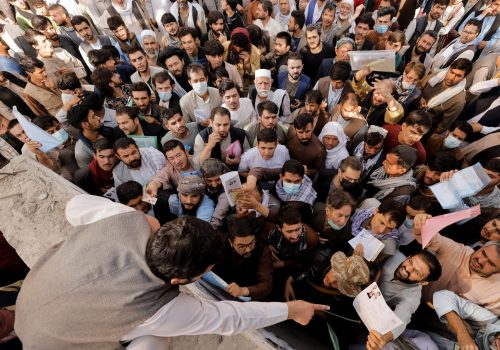
The effective employment of biometric data at US entry points has the potential to cut down on travel times and enhance border security.

Issue Brief

Jan 31, 2022

Biometrics at the border: Balancing security, convenience, and civil liberties

By Seth Stodder, Thomas S. Warrick

Forward Defense nonresident senior fellows Seth Stodder and Tom Warrick consider how US Customs and Border Protection can employ biometrics for safer, more efficient border operations.

Defense Policy
Defense Technologies

Issue Brief

Jan 31, 2022

What do we know about cyber operations during militarized crises?

By Michael Fischerkeller

This essay focuses on how cyber operations employed during militarized crises are likely to impact escalation management. Cyber operations intended as offramps in a crisis could have an outcome opposite than that intended. Given the absence of direct experience, policymakers must critically examine assumptions and claims that cyber operations can serve as de-escalatory crisis offramps.

Cybersecurity

Issue Brief

Jan 31, 2022

China Pathfinder: Q4 2021 Update

By GeoEconomics Center and Rhodium Group

Over the past ten months, teams from the Atlantic Council and Rhodium Group have taken a dive into China’s economy to address a fundamental question: Is China becoming more or less like other open-market economies? 

China
Fiscal and Structural Reform

Report

Jan 25, 2022

Cybersecurity for innovative small and medium enterprises and academia

By Franklin D. Kramer, Melanie J. Teplinsky, and Robert J. Butler

Innovation is fundamental to United States global leadership, critical both for the economy and for national security. Yet the resilience of the US innovation ecosystem against adversary cyber espionage and attack—most specifically from China—has not received the attention required, particularly given the essential innovation roles played by small and medium-sized enterprises (SMEs) and by academia.

China
Cybersecurity

Global Energy Agenda

Jan 19, 2022

The 2022 Global Energy Agenda

By Randolph Bell, Jennifer T. Gordon, Ameya Hadap, and Paul Kielstra (Editors)

The second edition of the Global Energy Agenda provides context for the year that has passed. It features a survey of thought leaders in the energy sector, as well as a series of essays by the leading figures in energy, to set the energy agenda for 2022.

Energy & Environment
Geopolitics & Energy Security

Report

Jan 13, 2022

Iranians on #SocialMedia

By Holly Dagres

This report by the Future of Iran Initiative and Digital Forensic Research Lab (DFRLab) explores the social media habits of Iranian netizens and how the Islamic Republic is repressing the online space.

Financial Sanctions and Economic Coercion
Human Rights

Report

Jan 4, 2022

After the insurrection: How domestic extremists adapted and evolved after the January 6 US Capitol attack

By Jared Holt

This report by the Digital Forensic Research Lab (DFRLab) provides an overview and analysis of the shifts observed in domestic extremist movements since the 2021 Capitol attack.

Elections
Rule of Law

Issue briefs and reports

Jan 4, 2022

Experts react to the year since January 6

By Digital Forensic Research Lab

Domestic extremism experts weigh in on the year since the January 6 attack and their perspectives on continuing threats to US democracy.

Elections
Media

Report

Dec 23, 2021

Proactively countering North Korea’s advancing nuclear threat

By Markus Garlauskas

Markus Garlauskas suggests a strategy to counter North Korean nuclear weapons by impeding the growth of its arsenal, investing to stay ahead of new nuclear threats, and adjusting operations on the Korean Peninsula.

Defense Policy
Defense Technologies