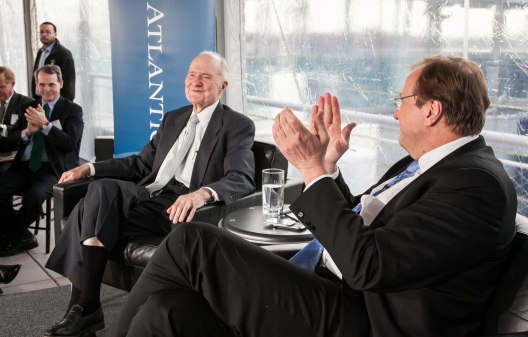
 Luncheon Keynote
Conversation with Lieutenant General Brent Scowcroft, former National Security Advisor to Presidents Gerald Ford and George H.W. Bush
Moderated by Frederick Kempe, President and CEO, Atlantic Council
The conversation with Lieutenant General Scowcroft focused on the core idea underlying the Global Trends 2030 report, the issue of whether or not the world is at another “tipping point.”
Related ContentExplore the other panels from the Global Trends Conference Read the National Intelligence Council’s Global Trends 2030: Alternative Worlds report Read the Atlantic Council’s Envisioning 2030: US Strategy for a Post-Western World report |
Lt. Gen. Scowcroft argued that indeed the world is at a tipping point but of a different kind, a “quiet assault on the Westphalian state system.” As globalization erodes borders of nation-states in ways that industrialization did not, the information revolution has politicized mass amounts of people and undermined forces of stability and continuity. Lt. Gen. Scowcroft emphasized that the transatlantic community, with its common idea regarding the relationship between individuals, society, and the state, is the foundation and sustainer of the current international order. He added that the bulk of the world’s people may not share the same notion of societal organization and values, which makes the unity of the West “vitally important” in tackling new challenges arising from the empowerment of non-state actors. Other parts of the conversation focused on the US-China relationship, China’s place in the Westphalian system, and the nuclear threat to global security.
Transcript
| Transcript by Federal News Service Washington, D.C. |
FREDERICK KEMPE: You know, I’m delighted – I’m just delighted that you all are having such lively conversations at your tables. Good afternoon. We have just a terrific opportunity to engage in conversation – and this will be conversation, not speeches – to engage in conversation with one of America’s, and I would say one of the world’s foremost strategic thinkers.
In fact, as we were establishing the Brent Scowcroft Center on International Security at the Atlantic Council this year, an enlargement and deepening of the international security program, and it is the strategic foresight initiative of that center that is overseeing this entire enterprise here at the Newseum with the National Intelligence Council, in one of my conversations we were talking about the purpose of the Atlantic Council. And I said words to the effect that I thought we were really becoming a very fine policy shop.
And General Scowcroft actually said, well, you know, what I really hope the Scowcroft Center will become is a place that does strategy, not to the exclusion of policy but as a starting point for policy. And that’s really what the NIC’s report is all about. It’s what our accompanying report is all about. And it’s what this conference is all about, where we’ve had the privilege of hearing from some of the world’s leading minds on urbanization, future of warfare, individual empowerment, technological change, a lot of issues that wouldn’t have typically been thought of in the realm of grand strategy a couple of decades ago.
But if we’re – but if we’re able to put all of these pieces together and put them in a broader perspective, it’s really with someone like you, General Scowcroft, and in this kind of session. I think that’s what we’ll try to do. General Scowcroft is the only person in American history to serve as U.S. national security advisor to two different presidents – Gerald Ford and George H.W. Bush. I usually save this next line only if Henry Kissinger is in the audience. (Laughter).
And I say – but he was actually national security advisor three times because he was the deputy national security advisor to Henry Kissinger when Henry Kissinger was secretary of State and national security advisor, to which Henry Kissinger answers something to the effect, well, I could handle both jobs just fine. (Laughter.) But at any rate, so I had to add Dr. Kissinger’s laugh lines here.
During his career, and not just – throughout his career, not just at the National Security Council, even at earlier stages in his career in the military and the Air Force, General Scowcroft has worked on strategic and long-term planning issues. And you know very well how difficult it is for governments to incorporate the kind of things we’re talking about these days into the policy process. You were one of the best at the National Security Council to do that.
What makes our conversation unique today also is in some ways the context the NIC has set for us. By saying in its report that this period of time is reminiscent to 1815, 1918, 1945, 1989, it in a way tees you up because you were one of the most important players in the George H.W. Bush White House when you were confronted with that last great transitional point in history, the most recent of them.
It’s easy to look back on that era and assume that it would all turn out exactly as it did. But of course, we didn’t know that then. The decisions took tremendous foresight, courage, political will, humility and I’ll understand that – underline that two or three times – humility, knowledge of our resources, knowledge of the strategic context and wisdom.
During that period of time, General Scowcroft acted on the importance and moment in history. The Bush administration engaged and led its most important allies while forging a new relationship with a transforming Soviet Union. It began to transform the NATO alliance for a post-Cold War era, peacefully ended a dangerous division of Germany and anchored it into the Western alliance, by no means a sure thing at that time, established an unprecedented coalition with the U.N. Security Council resolution to evict Saddam Hussein from Kuwait. So those were some pretty interesting times.
So let me just tee up a first question, and that is, do you agree with the NIC’s statement that this is reminiscent of those grand transitional points in history. And having been in the White House at one of those points, what should President Obama and his administration be doing about it?
BRENT SCOWCROFT: Well, my answer is yes and no. But let me first say I understand why the world’s in such a mess now if I’m one of its great strategic thinkers. (Laughter.) But I think whether the world is at another of those tipping points, the answer is yes. But to me, it’s a very different kind of a tipping point because the other ones were consequential to events that took place in a very limited period.
And the last one – the end of the Cold War, for example, was a dramatic change in the whole makeup of the world. And one of the primary changes was during the Cold War our strategy was a given. We didn’t argue the strategy. It was containment, put our arms around the Soviet Union until it changed its ways. We argued about tactics a lot back and forth, the role of nuclear weapons, all these things. But the strategy was a given. Now, all of a sudden the Cold War ends. The strategy has disappeared. And the world is very different. And we have no strategy. It’s not given. So you act one way here and one way there. What is the unifying symbol for the way you act?
And that’s missing right now. But I think we are facing another seminal change. But to me, it’s of a very different character. And the change is, in a way, a quiet assault on the Westphalian nation-state system. That has been for 500 years the be-all, the end-all. The nation-state was a completely independent sovereign entity owing no allegiance to anybody else, controlling its own people. And that was pretty much through the world except for – except for China basically. India and Japan both were incorporated one way or another in that.
And now, I think the tipping point, if that’s what it is, is of a different nature. And it is the inroads of what we call globalization on that. A globalization is behaving in the absolute opposite way for industrialization. Industrialization made the – made the nation-state strong and powerful and able to be independent. You had to have a strong state to organize all of the instruments of industry. But now, globalization is working to erode the borders of the nation-state, not to make it stronger. More and more of the things that states need for their own welfare, they can’t get by themselves but only by reaching out in cooperation.
Climate change is one of the most obvious. We can decide climate change is the most important thing in the world and we need to have a carbon-free world. If we do it by ourselves, it has no impact – health care and so on. But for our purposes here, information technology, I think, is the most important of these undermining the notion of the nation-state system. And to me, one of the best examples of that is the Arab awakening, Arab Spring, whatever you want to call it, when the self-immolation of a poor fruit peddler in Tunis started this explosion.
Now, why? One of the reasons is Twitter, Facebook and so on. It’s easy to organize. It used to be, you know, to organize a demonstration in Tahrir Square took a lot of work and it was hazardous because the police were watching and so on and so forth. Now, you just push – turn out at the square at 10 o’clock tomorrow morning and you get a million people out there. This is a different kind of world. And what the information revolution has done is politicized the world’s people. For most of mankind, the bulk of people lived just like their parents lived. They expect their children would live just the way they lived. There was a kind of an inexorable order of things. That was the way the world was.
Now, they look at their – look at their cellphones, they look at their TV and they say, hey, that’s not the way they live, why do I have to be? And I think that is undermining the whole structure of the Westphalian state system. And right now, we’re in this uneasy coexistence. And I don’t know how it’s going to end up. But it’s a different kind of an inflection point than 1815, 1945 or 1990, all of them occasioned by sharp changes in the political environment.
MR. KEMPE: Although if you look at the 1815 Concert of Nations, maybe we’re talking about the concert of new networks and non-state actors and everybody else.
MR. SCOWCROFT: We tried.
MR. KEMPE: Well, here’s a question for you. So if we’re heading – I mean, maybe the title of the Atlantic Council’s accompanying report, then, shouldn’t have been “U.S. Leadership in a Post-Western World,” but more “U.S. Leadership in a Post-Westphalian World.” If you agree with that, then what is – what is your job in the White House in this kind of world? How does this – how does this dictate how you exert influence and power?
MR. SCOWCROFT: I still think that the Atlantic Council, that NATO, that the West has a role to play. The world is changing dramatically. But the Atlantic community is a group that has a common idea about man and his relationship to society and to the state. And the bulk of the world’s people don’t have that concept that we have. And therefore I think that the West, the unity of the West, the Atlantic Council, what it’s trying to do is still vitally important.
MR. KEMPE: Just one more follow-up on that. One of the key megatrends – in fact, the megatrend that was cited as most important in “Global Trends 2030” was individual empowerment. You’ve now talked about it transforming politics, politicizing the individual. But you also just talked about how this idea of man’s relationship is – you know, is an Atlantic value, not the majority value.
Does this individual empowerment and particularly what is predicted in the report as a doubling of the global middle class from 1 billion to 2 billion people by conservative estimates through 2030, 3 billion by other estimates, how does that change the picture for the U.S.? Does that mean we’re going to have a bunch of middle classes all over the world that want to embrace what we would term as Western values?
MR. SCOWCROFT: No, I – individual empowerment is not the term I would use. I don’t – I’m not sure what I would use. But what’s happening is that the unit in the world – the nation-state is no longer an applicable description of what’s happening because individuals without allegiance to any particular state or flag, wearing any uniform and so on are acting on the scene. We — the United States, we declared a war on terrorism. How do you declare a war on a method for killing people, you know?
Does that mean this guy out here, he’s a bad guy, it’s all right to go after him, even though he doesn’t wear the uniform? It’s one thing to declare war on Ethiopia and therefore any Ethiopian is subject to the laws of war. How do you declare war on terrorism? And we haven’t fit that in. Why do we have Guantanamo Bay? It’s probably the only place in the world that has no jurisdiction. It belongs to Cuba, it was leased by the United States and the lease has run out. (Laughter.) So we can put people there. There’s no law that goes into there.
And that’s a good description of this mixture of worlds we have. We live this – the Westphalian system is a very rigid, very pure system. And it went amok in the 20th century. There’s no question about it. It became a zero-sum game. But it’s now being eaten away, and we don’t know how to deal with the al-Qaidas and so on. Al-Qaida is probably maybe a little different from when Osama was running it but not much. It doesn’t depend on leadership. It doesn’t depend on uniform or flags. It’s emotion of one kind.
And we have almost no idea why or what it means to get young people to strap explosives around their waist and blow themselves up. You know, that’s contrary to one of the basic instincts of mankind which is self-preservation. What makes people do it? What kind of force is this? You know, it used to be patriotism. You go out and die for your country. But this is what this inflection point is. But it’s a very different kind of inflection point, I think, than the end of the Cold War, although we couldn’t figure out what was coming next there either. (Laughter.)
MR. KEMPE: And that is the point of those inflection points, that human agency made a lot of the difference between a happy – a relatively happy outcome at the end of 1945, 1989, less so at the end of 1918. But my last question – and then let me go out to the audience – is an area where you’re quite expert which is the U.S.-China relationship. Put that in the context of the world you’re talking about. How do Chinese leaders look at it?
And if you’re looking at one of the things that will be most tricky during this period of time is how do we manage the relationship between the U.S. and China, looking at what’s going on in the South China Sea, looking at potential, you know, tensions elsewhere – the East China Sea with Japan. How does – how do the Chinese see this new world? How should they respond? And then, what should the Obama administration be doing during its second term, this next four years, to get us in the right place with China?
MR. SCOWCROFT: Well, as I said, China is probably – it’s the only major state that really wasn’t much of a participant in the Westphalian system. Indeed, for China, Westphalia is the time the West raped China in the last 150 years. So they don’t have instinctively that sense for the Chinese, as Henry did in his thin volume on China. (Laughter.) But one of the things he really lays out is for the Chinese it’s different. If you’re not Chinese, you can’t become Chinese. And rather than the Westphalian system, there is China and there’s everybody else.
That instinctively gives you a different kind of a background through which you filter events. And I think that we have to recognize that for China. And it’s not clear the extent to which they recognize or accept it for themselves. But we talked about China being a responsible stakeholder. Well, stakeholder in a system that for the Chinese – they didn’t have anything to do with it. They don’t have any necessary stakes in this. They’re a victim of the system rather than a responsible stakeholder in it.
So we have to look at things a little – a little differently. And I think China is growing rapidly and it’s developing economically in a phenomenal fashion. You know, Deng Xiaoping when he finally emerged and saw the damage that Mao had done to the state – Mao believed in revolution every eight years because as soon as you became a bureaucracy you got ingrained and you had to be overthrown. Keep the revolution going, which was not very good for China.
Deng decided that communism wasn’t going to work and that the way that the system – communist, what you call it – could perpetuate itself is to increase the standard of living a little bit steadily in China. So he said: I don’t care whether a cat is black or white, as long as it catches mice. To get rich is glorious and so on. So he overturned the economic system. And they built this tremendous economic powerhouse. But there was no accompanying political evolution to manage it.
And now, they’re having problems. They’re having problems with the environment. They’re having problems with corruption. I think in a way a lot of the leadership knows that the system has outgrown the leadership. But they don’t know what to do about it. And by in large, my sense about the Chinese, they’re very worried about instability. Instability they think historically has been the nightmare of China. So they look around and they don’t see what can maintain the stability other than the current system.
MR. KEMPE: But that’s going to be their challenge between now and 2030.
MR. SCOWCROFT: It’s going to be a huge problem – challenge. And they have taken now to keep pace with the rest of the world state-owned industries. These are powerful corporations who have single purposes and a lot of money. And they use both. And the system doesn’t really know how to fit them in to a political structure which is not based on state-owned industries but the Communist Party apparatus. So they’ve got huge problems. And I think we have to be extraordinarily tolerant. I’d say more tolerant than the Chinese because they’ve got huge problems they have to deal with.
And hopefully, I think we can work our way through this together. As I look around the world at the major issues facing the world, I don’t see any big issues where we and the Chinese are unalterably, philosophically at odds. We disagree about a lot of things but not fundamentally. This is not a Nazi Germany. This is not a Stalinist Soviet Union. And therefore, we ought to be able to accommodate and it will take some far-sighted diplomacy but I think we can do it.
MR. KEMPE: Thank you, General. Questions? Please, Harlan?
Q: I’m Harlan Ullman. Brent, thanks again for a marvelous discussion. In context to my question, I would argue the date that should suit us today is July 1914 in slow motion. But your comments about the absence of a strategy I think hit home in the sense that I believe – and I agree with you – the Atlantic alliance is critical. We have failed to understand the strategic significance.
If the euro undoes part of the EU, it seems to me strategically we’re going to be in very, very deep trouble. And perhaps not sending Tim Geithner over to be our messenger but somebody more senior would be a good idea. In the last year of the Nixon administration, as you recall, 1974 was to be the year of Europe. If we were to recreate that today and make Europe a central strategic priority, how would you suggest the White House might go about doing that?
MR. SCOWCROFT: Another simple question, Harlan. Thank you. Let me go back to 1914. You know, that was interesting because in the beginning of the 20th century, there was a lot of talk that war was old history. We were too smart now. We understood what the world was like. There aren’t going to be any more wars. This was 1910.
It shows how hard it is. I think Europe’s borning (ph) has been very complicated. And it hasn’t been a smooth path. We have – we have pushed – we, the United States, have pushed European unification except for a period when France and Germany were working closely together and we suspected the French were doing it to kick us out of Europe rather than unification of Europe. So it’s been – it’s been in and out.
And I think Europe for its own reasons has done the easy part – currency unification, not fiscal unification, just monetary unification, doing the easy part. Now, that’s come – (inaudible) – and they’re in agony and I think that Germany, which was the pivot here, finally decided that Europe was important enough to be saved and they backed away from traditional German economics. But it’s slow and it’s painful. And now, Europe has to take many of the steps that it hasn’t taken before because it was just too hard and didn’t have to. You could go through with this surface. Can we – can we all make it work? I don’t know.
But that’s why I’m so proud at what the Atlantic Council is trying to do now because it is – it is an attempt, to me, to get us through a period when we’re all looking at different ways. I said, you know, that the nation-state system is in trouble now. But where’s the international system? The U.N. was built for a country – for a world that’s just disappeared. But it’s the only thing we have.
Now, how do we build a structure that allows us to somehow accept the change in the nation-state system but have a production change, not simply a collapse into chaos? That’s our challenge and it’s a huge challenge. But I think the extent to which we and the Europeans can resolve it in a useful way will be a good part of the determinant of whether we’re successful or whether this is going to be a really messy century.
MR. KEMPE: Thank you. You’re absolutely right. This is exactly what the Atlantic Council is aimed at which is how do you actually leverage, save, reinvigorate the trans-Atlantic alliance and make it adjust to this world that we’re talking about. And if we do do it, the world has a better chance of turning out well, something closer to fusion in the NIC report. And if we don’t do it, then I think we get closer to stalled engines. So please?
Q: Hello, sir. I’m John Handlich (ph). I have a question about really the outsourcing of defense both to intelligence and the private sector. Over the last decade in pursuing counterterrorism we’ve become exceptionally good at identifying persons of interest and tracking small groups and individuals and man-hunting. And as we look ahead at “Global Trends 2030” and the increasing power of individuals and also we heard about cyber on one end and individuals on the other, whether they be terrorists, transnational criminal organizations, lone wolves or just people who can affect political change in profound ways, trying to understand those.
Hand in hand with that has been the increasing role of intelligence in security operations. Whether now we can talk about drone operations fairly openly. Whether when we look at the National Security Agency, the director is also the commander of Cyber Command and you cannot do, let me say, the title 10 functions of cyber defense without having that close connection with the title 50 sections of cyber defense. So what I see is trends that are inevitably pulling defense and security into the intelligence operations, turning to the intelligence community actually to conduct the operations, particularly as we’re trying to soften our footprint – our military footprint in various problematic areas.
The second side of that is the privatization of security with the Blackwaters and Triple Canopies and then in maritime security just to deal with piracy, the tremendous explosion of private maritime security organizations and the setting up of arsenal ships in the Gulf and off Sri Lanka and whatnot where commercial ships can come and arm up and then toss the arms overboard or whatever they need to do later. But it’s all activities that are completely outside our traditional defense and military organizations. And as I look at these trends to the future, I just see nothing to slow that down but everything to accelerate it. If you have any comments, sir?
MR. KEMPE: Interesting questions.
MR. SCOWCROFT: Yeah, well, interesting couple of questions to answer. The second part first, about private armies and contractors and so on. I think that happened along with fighting wars off-budget. It was a gimmick because accounting purposes lets you spend money over there what the Congress wouldn’t give you to spend on your own forces. And I think we’re paying a heavy price for that. The more fundamental question, though, when you talk about drones and things, there are two aspects to that.
One is that we have now, again, partly because we analogize with warfare, have become, you know, policemen, judge, jury and executioner on the flimsiest kind of grounds. And this is happening. We go out and we target leaders and so on. This is happening at a time when life is probably less valuable per se for those groups than it’s ever been. And the notion, A, that we think that’s the most effective way to do it to me is questionable.
But the other aspect is you talk about the military and organized armed forces being drawn into the intelligence, I think it’s the other way around. And that’s what worries me, that intelligence is becoming operational and less and less is the focus on finding out what is going on in the world and reducing the uncertainties in the mind of the decision-makers rather than finding this guy or that guy or the other guy in an operation which to me denigrates from the real value of the intelligence community. So I think it’s a dangerous course that we’re pursuing. And I think we ought to look at it very, very seriously.
MR. KEMPE: Thank you. We’re down to the last five minutes. I’m just going to take a question here and a question – oh, now I see five, six questions. I’m going to have to take people as I saw them. So a question here, question there, if you can leave them – leave these to all 30-second questions, right, and then we can do one more. But 30 seconds, please.
Q: Sure, Andrew Patterson (sp) –
MR. KEMPE: Then we’ll wrap them up and you can close.
Q: Dr. Scowcroft, if you can add to your list of factors eroding the nation-state, the financial crisis, if Nick Brady had come to President Bush, Sr., asking for an $800 billion bailout, would you advise that we just offer the bailout and follow the Wall Street into the maw of day trading or do we use it as an opportunity to reassert the sovereignty of the nation-state.
MR. SCOWCROFT: I don’t do economics. (Laughter, applause.) Yeah, no, I don’t –
Q: It threatens sovereignty!
MR. SCOWCROFT: No, I don’t think you can stovepipe it. And I don’t think, with all respect to the commander-in-chief at that time, George Herbert Walker Bush, realized that a political statement which he had hung so much was not in the best interest of the country and he abandoned it: read my lips, no new taxes. In the interest of the country, he agreed to new taxes and probably – maybe it cost him his reelection. But that’s — that’s an issue of judgment, not a particular focus on economics.
MR. KEMPE: Please.
Q: Hello. Sean Kanuck with the National Intelligence Council. This continues on the Westphalian and sovereignty theme. I would welcome any further thoughts you may be willing to share regarding the fact that many nation-states now seem to prefer pursuing foreign policy objectives through clandestine cyber means rather than through overt military or diplomatic efforts. And what does that mean for legitimacy and/or sovereignty going forward? Thank you.
MR. KEMPE: And in the interest of time, I’m really sorry, there are a bunch of people who’ve wanted to ask questions and we didn’t get to you. I would pile onto this there’s been a lot of talk today about whether cyber’s the next area where we need a set of arms control negotiations, set of rules, you know, that this is – this is maybe the new arms control talks for this new world that we’re talking about. But let me pile that on to this question.
MR. SCOWCROFT: Yeah, well, that’s hard to talk about in two minutes. But I think cyber has arisen as not only one of the most vexatious problems we have but one of the most fundamental since the development of nuclear weapons. It really has the ability to destroy modern civilization, not by blowing it up but by destroying the whole records system. And therefore I think we need to look at it.
We need to take ourselves back into the 1970s and when we were finally realizing that nuclear weapons were not just weapons. They had the capability of destroying the world. And we were building them, the Russians were building them and there was an arms race. We didn’t know what to do about it. And this was a time when our distrust, dislike, opposition to the Soviet Union was at an all-time high. But we sat down with them. And we said, look, you know, this is really too dangerous. Can’t we develop some kind of rules, something here to mitigate it? And we’re still working on it.
But it’s far different than it was in the 1970s. I think we really need to do that in cyber. We need to sit down with the Russians, with our European friends, with the Chinese. And is cyber more complicated? Yeah, but in those days, nuclear weapons were very complicated too. And just see if there are not some kinds of things we can do to avoid this, well, we’re worried about defending cyber but boy we’re not going to give up any offense because it’s really important for us. I think it’s time for a look. I don’t know what the answer is. But it’s time for us to look very seriously in that direction.
MR. KEMPE: And I think it’s time for us at the Atlantic Council to take that on as well.
MR. SCOWCROFT: Yeah.
MR. KEMPE: And we’ve got a great cybersecurity initiative in the Brent Scowcroft Center run by Jay Healey that’s – that is called cyber statecraft and not cybersecurity because we know that’s where things are going. You have to get this into statecraft. Let me – you know, before you all continue your forced march to the second half of this afternoon, I think 2:30, is that right – right over here we’ll pick up again.
I just want to thank every – have everyone in the audience – or thank you on behalf of everyone in the audience and say a couple of things. First of all, this organization, I don’t think it goes too far to say, exists today because of you. And I think we all owe you a great thanks, that at the end of the Cold War you stepped in and you did so much to really recognize the importance of the Atlantic Council and the potential of it.
The other thing is you said you were proud to be associated with us. I can’t tell you how proud we are that you’ve entrusted the Atlantic Council with your name and the launch this year of the Brent Scowcroft Center on International Security. So on behalf of everyone, thank you not just for now, thank you not just for the past in helping the Atlantic Council, thank you not just for the Brent Scowcroft Center on International Security, but everything you’ve done for the council and for the country. (Applause.)
MR. SCOWCROFT: I thank you all for everything. Thank you. Thank you. Thank you. (Applause.)
(END)