
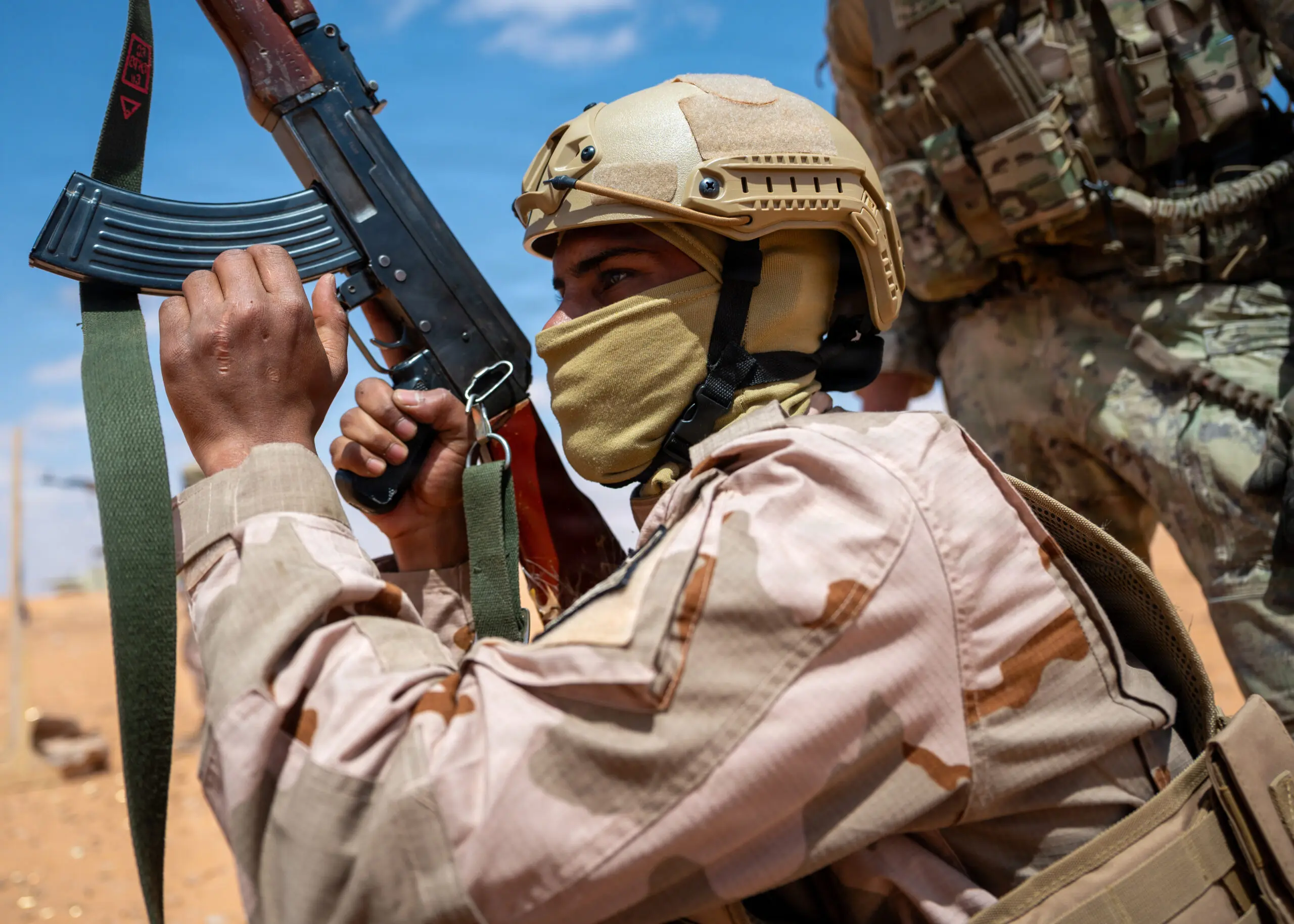
SIRTE, Libya—The troops moved through a rehearsal for hostage rescue and direct action against terrorist targets with the kind of discipline that comes only from serious training. What made the scene remarkable was not the tactics alone. It was who was training together.
At Flintlock 2026, US Africa Command’s (USAFRICOM’s) premier special operations exercise, Libyan forces from rival camps that had spent years on opposing sides of a civil war trained in Sirte alongside US and international partners. Libya, Italy, and the United States announced the exercise as part of a broader effort to support the continued development of a unified Libyan military, and AFRICOM described the Libya portion as the first time the country had hosted an operating location with joint forces training alongside one another.
That setting mattered. Sirte was once the Islamic State’s (also known as Daesh’s) most important stronghold outside Iraq and Syria. Seeing Libyans from competing factions train together was a reminder that persistent US engagement can help convert security vacuums into opportunities for stability. It also showed that the United States still has a comparative advantage in Africa when it brings patient diplomacy, professional military partnership, and a realistic understanding of local politics to bear.
I have just returned from a trip to USAFRICOM headquarters and a site visit to Sirte, traveling by military aircraft. What I saw reinforced two conclusions. First, the command’s partner-centric model can produce tangible results. Second, the continent’s security challenges remain a strategic vulnerability for the United States because they have been chronically under-resourced and under-prioritized. Parts of the continent have turned into a terrorist safe haven similar to what al-Qaeda enjoyed in Afghanistan before September 11, 2001.
That vulnerability is visible right now in Mali and neighboring countries in the Sahel. Al-Qaeda-linked fighters from Jama’at Nusrat al-Islam wal-Muslimeen (JNIM) have expanded pressure on Mali’s Russia-backed military junta and carried out attacks that threaten the government’s control and economic lifelines. Western forces have had little operational presence in Mali since France’s 2022 withdrawal, while Russia’s security role has grown. The result is a warning for Washington: when the United States and its partners step back, jihadist groups and adversarial powers fill the space.
The United States has spent more than two decades fighting Islamist terrorism primarily in the Middle East and Central Asia. Africa, however, has not received the attention or resources it demands. The transnational terrorist threat emanating from the continent is no longer peripheral. It is a US problem because African nodes now help finance, coordinate, inspire, and in some cases plot activity far beyond the continent. If Washington is serious about protecting the homeland, competing with Russia and China, securing critical mineral supply chains, and preventing the next major terrorist catastrophe, it must treat Africa with the urgency the facts require. For the first time in nearly a decade, Islamic terrorists are on the verge of recreating a new caliphate sanctuary that could serve as an incubator for attacks against the US homeland and interests abroad.
Partner enablement, capacity building, and the right strategy
USAFRICOM’s military approach is fundamentally sound: work through and with African partners to build local capacity, help them build sustainable capabilities, maintain visibility on emerging threats, and support conditions for legitimate governance and investment. The command does not run trade policy, but security cooperation is an essential enabler of trade. Foreign direct investment, mining projects, energy development, port activity, and election processes all require a minimum level of security. In that sense, counterterrorism and partner-force development are not separate from economic strategy; they create the operating environment in which diplomacy, commerce, and development can succeed.
The problem is not that Washington lacks a strategy. The problem is that execution demands sustained whole-of-government engagement and resources that have not materialized at the scale required. This is especially true across the Sahel and West Africa, even as the Horn of Africa and the Maghreb remain critical theaters.
The Daesh and al-Qaeda threat: Why it reaches the homeland
The most direct homeland concern is not that every African affiliate is preparing a 9/11-style operation. The risk is more complex and more durable. African networks can generate revenue, move funds, train operatives, provide safe havens, coordinate with global terrorist structures, exploit migration and smuggling routes, and inspire attacks by sympathizers abroad. For example, the National Counterterrorism Center states that Daesh-Somalia supports global Daesh activity by raising money, recruiting fighters internationally, and plotting attacks outside Africa.
Somalia illustrates the problem. Senior Daesh figures associated with the Somalia-based al-Karrar office and financing networks have operated from Somalia, which has become an important hub for Daesh activity in Africa. Analysts at West Point’s Combating Terrorism Center have assessed that Daesh-Somalia is far smaller than al-Shabaab inside Somalia but has an outsized role in Daesh’s global network because al-Karrar helps oversee financing for other Daesh affiliates.
The United States has not been passive. AFRICOM has conducted repeated strikes against Daesh-Somalia and al-Shabaab, including a two-week operation in August 2025 against Daesh leadership safe havens in Puntland’s Golis Mountains, additional strikes early this year, and continuing operations coordinated with the Federal Government of Somalia. These strikes matter, especially when they disrupt leadership nodes and external operations facilitators. But strikes alone cannot solve the problem. They must be paired with deeper cooperation with Somali federal authorities, Puntland, Somaliland, and other local partners; better financial disruption; and sustained intelligence coverage.
The financing picture is equally important. Daesh-Somalia and other African affiliates generate revenue through extortion, illicit taxation, kidnapping for ransom, and other criminal enterprises. US Treasury reporting has identified Daesh-Somalia as one of the group’s more successful branches in revenue generation, with millions of dollars raised annually in some recent periods, and has described Somalia-based networks facilitating funds to other African Daesh branches.
Al-Shabaab, al-Qaeda’s strongest affiliate in East Africa, remains a larger and more entrenched local threat than Daesh-Somalia. It has built a sophisticated taxation and extortion apparatus and is estimated by the Africa Center for Strategic Studies to raise roughly $100 million annually. That scale gives the group resilience, operational reach, and the ability to outlast episodic pressure.
The landscape is not a single unified jihadist front. Daesh-Somalia and al-Shabaab are rivals and have fought each other. In the Sahel, Daesh-Sahel Province and JNIM also compete, cooperate tactically at times, exploit separatist and ethnic conflicts, and adapt to local grievances. That nuance matters. A US approach that treats every armed actor as the same will fail. But rivalry among these groups should not obscure the larger trend: jihadist organizations are expanding influence in weakly governed areas, monetizing disorder, and building networks that can threaten US interests directly and indirectly.
Daesh-Sahel Province and JNIM have expanded significantly across Burkina Faso, Mali, and Niger, while pushing pressure southward toward coastal states including Benin, Togo, Côte d’Ivoire, and Ghana. The human toll is already severe. The Global Terrorism Index has found that the Sahel accounts for a majority of global terrorism deaths, underscoring that this is not only a future strategic risk for Washington but a present catastrophe for African populations and governments.
The United States also lost significant access and basing after the coups and subsequent withdrawal from Niger, including Air Base 201 in Agadez. That withdrawal created major intelligence, surveillance, and reconnaissance (ISR) gaps in a region where extremist groups continue to professionalize and expand. It has become a breeding ground and safe haven for terrorism.
Russia and China: Exploiting instability for strategic gain
The threat environment is compounded by great-power competition. Russia’s Africa Corps, the state-integrated successor to the Wagner Group, operates in Mali, Burkina Faso, Niger, and elsewhere, providing security support to juntas while seeking access, influence, and economic concessions. Its model often deepens dependency, fuels anti-Western narratives, and leaves host nations no more secure than before. It is also illustrative of how Russia undermines global security to avoid economic sanctions.
China’s investments across the continent translate into political leverage, especially in infrastructure, mining, and logistics. Africa’s vast mineral potential makes it a critical arena for competition. The continent holds roughly 30 percent of global critical mineral reserves, including resources essential for clean energy, defense, and advanced technology. Yet much of that resource base remains underexplored and underdeveloped. A relationship grounded in transparent trade, mutual respect, and security cooperation is the sustainable path for the United States to diversify supply chains away from adversarial dominance.
The resource imperative: Critical minerals and strategic autonomy
The stakes extend beyond counterterrorism. The United States has repeatedly stated its goal of reducing dependence on China and Russia for critical minerals and rare earth elements. Africa offers a viable alternative if stability can be established. Security is the essential enabler for responsible foreign direct investment. Without it, governance remains fragile, elections become vulnerable, and resource projects either stall or fall into the hands of actors willing to operate in corrupt or coercive environments.
Some of this work is already underway. Project Vault and FORGE point toward a more collaborative US critical minerals strategy that combines public-private financing, stockpiling, and trusted supply-chain partnerships. The State Department has described Project Vault as part of the Export-Import Bank’s critical minerals portfolio, while my Atlantic Council colleagues have noted that Project Vault and FORGE reflect an effort to move from ad hoc transactions toward a broader allied minerals framework. These initiatives are promising, but they will not succeed in fragile regions without security and governance support.
The need for whole-of-government action
The Pentagon is seeking approximately $1.5 trillion in total defense resources for fiscal year 2027, a major proposed increase over prior levels. The public budget materials do not by themselves demonstrate a specific, proportional increase for AFRICOM, which is alarming and must be remedied. Congress will weigh the proposal in the coming months. But the debate over topline spending numbers should not obscure the core point: Africa’s threat environment is underfunded relative to its importance.
Because the United States has fewer bases and less assured access in parts of West Africa, it has limited ability to use short- and medium-range unmanned systems for collection or strikes. Longer-range systems can help close the gap, but many are prioritized for other theaters. Access, basing, and overflight rights do not appear overnight. Congress should therefore fund near-term ISR support while the executive branch rebuilds the diplomatic access required for cheaper, more persistent, and more flexible coverage.
ISR is not only about unilateral US action. It allows the United States to share intelligence with partner governments, improve partner operations, and receive local context that US collection alone cannot provide. Intelligence sharing is a two-way relationship. African partners often know the terrain, tribal dynamics, commercial networks, and local political incentives better than Washington ever will.
A stronger approach must include additional ISR, investment in unmanned systems for collection and, where legally authorized and operationally necessary, strikes. It also requires sustained diplomacy to restore and expand access, special operations advisory efforts that build genuine host-nation capacity, and financial tools that target terrorist revenue. And a new approach must recognize what is already happening. Senior State Department official Nick Checker traveled to Mali, Niger, and Burkina Faso in early 2026 as Washington sought to reset ties with Sahel juntas. The Treasury Department also lifted sanctions on some Malian officials as part of a broader effort to improve relations. These are not substitutes for a strategy, but they show the beginnings of a diplomatic opening that should be integrated with security and economic policy.
The Pentagon cannot solve this alone. Diplomatic initiatives must create political space for partnerships. The lack of Senate-confirmed ambassadors in key countries makes that harder, because ambassadors are essential to negotiating basing, access, overflight, security cooperation, and commercial relationships. Development assistance, reoriented toward trade and capacity building, must reinforce security gains. Treasury must continue attacking terrorist financing. The US Department of Commerce and US State Department should help legitimate investment follow stability.
Time for strategic clarity
Africa does not lack strategies. It lacks the sustained, high-level US commitment necessary to implement them effectively. I saw the potential in Libya: capable US military professionals and international partners helping rival local forces train together in a city once synonymous with Daesh control. I also saw the gaps that threaten the wider continent: intelligence voids, access constraints, weak governance, and adversaries eager to fill every vacuum.
The terrorism threat linked to African networks makes this an American problem that must be addressed with American resources and leadership. The window is narrowing. Expanding jihadist influence in the Sahel, great-power footholds in a resource-rich continent, terrorist financing networks, and threats to critical supply chains are not theoretical future scenarios. They are present-day realities.
The United States has the right framework in USAFRICOM’s partner-centric approach. What it needs now is the political will, budgetary allocation, and interagency coordination to scale that framework to meet the moment. Failure to act decisively will cede strategic ground to adversaries and invite greater threats.
Only this integrated approach can reverse momentum that currently favors terrorists, Russia, and China. US government efforts to date have been insufficient. Cabinet and executive-level intervention is necessary for basing, access, and overflight required to provide the means to achieve US objectives. This cannot be left to senior bureau officials from the State Department and a regional envoy to solve.