
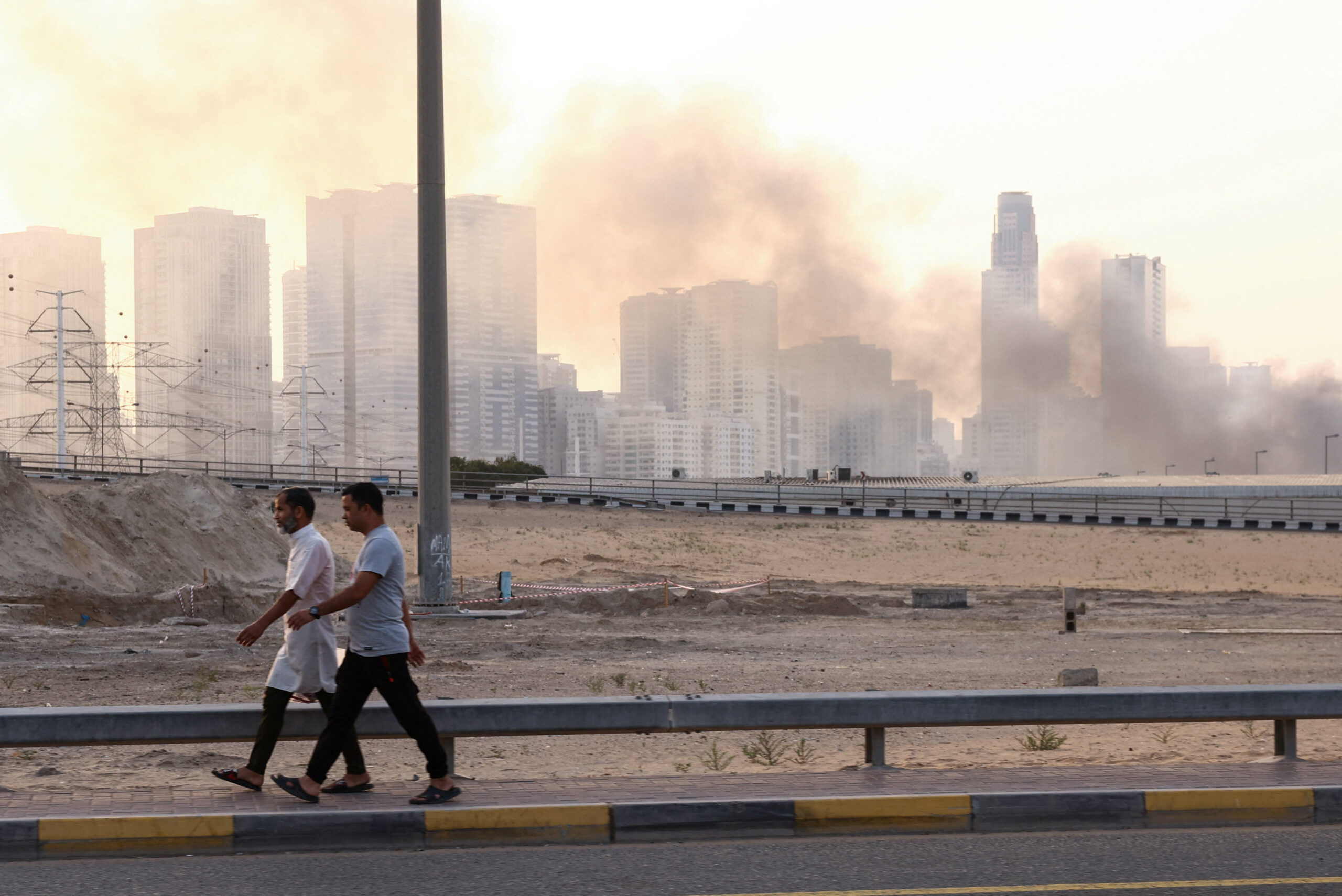
WASHINGTON—The opening days of the latest Iran war shocked the Gulf to its core. Within the first forty-eight hours of the conflict, Iran targeted all the countries in the Gulf Cooperation Council (GCC), from the United Arab Emirates (UAE), which suffered the brunt of hundreds of drones and missiles, to Saudi Arabia, Oman, Qatar, and beyond. Iran did not limit its strikes to US military bases in many of those countries; it also targeted civilian sites, including airports and hotels, followed by major oil and gas infrastructure. Gulf air defenses were largely effective against Iranian missiles, helping prevent catastrophic damage, but Iranian drones proved harder to repel. The casualties and damage from drones to major airports and iconic tourist spots will have lasting consequences on the region’s reputation as a business hub.
In response to Iran’s assault, the GCC states have banded together, demonstrating that even amid a public feud between Riyadh and Abu Dhabi, Gulf solidarity remains strong. Saudi Arabia and the UAE have made it clear that Iranian attacks crossed a red line, and that they reserve the right to respond.
US President Donald Trump told CNN on Monday that the Iranian attacks on the Gulf were “the biggest surprise” of the conflict so far. The Gulf countries, he said, “were going to be very little involved and now they insist on being involved.”
Regardless of whether the Gulf states decide to respond militarily in the coming days, the events of the weekend will force them to reassess their national security and economic strategies in ways that could have lasting consequences, long after US operations in Iran have concluded.
Shockwaves in the UAE
The overwhelming Iranian assault on the UAE is one of the most noteworthy elements of the initial Iranian response. The UAE suffered almost as many Iranian missiles and drones as Israel in the first twenty-four hours of the war, despite vowing that it would not allow its airspace to be used to attack Iran. Abu Dhabi and Tehran had maintained a longstanding “gentlemen’s agreement” to avoid direct confrontation, based in part on the fact that Iran has considerable financial interests in Dubai. It is not clear why Iran targeted the UAE so aggressively, but Tehran may assume the UAE can pressure Washington to stop the campaign. Iran might also be aware that attacks on Dubai are a major pain point for the UAE, which relies on the city’s reputation as a business and tourist hub.
The UAE spent decades fostering Dubai’s global reputation as an oasis of stability, and that reputation is a keystone of the UAE’s economic approach. Over three quarters of the UAE’s gross domestic product comes from non-oil sectors, and those sectors are the primary source of economic growth. But that reputation is also a considerable vulnerability for a country that sits only several dozen miles from Iran.
In 2019, the UAE decided that the best way to protect its reputation as a business and tourism hub was to pursue de-escalation with Iran. At that time, a series of attacks on ships off the UAE coast convinced Emirati leaders that confrontation with Iran was too risky and US security guarantees were insufficient. They paired a gentlemen’s agreement with Iran with a similar détente with the Houthis in Yemen, winding down a series of ground offensives by UAE-backed Yemeni forces against the Houthis. The UAE’s de-escalation strategy was reinforced by the muted US response to Iran-backed attacks on a major oil site in Saudi Arabia in September 2019, which ultimately led Riyadh to pursue a similar agreement with Tehran.
When the Houthis attacked the UAE in January 2022 with apparent Iranian support, it forced a moment of reflection for Abu Dhabi: While the UAE repelled most of the drones and missiles, the attacks suggested that their gentlemen’s agreement with Iran and the Houthis had proven insufficient. Some Emiratis refer to the 2022 attacks as “our September 11,” because they forced such a profound reckoning for the country. The Iranian assault over the weekend was an exponentially greater assault: over ten times as many missiles and drones, more casualties, and direct hits in the heart of Dubai. If the January 2022 attacks challenged the UAE’s national security and economic approach, Iran’s attacks will likely force a wholesale reassessment of the UAE’s approach.
While US and Israeli strikes have degraded Iranian military capabilities and crippled the regime, Iran continues to pose a threat to the UAE given its proximity and the effectiveness of Tehran’s ample drones in disrupting stability in Dubai. It remains unclear how the UAE will respond to this threat, but Emirati leaders are undoubtedly going to be looking for a new strategy.
The limits of a “friends to all” approach
Another surprising aspect of the Iranian response was that it targeted Oman, a country that has been careful to balance cooperation with the United States with close relations with Iran. Accordingly, the US military presence in Oman is much more limited than in other Gulf countries.
The Omani approach, colloquially known as “friend to all, enemy to none,” has allowed Oman to be a mediator with the Iranians and previously protected the country from the kind of Iranian threats experienced by its neighbors. The fact that even Oman fell victim to an Iranian attack underscores that in the current conflict, all countries in the region are being pushed to choose a side.
An inflection point for Gulf-US military relations
Iran’s stated justification for striking its Gulf neighbors has been the presence of US bases and other military assets in the countries, even if its attacks have not been limited to those sites. Gulf states long believed that the presence of US military bases on their territory would translate into US security support, especially against Iranian and Iran-backed attacks. But as the United States has sought to reduce its military presence in the Middle East, Gulf governments have grown concerned that US forces would not come to their defense in times of need. The US response to the Iran-backed attacks in 2019 reinforced this concern. That concern escalated considerably in August 2025, when Israel struck Hamas personnel in Doha. The Israeli strike suggested that Qatar’s status as a US major non-NATO ally and the presence of the largest US military base in the region in Qatari territory were incapable of shielding the country from attacks.
Iran’s attacks on the Gulf over the weekend—combined with the prospect of sustained instability in Iran—have increased the perceived risks of housing US military bases at a time when Gulf states are also questioning the benefits of such bases. In the face of this shifting cost-benefit analysis, it is critical that the United States undertake a serious dialogue with all its Gulf partners about the future of its military relations in the region.
Riyadh eyes a new era
Saudi Arabia arguably stands to benefit the most from a weakened Iran. Saudi Arabia has long sought to become the dominant power in the Middle East, and Iran has consistently posed the greatest threat to this goal given its military capabilities, network of proxies, and regional ambitions. That threat was dulled following last year’s twelve-day war and the weakening of Iran’s proxy network. Now, the ongoing US and Israeli operations could deal a more resounding blow. Saudi Arabia’s dominant role in the region may explain why Iran initially demonstrated relative restraint: In the first forty-eight hours since US and Israeli strikes began, Iran reportedly conducted just two attacks on Saudi Arabia, compared to more than 150 missiles and five hundred drones against the UAE. Iran may have calculated that Saudi Arabia was the most likely of the Gulf countries to respond militarily, and so refrained from major attacks against Saudi Arabia until it made the decision to elevate its attacks against the Gulf on March 2, at which point it started targeting major oil and gas infrastructure in the region, including Saudi Arabia.