
Building talent and institutional readiness
This issue brief is part of the GeoTech Center’s “Atlantic Council Commission on Artificial Intelligence: US leadership in the age of AI” report, which offers an action-oriented roadmap for strengthening US domestic AI capacity, aligning with allies, and sustaining global leadership.
Winning in AI requires developing technical skills, strong public institutions, and programs to support workforce transitions. The United States’ AI leadership depends on three imperatives: developing homegrown talent from grades K–12 through graduate education; attracting the world’s best researchers and builders; and adapting the existing workforce, including that inside government, to function effectively in an AI-driven economy. Together, these imperatives will define whether the United States can maintain its technological edge.
Put simply: sustaining US leadership in AI depends on the American people. This includes a full-spectrum talent strategy that develops world-class domestic talent, attracts the best global innovators, and continually integrates and upskills the existing workforce to keep pace with rapid technological change. In April 2025, the White House Executive Order Advancing Artificial Intelligence Education for American Youth made AI literacy a core US policy goal and serves as a baseline.
The United States’ innovation potential stems from its world-class workforce. This workforce, in turn, has enabled the country’s technology sector to produce the world’s five most valuable global companies, including Microsoft, Google, Apple, and Amazon. However, while the United States has historically been the destination of choice for top-tier talent, it is gradually losing ground to countries offering attractive incentives and investing in their education systems. Based on robustness of education systems, labor force participation and innovation, the United States currently ranks fifth in the world behind Japan, China, Sweden, and Singapore. It ranks twenty-fourth out of thirty-seven Organisation for Economic Co-operation and Development (OECD) countries in math, and twelfth in science. The 2025 Computer Science (CS) Rankings featured just one US university in the top ten.
AI development requires both software skills and hardware skills. The former category includes skillsets traditionally associated with CS and AI: programming languages, machine learning, and natural language processing, as well as a strong foundation in mathematics and statistics. Data engineering talent is also critical to maintaining data pipelines for AI. Hardware skills include the talent required to build and operate data center infrastructure—including networks, optics, semiconductors, mechanical and electrical, and clean room engineers—core to AI. Also critical are mid-career practitioners who translate models into production systems, manage AI deployments at scale, and operationalize AI across sectors. These practitioners are as strategically important as the researchers who produce breakthroughs.
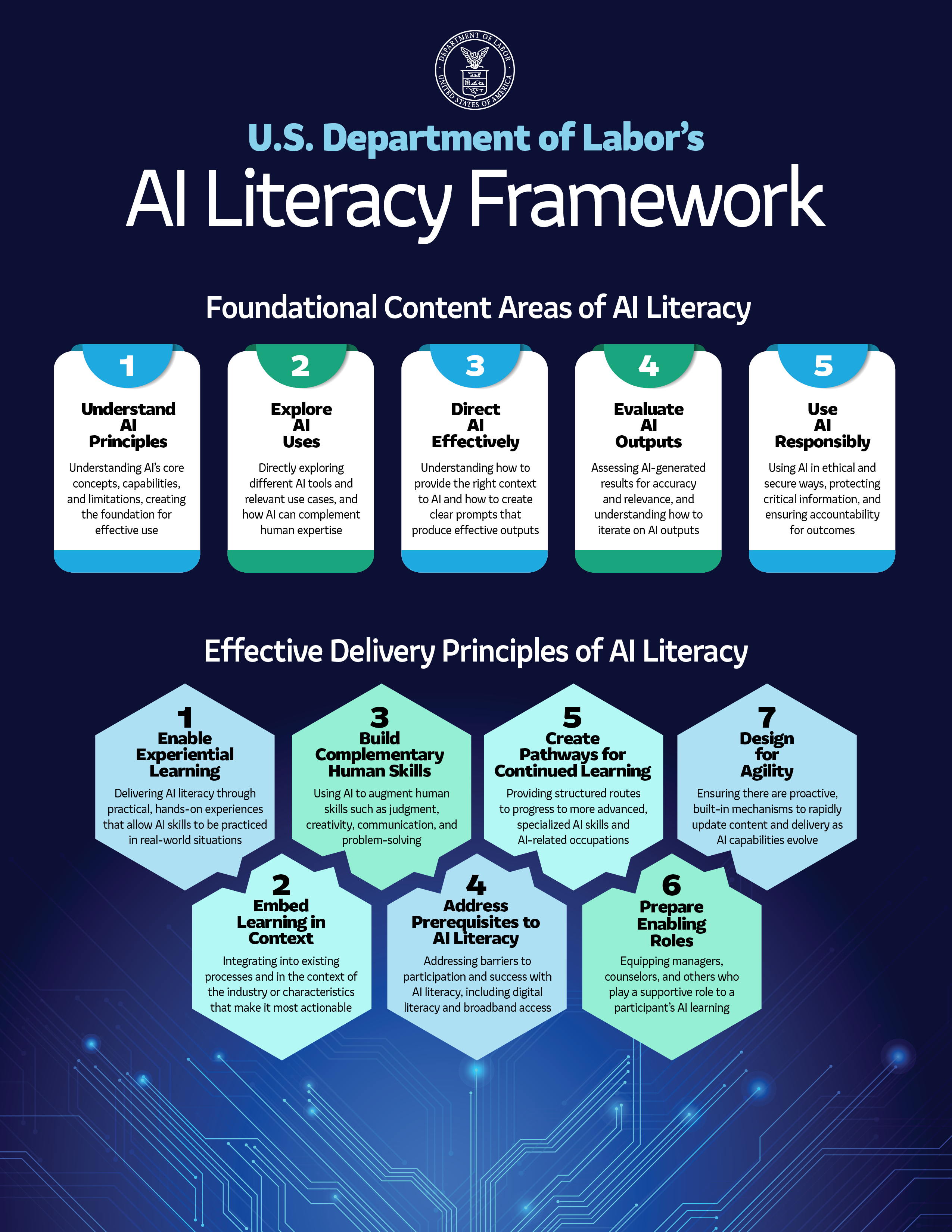
Beyond building a technical workforce, human soft skills such as ingenuity and creativity have traditionally made up a significant component of US leadership driving innovation—albeit one that is more difficult to measure. Sustaining AI’s diffusion requires the capacity to identify where AI is genuinely useful, but also the imaginative capacity to see where it is not being applied at all. Here, the arts and the humanities—scholars, designers, ethicists, and domain experts who can bridge AI possibilities with social complexity—are key for durable AI adoption. An emerging AI talent base must also include capable policymakers. Federal and state governments alike must be able to anticipate, and not just react to, the workforce shifts AI will drive. The US Department of Labor’s (DOL) AI Literacy Framework identifies five foundations of AI literacy: understanding AI principles (core capabilities and concepts); exploring AI uses; directing AI effectively (prompt engineering); evaluating outputs; and using AI responsibly. Literacy means understanding how AI works; fluency means knowing how to use it to solve real problems. For the United States to be truly AI ready, AI fluency—not just literacy—will be required across the nation’s workforce and government.
Flashpoints
Evidence-supported policymaking
The narrative around AI-driven workforce changes is diffuse and speculative, and the scope of impact appears to demand urgent action on all fronts. However, if everything is urgent, nothing is: “policymakers,” as one report put it, “cannot manage what they cannot measure.” In the near term, the most salient measurement challenge is the impact on entry-level opportunities, paired with factors that are affecting new college graduates such as post-pandemic labor market corrections and older cohorts delaying retirement. A 2025 survey shows that 59 percent of recent college graduates have found it “very challenging” to secure a full-time, entry-level job. Many employers report plans to eliminate entry-level roles as AI adoption automates routine tasks, shrinking the pool of traditional “starter” jobs for early-career workers. At the same time, according to data from LinkedIn, AI can also create new jobs, with 1.3 million jobs added in 2024-25.
An educational system unprepared to meet rapidly growing AI skills demand
The United States cannot meet its AI-ready workforce goals through top-ranked institutions and higher education alone. The 2021 Atlantic Council Commission report spotlighted alternative pathways for an AI-ready workforce, including through career and technical education (CTE) programs and community colleges. However, hiring faculty and staff has become increasingly challenging as academic institutions face funding cuts and compete both with one another and with higher-paying opportunities in industry.
The talent pipeline begins before the higher education level. China’s Ministry of Education, for example, has instituted a comprehensive, tiered AI education system across all K–12 levels. Unless the United States modernizes its own K–12 teaching approach, it will be outpaced in developing the talent base essential for AI competitiveness.
Attracting and retaining world-class talent
Highly skilled, foreign-born innovators and entrepreneurs have historically brought great economic value and innovation to the United States. A US National Bureau of Economic Research study found that immigrant inventors produce nearly a quarter of total innovation output (patents and economic value generated), despite representing just 16 percent of all US-based inventors. Sixty percent of US start-ups in the 2025 Forbes Artificial Intelligence 50 list have foreign-born founders. Four of the seven most valuable US public companies are led by immigrants, including Nvidia’s Jensen Huang (Taiwan), Google’s Sundar Pichai (India), and Microsoft’s Satya Nadella (India).
Many countries have instituted visa policies to attract AI talent. China introduced a visa for young science and tech talent and has incentivized Chinese nationals to return home after their foreign education. Similarly, the United Arab Emirates (UAE) has begun offering a Green Visa that allows skilled foreign workers to self-sponsor. Canada’s Global Skills Strategy enables Canadian employers to hire highly skilled foreign talent, with a processing time of only two weeks. In the United States, discussions about the importance of and ongoing need for such talent have become politically divisive. The challenge is nuanced, with a growing perception that US-born individuals are increasingly falling behind.
The federal government’s talent challenge
Public institutions need AI talent to effectively govern, acquire, and adopt this technology. In 2024, the US federal government recruited two hundred AI experts from the private sector through an “AI talent surge.” In 2025, however, many of these experts departed federal service as a result of US Department of Government Efficiency (DOGE)-led downsizing initiatives. While DOGE’s initiatives created immediate pressures on government capacity, long-term, structural issues such as lengthy hiring timelines, salary caps, and rigid qualifications systems have long affected the federal government’s ability to attract and retain talent. The Trump administration launched the Tech Force initiative in December 2025, with the aim of recruiting one thousand elite engineers who will “receive technical training, engage with industry leaders, and work closely with senior managers from companies partnering with the Tech Force.”
The government needs in-house expertise for AI-fluent policymaking that supports desired workforce outcomes. The recruitment strategy for most technically demanding roles in government is finding people who are driven by mission. Models for attracting technical talent to public service include programs like the CyberCorps Scholarship for Service, which has recruited and trained more than five thousand individuals in cybersecurity since 2002. Such programs have the added benefit of creating a cadre that brings an understanding of how government works to their future private-sector roles, serving as unofficial bridge builders between sectors.
Findings and recommendations
Finding: AI talent is a critical enabler of national competitiveness and prosperity. The current US policy environment sends mixed signals. The Trump administration has articulated AI dominance as a paramount national goal through its AI Action Plan, built on the pillars of accelerating innovation, building AI infrastructure, and leading in international diplomacy and security. Yet the workforce policies that undergird this ambition are relatively weak. AI talent should be seen as a national security interest, acknowledging its dual role in maintaining a modern, agile government and as a cornerstone of sustained US economic leadership.
- Recommendation: Create a national interest designation for AI to recognize the technology, and the fostering of related talent, as a strategic priority. This designation, enacted through legislation, should carry concrete operational weight, including expedited processing for AI-related visa petitions, preferential fellowship eligibility, and a clear legislative mandate for cross-agency coordination on talent strategy.
- Recommendation: Measure and disclose AI talent trends. To address the lack of robust, longitudinal data, the US Office of Science and Technology Policy (OSTP), in collaboration with DOL, should publish an annual report on the state of AI talent in order to track domestic supply, international competition benchmarks, and federal talent gaps.
Finding: Education reform and stronger nontraditional pathways for AI skilling are urgently required. Broad-based AI fluency—building on a baseline of basic literacy—across the US population is essential for enabling trust. AI is often perceived negatively by Americans who feel they have little control over how the technology is used in their lives. The Trump administration has moved in the right direction with its April 2025 Executive Order on Advancing AI Education for American Youth, establishing a policy of promoting AI literacy and proficiency by integrating AI into education, providing comprehensive AI training for educators, and fostering early exposure to AI concepts to develop an AI-ready workforce. However, additional actions should be taken.
- Recommendation: Fully fund and scale the White House AI Education Task Force’s K–12 mandate. The task force is executing a presidential AI challenge for US youth, establishing public-private partnerships for K–12 AI education, and strengthening existing agency programs that can support K–12 education initiatives. These are important initial steps but must be backed by dedicated and sustained federal appropriations.
- Recommendation: Establish funding for the integration of AI core topics in traditional college education. Congress should establish dedicated federal funding, administered through NSF and DOE, to support the integration of foundational AI topics (AI literacy, computational thinking, statistics, foundational machine learning concepts) into undergraduate curricula across all disciplines, not just computer science programs. Similarly, relevant humanities credits (philosophy, ethics, sociology, law) should be integrated into CS/AI degrees. Funding should support curriculum development and institutional capacity building, with priority for state-funded universities that serve student populations at scale.
- Recommendation: Prioritize teacher training as an enabling step. The bottleneck in K–12 AI education is educators’ capacity to deliver it. NSF and DOE should expand funding for educator credentialing in AI literacy.
- Recommendation: Expand and formalize nontraditional AI skilling pathways. The establishment of public-private partnerships to provide lifelong learning and reskilling initiatives is core to cultivating a broader AI-ready workforce and reorienting the existing workforce toward AI-enabled workflows. Examples include the National Applied AI Consortium, a federally funded program that partners with tech companies through community colleges to build capacity for AI education and training nationwide. Such partnerships can also help align curricula with skills the market demands. This includes the expansion of pathways such as vocational training, micro-credentials, community colleges credentialing, and apprenticeships.
Finding: Attracting and retaining talent is foundational to US technological leadership. The United States must be ready to compete with other countries seeking to attract talent. However, it is currently undermining AI dominance goals through an immigration posture that deters the talent it needs. For example, the Trump administration’s $100,000 fee for new H-1B visa petitions went into effect in September 2025, disrupting high-tech talent pipelines, particularly for small businesses and venture-backed start-ups. Instead, the US government should institute sensible immigration reform that balances concerns about immigration inflows with the crucial role foreign talent plays in the innovation ecosystem.
- Recommendation: Reform the H-1B program to better serve AI talent goals. Reform of the H-1B program will incentivize foreign nationals to join the US workforce at the cutting edge of innovation through sensible sponsor fees, higher visa caps, and predictable transfer, renewal, and adjudication timelines. The H-1B program as it is currently designed also constrains workers, making it challenging to change employers without jeopardizing status. On the sponsor side, the system creates significant burdens for small firms and start-ups, allowing larger incumbents to derive the most benefit. For fiscal year 2027, US Citizenship and Immigration Services (USCIS) is replacing the random H-1B lottery with a weighted selection process. USCIS should work with OSTP to develop a weighting rubric that favors AI skills within the H-1B selection process.
- Recommendation: Extend Optional Practical Training (OPT) and science, technology, engineering, and mathematics (STEM) OPT for AI-relevant PhD graduates. Currently, post-graduate work authorization for international students in STEM fields caps out at three years before an H-1B is required. Given the low H-1B lottery odds (less than a 30 percent approval rate in recent years), many top AI researchers complete their training at US universities and then leave for countries with more predictable pathways to residency and citizenship. Studies by the Center for Security and Emerging Technology (CSET) and the National Academies have found bottlenecks in the US immigration system are an extremely relevant factor in these researchers’ decisions to leave. Extension of the post-graduation work authorization for PhD candidates in AI-related fields is critical for retaining top talent during these individuals’ peak years of innovation potential.
- Recommendation: Create a dedicated AI innovator visa. Congress should authorize a new visa category specifically for individuals with demonstrated expertise in AI research, development, or governance. This category can be modeled on the O-1 visa for extraordinary ability but with streamlined adjudication timelines, lower evidentiary burdens for early-career researchers, and a direct pathway to permanent residency.
Finding: Building a skilled federal AI workforce is a prerequisite for effective governance and deployment of AI. The federal government cannot effectively govern, acquire, or deploy AI systems without meaningful in-house expertise. This is both a capability gap and a credibility gap. Agencies without AI-literate staff are poorly positioned to hold vendors accountable, set meaningful procurement standards, or anticipate second-order effects of AI adoption on their missions.
- Recommendation: Strengthen Tech Force with sustained employment guarantees and mid-career tracks. Following an exodus of AI talent from government agencies, the Tech Force program should create sustained pathways to ensure mission-driven individuals are retained and trust in federal government career pathways is rebuilt.
- Recommendation: Revive and expand mission-driven pipeline programs. Programs like the CyberCorps Scholarship for Service demonstrate that structured, mission-first talent pipelines can work at scale. A parallel AI Scholarship for Service program, administered through NSF in partnership with universities, should be established to provide full tuition coverage and a stipend to students pursuing AI-related graduate degrees in exchange for a minimum two-year federal service commitment. This would create a valuable pipeline of AI talent into government.
- Recommendation: Mandate AI fluency training for all senior federal acquisition and procurement officials. Acquisition roles are an underappreciated aspect of the federal AI talent gap. Federal contracting officers who lack AI literacy cannot write effective requirements, evaluate vendor proposals meaningfully, or hold contractors accountable for performance. The Office of Management and Budget (OMB), in coordination with the Federal Acquisition Institute, should develop and mandate a standardized AI certification for all contracting officials working on AI-adjacent acquisitions.
Finding: Understanding the impact of AI on the US workforce writ large is necessary to build sound policy responses. The United States currently lacks a consistent, standardized government-produced assessment of how AI is reshaping the labor market in real time, including disruptions for mid-career workers. The White House AI Action Plan directed DOL to establish an AI Workforce Research Hub “to lead a sustained federal effort to evaluate the impact of AI on the labor market and the experience of the American worker.”
- Recommendation: Launch a quarterly AI workforce impact assessment. DOL should publish a quarterly assessment, modeled on the rigor and accessibility of the monthly jobs report, tracking job displacement and creation attributed to AI adoption by sector. The report should track shifts in wages for AI-adjacent skills, as well as effects on entry-level jobs. Proposed legislation would direct the Departments of Labor, Education, and Commerce to assess which demographic groups are most likely to benefit or be harmed by AI-driven changes. Standardized, recurring measurement will enable policymakers to detect and more proactively manage emerging impacts.
- Recommendation: Operationalize the AI Workforce Research Hub. The hub directed in the AI Action Plan could serve as the institutional home of the quarterly assessment. It should establish data-sharing partnerships with AI labs (which have begun publishing their own economic impact surveys). Additionally, the US Bureau of Labor Statistics (BLS) incorporates AI into its ten-year employment projections, but notes, “The timing and scale of many potential impacts of GenAI [generative artificial intelligence] are too uncertain to be reflected in BLS projections.” The hub should collaborate closely with BLS to structure projection methods related to fit-for-purpose AI for rapid technological change.
About the authors
Trisha Ray is an associate director and resident fellow at the Atlantic Council’s GeoTech Center.
Explore the program
The GeoTech Center champions positive paths forward that societies can pursue to ensure new technologies and data empower people, prosperity, and peace.
Image: Credit: Trnava University via Unsplash