In-depth research and reports

Our programs and centers deliver relevant, policy-focused research that matters to inform debate and action. Our focus is always on moving debate forward, integrating analysis with active, relevant conclusions throughout our published work.

Issue Brief

Apr 2, 2021

Decoupling/reshoring versus dual circulation: Competing strategies for security and influences

By Hung Tran

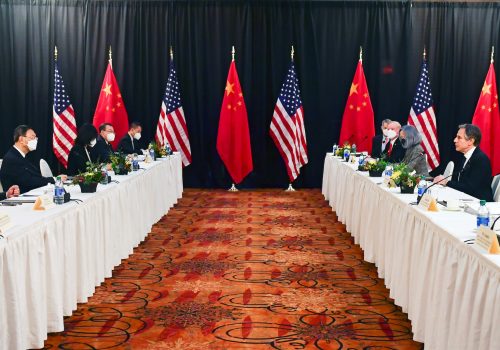
Increasing competition between the US and China, on issues ranging from trade to technology, is leading to a bifurcation of the global economy into two systems. How do the different strategies (decoupling vs dual circulation) pursued by the US and China match up?

China Digital Policy

Report

Mar 31, 2021

Raising US climate ambition in advance of COP26: An economic and national security imperative

By Margaret Jackson, Zachary Strauss

In advance of the annual UN Climate Summit in Glasgow this November, the United States must raise its clean energy and climate ambitions and reassert global climate leadership. If left unchecked, climate change will continue to exact a heavy economic toll on the United States and threaten US national security interests and American lives.

Climate Change & Climate Action Energy & Environment

Issue Brief

Mar 31, 2021

The role of the private sector in catalyzing inclusive economic opportunities in the Northern Triangle

By María Fernanda Bozmoski and Domingo Sadurní

As in every democratic country in the world, the private sector in Central America’s Northern Triangle (Guatemala, Honduras, and El Salvador) has a central role in generating employment, driving economic growth, and spurring innovation. But in a region plagued by one of the highest levels of economic informality, weak government institutions, and pervasive corruption, private enterprises—both decades-old industry behemoths and newer startups—can have a more positive influence in steering the Northern Triangle toward inclusive and sustainable economic development.

Americas Entrepreneurship

Issue Brief

Mar 31, 2021

Putin’s Mediterranean gambit: Endgame unclear

By Mark N. Katz

For more than 250 years, Russian leaders have sought to project power and influence in the Mediterranean region. Sometimes these efforts have met with a significant degree of success. At times, though, Russia has pulled back from the Mediterranean because of setbacks in the region, events in Europe, or convulsions inside Russia. These pullbacks, however, have never been permanent and have always been followed by renewed Russian efforts to gain influence in the region.

Conflict Europe & Eurasia

Issue Brief

Mar 29, 2021

The downsides of downsizing: Why the United States needs four hundred ICBMs

By Matthew Kroenig, Mark J. Massa, Christian Trotti

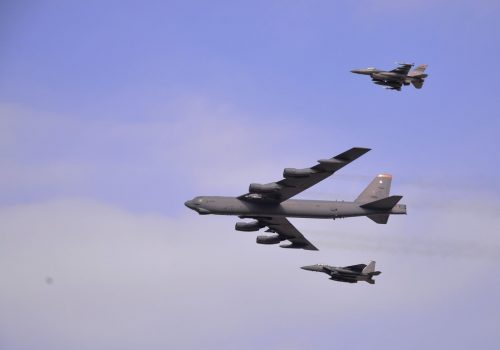
The United States is at a nuclear modernization crossroads. Critics of the land leg of the nuclear triad believe that an intercontinental ballistic missile (ICBM) force of 300 missiles will be cheaper and more stable than a force of 400. This issue brief shows that 400 ICBMs support the goals of US nuclear deterrence and are affordable.

China Defense Policy

Report

Mar 29, 2021

Broken trust: Lessons from Sunburst

By Trey Herr, Will Loomis, Emma Schroeder, Stewart Scott, Simon Handler, and Tianjiu Zuo

The story of trust is an old one, but the Sunburst cyber-espionage campaign was a startling reminder of the United States’ collective cyber insecurity and the inadequacy of current US strategy to compete in a dynamic intelligence contest in cyberspace.

Cybersecurity Intelligence

Issue briefs and reports

Mar 22, 2021

The China plan: A transatlantic blueprint for strategic competition

By Hans Binnendijk, Sarah Kirchberger, James Danoy, Franklin D. Kramer, Connor McPartland, Christopher Skaluba, Clementine G. Starling, Didi Kirsten Tatlow

China presents the United States and its partners with the most serious set of challenges they have faced since the Cold War. To manage this challenge, transatlantic nations need a blueprint to build a common approach.

China Europe & Eurasia

Issue Brief

Mar 22, 2021

Iraqi diaspora mobilization and the future development of Iraq

By Dr. Oula Kadhum

In a new report, Dr. Oula Kadhum explores Iraqi diaspora mobilization before and after the 2003 invasion and fall of the regime of Saddam Hussein.

Iraq Politics & Diplomacy

Issue briefs and reports

Mar 16, 2021

COVID-19 Recovery in Latin America and the Caribbean: A Partnership Strategy for the Biden Administration

By Jason Marczak and Cristina Guevara

The United States has the opportunity to position itself as the most important partner for its neighbors by supporting the region’s sustainable and inclusive recovery.

Coronavirus Latin America
EU-Turkey

In-Depth Research & Reports

Mar 15, 2021

Europe’s geostrategic sovereignty and Turkey

By Bahadır Kaleağası

A more positive relationship between the European Union and Turkey is a decade-long project of advocates from all over Europe and across the Atlantic. Drawing on history, witnesses see how this relationship can be an excellent win-win algorithm, as much as it can rapidly turn out to be a lose-lose situation or even a triple win-or-lose equation—with political, economic, and social resonance reaching far beyond the Continent.

Climate Change & Climate Action Economy & Business
Women in Swiss security

In-Depth Research & Reports

Mar 8, 2021

NATO partnerships for Women, Peace, and Security

By Lisa Aronsson

Lisa A. Aronsson outlines the achievements and the implementation challenges NATO faces, and offers three sets of recommendations for overcoming institutional hurdles, leveraging non-NATO members, and reviving NATO's sense of purpose on the Women, Peace, and Security agenda.

Europe & Eurasia NATO

Issue Brief

Mar 5, 2021

Biden and Ukraine: A strategy for the new administration

By Anders Åslund, Daniel Fried, Melinda Haring, John E. Herbst, William B. Taylor, Alexander Vershbow

The United States has been an essential partner for Ukraine since the Kremlin's invasion in 2014. Now that Joe Biden has taken office, he has a real chance to move past the difficult detour that US-Ukraine relations took under his predecessor.

Conflict Corruption

Assumptions Testing Series

Mar 4, 2021

Assumption #2: Strategies of coercion are effective

By Erica Borghard

Policymakers should cultivate more realistic expectations about the likelihood that their coercive threats will work as intended, evaluate their full costs against their potential benefits, and invest more in deterrence and defense.

Issue Brief

Mar 4, 2021

It’s time to get serious about a pressure strategy to contain North Korea

By Andrea R. Mihailescu

A Biden administration North Korea Strategy should continue dialogue with Kim's government, backed by a variety of pressure and enforcement tactics, in order to strive for the goal of arms reduction.

Arms Control Economy & Business

Report

Mar 4, 2021

New Atlantic Council poll: Insights on Venezuelan and Cuban American sentiments regarding US policy toward Venezuela

By Adrienne Arsht Latin America Center

Venezuelan-American and Cuban-American voters support an alternative policy approach that places the alleviation of human suffering at the core of US efforts.

Corruption Democratic Transitions
Election Integrity Partnership EIP banner

In-Depth Research & Reports

Mar 2, 2021

The Long Fuse: Misinformation and the 2020 Election

The executive summary of the Election Integrity Partnership's collaborative report, "The Long Fuse: Misinformation and the 2020 Election."

Disinformation Elections

Report

Mar 2, 2021

Advancing US-ROK cooperation on nuclear energy

By Stephen S. Greene

Although nuclear power is a key component in US and South Korean electricity generation, the nuclear energy industry in both countries is struggling. Research and development, bilateral trade, and the sale of nuclear energy technologies to third countries represent opportunities for bilateral cooperation that will strengthen both country’s nuclear energy industries.

East Asia Energy & Environment

Report

Mar 1, 2021

Report release: The future of the US-ROK alliance

By Barry Pavel, Miyeon Oh, Robert Dohner, Alexander Vershbow, Markus Garlauskas, Todd Rosenblum

In a rapidly changing environment, the US and ROK must develop an integrated strategic vision for security in the Indo-Pacific, innovative approaches to denuclearization, and responses to a rising China.

Indo-Pacific Korea

Issue Brief

Mar 1, 2021

A primer on the proliferation of offensive cyber capabilities

By Winnona DeSombre, Michele Campobasso, Dr. Luca Allodi, Dr. James Shires, JD Work, Robert Morgus, Patrick Howell O’Neill, and Dr. Trey Herr

Offensive cyber capabilities run the gamut from sophisticated, long-term disruptions of physical infrastructure to malware used to target human rights journalists. As these capabilities continue to proliferate with increasing complexity and to new types of actors, the imperative to slow and counter their spread only strengthens.

Arms Control Conflict

Report

Mar 1, 2021

Countering cyber proliferation: Zeroing in on Access-as-a-Service

By Winnona DeSombre, James Shires, JD Work, Robert Morgus, Patrick Howell O’Neill, Luca Allodi, and Trey Herr

The proliferation of offensive cyber capabilities (OCC) presents an expanding set of risks to states and challenges commitments to protect openness, security, and stability in cyberspace. Access as a Service firms offer various forms of “access” to target data or systems, and through these business practices are creating and selling OCC at an alarming rate. It is imperative that governments reevaluate their approach to countering the proliferation of OCC.

Arms Control Cybersecurity