New START might be dead, but legally binding arms control isn’t
Bottom lines up front
- Far from obsolete, arms control remains an important tool as the US manages nuclear competition.
- A new arms control treaty between the US and Russia makes sense—but its focus should be inspections and information sharing, not numerical limits.
- Agreements limiting chemical and biological weapons will be next to disappear unless the arms control community changes course quickly.
The United States faces a pivotal moment in the post-New Strategic Arms Reduction Treaty (New START) strategic environment. Almost fifty years of forward progress on nuclear arms control culminated with the treaty’s signing in 2010. While it was largely effective in managing US-Russian strategic nuclear competition, New START expired in February 2026 after existing as a hollow shell since Russia’s unilateral “suspension” in February 2023. Over the past fifteen years, other long-standing treaties have unraveled, little has taken their place, and remaining treaty frameworks face uncertainty. Experts debate whether arms control remains a viable approach or is dead, almost dead, or not quite dead yet.1Ward Wilson, “Why Nuclear Arms Control Is Dead,” Hill, July 9, 2021, https://thehill.com/opinion/national-security/561786-why-nuclear-arms-control-is-dead/; Ulrich Kühn, “Why Arms Control Is (Almost) Dead,” Carnegie Endowment for International Peace, March 5, 2020, https://carnegieendowment.org/europe/strategic-europe/2020/03/why-arms-control-is-almost-dead?lang=en; Ross Gottemoeller, “Arms Control Is Not Dead Yet: America Should Pursue Parallel Nuclear Negotiations with China and Russia,” Foreign Affairs, April 15, 2025, https://www.foreignaffairs.com/united-states/arms-control-not-dead-yet.
The central question for the United States is how to balance cooperation and competition in this moment. There are open debates about how the United States should change its strategic posture in the wake of new geopolitical realities. There are also deep concerns about the lack of guardrails and an unconstrained arms race. Despite recent erosions of the global arms control framework, the logic and purpose of formal arms control treaties remain valid, particularly in the present moment. Far from obsolete, formal arms control measures offer a durable and applicable tool for US management of great-power nuclear competition even amid deep political mistrust.
Who’s to blame?
Two notes of caution should be stated up front. Much of the blame for the current geopolitical situation can and should be attributed to the absence of constructive partners in Moscow and Beijing. Russia’s undermining of the existing treaty-based order, its maximalist negotiating posture, and its obstinate unwillingness to constructively engage have all undermined existing arms control frameworks. China, meanwhile, has continued to reject engagement, even as it undertakes a rapid and opaque expansion of its nuclear forces.2Peter Huessy, “Have Russia and China Killed Nuclear Arms Control?” National Interest, February 20, 2022, https://nationalinterest.org/feature/have-russia-and-china-killed-nuclear-arms-control-200573. Over the last few decades, Russia and China have also explicitly rejected US offers of the restraint they sought on issues such as missile defense, conventional forces in Europe, conventional long-range strike, counterspace, and cyber.3Tom Z. Collina, “U.S.-Russia Missile Defense Talks Deadlock,” Arms Control Association, January 2012, https://www.armscontrol.org/act/2012-01/us-russia-missile-defense-talks-deadlock; Gabriela Rosa Hernández, “Russia Refuses Annual Vienna Document Data Exchange,” Arms Control Association, March 2023, https://www.armscontrol.org/act/2023-03/news/russia-refuses-annual-vienna-document-data-exchange; Tom Z. Collina, “U.S. Alters Non-Nuclear Prompt-Strike Plan,” Arms Control Association, April 2011, https://www.armscontrol.org/act/2011-04/us-alters-non-nuclear-prompt-strike-plan; Shizuka Kuramitsu, “Russia Vetoes UN Resolution on Outer Space Treaty,” Arms Control Association, May 2024, https://www.armscontrol.org/act/2024-05/news/russia-vetoes-un-resolution-outer-space-treaty; “Fact Sheet: U.S.-Russian Cooperation on Information and Communications Technology Security,” White House, press release, June 17, 2013, https://obamawhitehouse.archives.gov/the-press-office/2013/06/17/fact-sheet-us-russian-cooperation-information-and-communications-technol.
But blame can also be placed on the arms control and disarmament community, both within the United States and globally, which has sidelined itself by tying its approaches and proposals to the disarmament project as a whole, thereby delinking its agenda from historical approaches to strategic stability and the hard realities of the security environment. Much of its institutional knowledge and perspective regarding practical arms control via negotiation, ratification, implementation, and verification has vanished.4Laura Kennedy, “Nuclear Arms Control and Nonproliferation Remain Critical National Security Challenges. How Prepared Is the State Department to Deal with These Issues?” American Foreign Service Association, January–February 2021, https://afsa.org/getting-state-back-nuclear-arms-control-and-nonproliferation. Its public proposals, meanwhile, have resulted in little follow-through.5“Under Secretary Bonnie Jenkins’ Remarks: Nuclear Arms Control: A New Era?” US Department of State, September 6, 2021, https://2021-2025.state.gov/under-secretary-bonnie-jenkins-remarks-nuclear-arms-control-a-new-era/. It continues to push ideas that lack US bipartisan understanding or consensus.6Steven Pifer, “The Logic for US Ratification of the Comprehensive Nuclear Test Ban Treaty,” Bulletin of the Atomic Scientists, March 7, 2024, https://thebulletin.org/premium/2024-03/the-logic-for-us-ratification-of-the-comprehensive-nuclear-test-ban-treaty/. It has grown unaligned with the needs of the deterrence community and the realities of the security environment.7Michael Albertson, ed., “Aligning Arms Control with the New Security Environment,” Center for Global Security Research, Lawrence Livermore National Laboratory, May 2024, https://cgsr.llnl.gov/sites/cgsr/files/2024-08/2024-0528-cgsr-cccasional-paper-aligning-arms-control.pdf. It has lost the interest of the other side of the negotiating table.8Xiaodon Liang and Shizuka Kuramitsu, “China Silent on U.S. Risk Reduction Proposals,” Arms Control Association, June 2024, https://www.armscontrol.org/act/2024-06/news/china-silent-us-risk-reduction-proposals. It has spent time and energy finalizing agreements or making statements that are quickly ignored or broken.9“Joint Statement of the Leaders of the Five Nuclear-Weapon States on Preventing Nuclear War and Avoiding Arms Races,” White House, press release, January 3, 2022, https://bidenwhitehouse.archives.gov/briefing-room/statements-releases/2022/01/03/p5-statement-on-preventing-nuclear-war-and-avoiding-arms-races/; Nivedita Raju, “Russia’s Anti-Satellite Test Should Lead to a Multilateral Ban,” Stockholm International Peace Research Institute, December 7, 2021, https://www.sipri.org/commentary/essay/2021/russias-anti-satellite-test-should-lead-multilateral-ban; “Russian Direct-Ascent Anti-Satellite Missile Test Creates Significant, Long-Lasting Space Debris,” US Space Command, press release, November 15, 2021, https://www.spacecom.mil/Newsroom/News/Article-Display/Article/2842957/russian-direct-ascent-anti-satellite-missile-test-creates-significant-long-last/; Anya L. Fink, “Russia’s Nuclear and Coercive Signaling During the War in Ukraine,” Congressional Research Service, November 26, 2024, https://www.congress.gov/crs-product/IN12464. It has searched for low-hanging fruit that does not exist.10 Zhao, “Practical Ways to Promote U.S.-China Arms Control Cooperation,” Carnegie Endowment for International Peace, October 7, 2020, https://carnegieendowment.org/posts/2020/10/practical-ways-to-promote-us-china-arms-control-cooperation?lang=en. It has failed to cultivate a strong voice in the military services or the Department of Defense.
This implies the need for a new, more brass-tacks approach to arms control—one grounded in security realities and one that can be pursued either in partnership with or in the absence of viable partners.
Distinguishing the substantive from aspirational and performative
In considering arms control approaches, most analyses focus on format, contrasting the pros and cons of legally binding treaties with other mechanisms (e.g., politically binding agreements, transparency measures, or norms). While these form a natural pairing, a more helpful contemporary contrast lies in distinguishing between substantive, aspirational, and performative arms control proposals. Loose conceptions of the three are as follows.
Substantive: The function of substantive arms control proposals is to create leverage and consensus through formal processes such as interagency negotiations around a proximate or impending national security goal. While interests and approaches must be negotiated, there is typically recognition of hard security challenges best managed through selective cooperation amid broader competition. Defense officials are integral to this process. Goals are seen as achievable in the short term.11Hence the historical focus of arms control deals on bilateral summitry. Leverage is created in negotiations between internal stakeholders in the process. Outside the negotiations, external measures can be taken to demonstrate that negotiating is beneficial.
Aspirational: The function of aspirational arms control proposals is to create leverage by setting high standards or goals that other states will be pressured to meet. Interests and approaches might differ sharply, but there are believed to be shared positions on conceptual or normative desires on overarching concepts such as strategic stability, transparency, or risk reduction. Goals are typically ambitious and longer term. Leverage is created by creating consensus or coalitions of the willing, which can depict non-participants as non-adherents to proper ethical or moral standards.
Performative: The function of performative arms control proposals is to create leverage through virtue signaling, scoring points on the international stage, or casting blame on others. Other actors’ interests and approaches might be largely irrelevant, as there is little expectation of needing to move toward an actual agreement via the more challenging processes of negotiation, verification, or enforcement. In many cases, leverage is unnecessary; the statement or display’s end goal in changing the discourse on the topic or the social reality.
Debates about the agreement’s form, while interesting, are less important than those about its function or purpose.12For more on prioritizing function over form in arms control, see: Michael Albertson, “Closing the Gap: Aligning Arms Control Concepts with Emerging Challenges,” Center for Global Security Research, Lawrence Livermore National Laboratory, February 2022, https://cgsr.llnl.gov/sites/cgsr/files/2024-08/CGSR_Livermore_Paper_10_Closing_the_Gap_0.pdf. Treaty-based arms control can be aspirational or performative, just as political statements can be substantive.13“Fissile Material Cut-off Treaty (FMCT) at a Glance,” Arms Control Association, November 2024, https://www.armscontrol.org/factsheets/fissile-material-cut-treaty-fmct-glance; “Treaty on the Prevention of the Placement of Weapons in Outer Space, the Threat or Use of Force against Outer Space Objects,” 2014, https://www.reachingcriticalwill.org/images/documents/Disarmament-fora/cd/2014/documents/PPWT2014.pdf; Susan J. Koch, “The Presidential Nuclear Initiatives of 1991–1992,” Center for the Study of Weapons of Mass Destruction, National Defense University, September 2012, https://ndupress.ndu.edu/portals/68/documents/casestudies/cswmd_casestudy-5.pdf. Categorization can also change over time: For example, a substantive proposal made at a particular time might become more aspirational or performative as geopolitical circumstances change.14One concrete example of this would be calls for banning intermediate-range ground-launched cruise missiles. A substantive proposal could have been made twenty years ago to multilateralize the agreement beyond the parties of the Intermediate-Range Nuclear Forces Treaty. This would have been aspirational when China was increasingly expanding its missile systems and Russia’s return to compliance was questionable. This same proposal now would be largely performative given security realities. Arms control’s overemphasis on form creates major problems when it comes to articulating the function of arms control proposals in the national security space. As former arms control negotiator Linton Brooks wrote presciently in 2020, “The commonest form of stupidity is forgetting what one is trying to accomplish.”15Linton F. Brooks, “The End of Arms Control?” Daedalus 149, 2 (2020), 84–100, https://direct.mit.edu/daed/article/149/2/84/27315/The-End-of-Arms-Control.
Hard security realities need practical solutions
Arguments against aspirational and performative approaches at this moment are simple. Russia and China have shown they do not share US aspirations regarding arms control and disarmament concepts such as risk reduction, escalation avoidance, and strategic stability.16“Sustaining the Nuclear Peace: On the Urgent Need for a New Strategy for Stability,” United States Institute for Peace, February 2025, https://irp.cdn-website.com/ce29b4c3/files/uploaded/USIP+Senior+Study+Group+on+Strategic+Stability+Final+Report.pdf. There are no longer moments of shared aspirational interests as seen in past US-Soviet and US-Russian statements on strategic stability.17“Soviet-United States Joint Statement on Future Negotiations on Nuclear and Space Arms and Further Enhancing Strategic Stability,” White House Office of the Press Secretary, June 1, 1990, https://bush41library.tamu.edu/archives/public-papers/1938; “Joint Statement by the Presidents of the United States of America and the Russian Federation on Principles of Strategic Stability,” White House, press release, June 4, 2000, https://clintonwhitehouse4.archives.gov/WH/New/Europe-0005/factsheets/js–strategic-stability.html. China views formal arms control as a “trick” and has likewise been unwilling to engage with US proposals on risk reduction.18Robert Rust, “Could China’s New Nuclear Weapons Signal a New Era of Arms Control?” Union of Concerned Scientists, October 1, 2025, https://blog.ucs.org/robert-rust/could-chinas-new-nuclear-weapons-signal-a-new-era-of-arms-control/; Wu Riqiang, “Why Isn’t China Interested in Nuclear Risk Reduction?” Lawfare, September 7, 2025, https://www.lawfaremedia.org/article/why-isn-t-china-interested-in-nuclear-risk-reduction. Moscow and Beijing see value in creating risks, manipulating escalation, and fostering instabilities to further their revisionist aims in Europe and Asia.19“China’s Emergence as a Second Nuclear Peer: Implications for U.S. Nuclear Deterrent Strategy,” Center for Global Security Research, Lawrence Livermore National Laboratory, Spring 2023, https://cgsr.llnl.gov/sites/cgsr/files/2024-08/cgsr_two_peer_230314.pdf. Allied or nonaligned countries that might share US aspirations have shown little willingness to pressure Moscow and Beijing to engage. Also, there is simply no time for performative approaches given geopolitical realities. Showmanship and virtue signaling are acceptable when they influence internal conversations or when others are doing the concrete work of negotiating, implementing, and maintaining substantive agreements. Absent this influence, and given rapid erosion, there is little value gained in appearances for international and domestic audiences.
In contrast, there are many arguments for a more substantive approach to arms control. Thought and energy in the field need to be devoted to substantive work to repair and rebuild from the decay of the last fifteen years. Otherwise, remaining agreements on nonproliferation, chemical weapons, biological weapons, and outer space will be next to disappear after New START’s expiration.20“Facing the Arms Control Interregnum: Workshop Summary,” Center for Global Security Research, Lawrence Livermore National Laboratory August 9–10, 2022, https://cgsr.llnl.gov/sites/cgsr/files/2024-08/Workshop-Summary-Arms-Control-Interregnum.pdf. Communities focused on arms control need to reconnect practical solutions and hard security realities. There is a need to rebuild a US consensus, both between the legislative and executive branches and within the US interagency (particularly in the defense and deterrence community). There is a need to ground proposals in negotiability, in terms of what the United States wants and what it is willing to include in talks. There is a need to rebuild or repair the arms control landscape in a stable and durable way to manage the emerging challenges in the strategic nuclear landscape.21See the arms control recommendations in “China’s Emergence as a Second Nuclear Peer.” Finally, this must be done in a way that allows the United States to meet its deterrence and security requirements as they continue to evolve in a two-peer, multipolar, and multidomain environment.22“America’s Strategic Posture,” Congressional Commission on the Strategic Posture of the United States, October 2023, https://www.ida.org/-/media/feature/publications/a/am/americas-strategic-posture/strategic-posture-commission-report.ashx.
Key elements of a US-Russia agreement
Substantive arms control has a clear function and purpose in managing the next decade of anticipated multipolar nuclear modernization after New START’s expiration. The trick is coming up with a substantive proposal that is durable enough to withstand partisan domestic politics and international ups and downs, flexible enough to allow for adaptation and technological surprise, and concrete enough to be grounds for detailed conversations. Key boxes must be checked in the US system regarding Russian so-called novel systems and Russia’s nonstrategic nuclear weapons.23Spenser A. Warren, “Russian Novel Nuclear Weapons and War-Fighting Capabilities,” U.S. Army War College, March 20, 2025, https://publications.armywarcollege.edu/News/Display/Article/4129339/russian-novel-nuclear-weapons-and-war-fighting-capabilities/. How the boxes are ultimately checked will be open to negotiation between the parties. The proposal must also have buy-in from the deterrence and defense communities on both sides as well as regional offices dealing with US-Russian relations, requiring time, energy, patience, and expertise. Expectations should be managed accordingly. The needs for durability, concreteness, and interagency buy-in suggest a legally binding treaty approach, and flexibility and managed expectations suggest limited aims.
With China’s participation unlikely, a follow-on US-Russia agreement designed to manage bilateral strategic nuclear competition over the next five to ten years makes sense. Such a substantive agreement with Russia will require discarding many of the aspirational or performative preconditions both sides stated earlier in the verbal jockeying about what should be in a New START follow-on agreement.24RFE/RL, “Putin Offers To Extend Last Nuclear Arms Pact With US,” RadioFreeEurope Radio Liberty, September, 22, 2025, Putin Offers To Extend Last Nuclear Arms Pact With US. The focus should instead be on the key challenge of managing US-Russia nuclear competition while the United States responds to China’s nuclear buildup. The main purpose of a US-Russia agreement would be to avoid wasteful or costly bilateral misperceptions through a legally binding mechanism that consists of data exchanges, notifications, inspections, and implementation body meetings.
The key elements of a substantive post-New START agreement are all realistic and achievable.
- With this larger purpose in mind, hard US-Russia central limits—the likely key negotiating stumbling block—are either wholly unnecessary or can be set safely higher than New START limits. Again, the key goal is to have the flexibility in a bilateral agreement to respond to Chinese nuclear force expansion.
- Regarding implementation provisions, New START’s text could be updated to include Russian strategic-range nuclear systems alongside intercontinental ballistic missiles, submarine-launched ballistic missiles, and heavy bombers.
- Data exchanges and notifications can be expanded to exchange information on total nuclear arsenals.
- Inspections at warhead storage facilities can be added to confirm the accuracy of the declared data.
- The treaty could be set for five years, with a further five-year extension, to take a bilateral treaty to a point at which the United States needs to make harder decisions about where to go next in its strategic modernization program vis-à-vis China.
- Unilateral withdrawal clauses could be built into the treaty, with the United States’ clause tied to Chinese nuclear expansion and Russia’s tied to US missile defense expansion.
The United States could propose a substantive, concrete framework of such a treaty relatively easily. Its purpose can be clearly articulated to public audiences and internal US stakeholders as a reasonable adaptation to modern realities. It does not raise the stakes too high for potential Russian engagement. It would be built mainly on the legal textual foundation of a successful legacy agreement. It would check the box on congressional interest in Russian nuclear systems of concern unaddressed by New START and begin gathering information on total warhead numbers. It would sidestep the major potential criticism by leaving the United States able to respond to China. It would set the framing and terms of the forthcoming “interregnum debate,” over where arms control is headed now that New START has formally expired. It would serve as a useful capacity-building exercise for both Congress and intergovernmental experts to relearn the process of treaty negotiation, ratification, implementation, and verification. It could serve as a bridge to a future point at which reductions are possible or more parties are willing to substantively engage.
To encourage Chinese participation, the United States could couple this substantive bilateral treaty proposal with a multilateral treaty proposal including the five permanent nations of the United Nations (P5). Because such a negotiation would involve states with divergent force levels and limited shared experiences, it would require a trade-off between the depth and scope of the multilateral agreement, essentially trading broader engagement for deeper implementation. In this construct, the United States, the United Kingdom, and France could jointly propose a P3 agreement to Russia and China on a simple premise: information sharing regarding nuclear holdings and limited reciprocal access. Russia has already gone much further with the United States under existing frameworks and has repeatedly called for the inclusion of the United Kingdom and France—conditions that this proposal would satisfy. China would be isolated as the remaining holdout. While China will ultimately decide to engage based on its own assessment of risks and benefits, such an approach would clarify for the broader international community where the principal obstacle to progress lies.
Former senior arms control negotiator Paul Warnke wrote in 1986, “One of the real problems in arms control is that neither side needs a deal.”25”Paul C. Warnke, “Lessons Learned in Bilateral Negotiations” in Leon Sloss and M. Scott Davis, A Game for High Stakes: Lessons Learned in Negotiating with the Soviet Union (Cambridge, MA: Ballinger, 1986), 55. Having articulated these substantive proposals clearly, the United States should proceed with putting its own strategic and regional deterrence houses in order. If Russia and China do not engage, the United States should not chase them. There is no silver bullet that will magically turn Vladimir Putin’s Russia or Xi Jinping’s China into willing negotiating partners. The United States should instead focus on the best alternative to a negotiated agreement (what negotiations literature calls a BATNA), working to improve its own position and weaken Russia and China’s positions.26Guhan Subramanian, “What Is BATNA? How to Find Your Best Alternative to a Negotiated Agreement,” Program on Negotiation, Harvard Law School, October 7, 2025, https://www.pon.harvard.edu/daily/batna/translate-your-batna-to-the-current-deal/. This structure—a bilateral proposal, a multilateral proposal, and a BATNA proposal—is a more holistic negotiating approach than searching for trade space or bargaining chips to create and then negotiate away.
The merits of “old school” arms control
Admittedly, this is an old school approach to a rapidly evolving problem set. There is a strong reliance on past mechanisms such as negotiations, interagency implementation, and data analysis, and a historical coupling of concrete, detailed cooperative agreements with continued strategic competition. There are no illusions about what these agreements can achieve or what geopolitical trends they can stop in their tracks. This will leave many in search of new approaches to arms control unsatisfied. There are no specific carveouts for emerging technologies like artificial intelligence or fast-moving issues like Golden Dome. There is no call for new, more intrusive, or more technology-dependent verification measures. This is because searches for new aspirational or performative approaches over the last fifteen years—aimed at going lower in numbers of launchers or warheads, capturing a wide range of new and emerging threats, and looping in more countries—have not proven fruitful. In pursuing these searches, time has run out for many agreements. The lack of results has validated that legally binding arms control might again be necessary.
As Brooks wrote in 2020, “International agreements are only impossible until they aren’t.”27Brooks, “The End of Arms Control?” The present moment demands an approach that is substantive, flexible, and reactive enough to respond to the two-peer challenge posed by Putin’s Russia and Xi’s China. What has been articulated here—a bilateral treaty proposal with Russia, a multilateral P5 proposal, and a simultaneous US modernization in the absence of cooperation—might not gain near-term acceptance in Moscow and Beijing, but it offers a concrete and coherent US arms control strategy in the post-New START era. It also serves as a rallying point within the arms control and disarmament communities to begin thinking more substantively about which proposals and negotiating positions meet the present moment, encouraging a shift from aspirational or performative rhetoric to practical negotiability. Without substantive focus, aspirational and performative proposals will continue to dominate the discourse and the community will continue to lose relevance in the broader national security debate.
This issue brief is part of the Scowcroft Center for Strategy and This issue brief is part of the Scowcroft Center for Strategy and Security’s Great nuclear debate series, a curated anthology of perspectives on arms control, force sizing, and missile defense from leading experts.
About the author
Michael Albertson is deputy director of the Center for Global Security Research at Lawrence Livermore National Laboratory. Prior to his current position, he worked in the federal government in a wide variety of Russia, deterrence, and arms control-related portfolios for the Department of Defense, the State Department, and the National Security Council staff. His work on Russian strategic nuclear arms control issues included implementation and compliance of the Intermediate-Range Nuclear Forces Treaty and New START and participation in the negotiation and ratification of the New START Treaty.
The views expressed here are the personal views of the author and should not be attributed to his employer or any of its sponsors.
Explore the program

Forward Defense develops and shapes policy solutions that build US military power to deter war and secure the future.
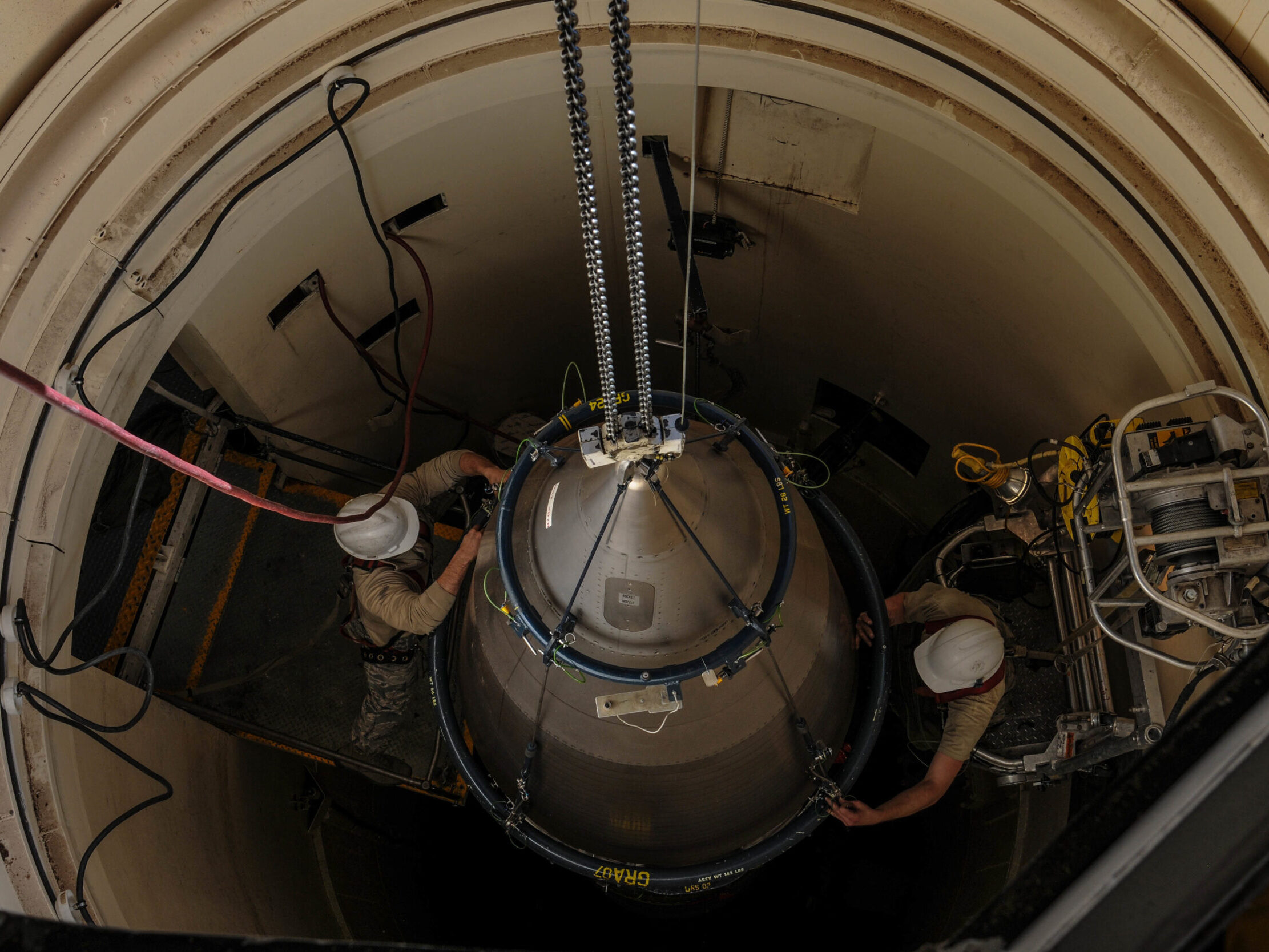
Image: Airmen from the 90th Missile Maintenance Squadron prepare a reentry system for removal from a launch facility, February 2, 2018, in the F. E. Warren Air Force Base missile complex. The 90th MMXS is the only squadron on F. E. Warren allowed to transport warheads from the missile complex back to base. Missile maintenance teams perform periodic maintenance to maintain the on-alert status for launch facilities, ensuring the success of the nuclear deterrence mission. (US Air Force photo by Airman 1st Class Braydon Williams)