Three lessons from Libya for the war in Iran
Debate over the US and Israeli intervention in Iran is already settling into a familiar frame: will Iran become “another Libya”? While the United States and its partners carried out sustained air campaigns inside both countries that led to the killing of their longtime leaders, there are obvious differences. Iran and Libya differ in size, institutional strength, regional position, and military capability. Treating the Libya intervention as a simple precedent risks drawing the wrong lessons.
The NATO campaign in Libya in 2011 is often remembered as a case of operational success followed by political collapse. But that framing misses the deeper problem. The campaign did not fail because NATO airpower was ineffective. It faltered because military success was never clearly connected to a viable political end state. Libya’s experience highlights three intervention design challenges that remain relevant as policymakers assess the trajectory of the Iran campaign.
Define the political end state
The Libya intervention is an example of how quickly strategy can drift when political goals are unclear or evolving during a campaign. NATO’s mission began under the objective of protecting civilians, authorized by United Nations Security Council Resolution 1973. However, as the operation progressed over seven months, the campaign increasingly aligned with the objective of removing Muammar al-Qaddafi from power. Protecting civilians, coercing a regime into negotiations, and enabling regime collapse all have unique strategic designs. A coercive campaign aimed at bargaining might focus on limited military pressure and political off-ramps. A campaign that anticipates regime collapse must plan for the far harder task of establishing political authority after the conflict to ensure a degree of stability.
In Libya, that distinction was never fully resolved. Once Qaddafi fell, the coalition had no shared strategy for how Libya’s political transition would be organized, how security would be restored, or which institutions would carry the state forward. Authority quickly fragmented across militias, regional actors, and weak interim governments, leaving the post-revolutionary state unable to consolidate control.
The lesson for the Iran war is not about regime change itself. It is about clarity of purpose. If military operations aim to coerce Iran’s leadership, policymakers must define the conditions under which pressure stops and negotiation begins. If military action risks destabilizing the regime more fundamentally, then the question of political succession and institutional continuity cannot be treated as an afterthought. Then Major General David Petraeus’s dictum during the Iraq war, “Tell me how this ends,” remains an appropriate question to consider.
Align the coalition’s goals
Coalition politics can shape the trajectory of an intervention as much as military capability. In Libya, NATO presented a unified front during the air campaign, but participating states held different views about the campaign’s purpose and limits. Some governments treated the intervention as a narrowly defined civilian protection mission, while others saw it as a pathway toward removing Qaddafi.
These differences did not prevent military coordination, but they complicated strategic alignment. Coalition members pursued different lines of effort, and responsibility for planning Libya’s political stabilization remained diffuse. Regional endorsement from the Arab League helped legitimize the intervention, yet the endorsement did not resolve disagreements among intervening powers about the campaign’s long-term goals.
For the Iran intervention, coalition management extends beyond military interoperability. The United States, Israel, and any supporting international partners must align on what success actually looks like. If one actor seeks deterrence, another seeks coercive bargaining, and another hopes the campaign weakens the regime beyond repair, strategy will inevitably drift.
Control escalation
The Libya campaign also illustrates both the power and the limits of airpower. NATO air strikes were effective in halting Qaddafi’s advances and shifting the battlefield balance toward opposition forces. From a purely operational standpoint, the campaign achieved its immediate objectives. Yet tactical success did not produce a stable political outcome. In Libya, the military campaign accelerated regime collapse without establishing a credible framework for what would replace it.
Interventions that rely heavily on airpower also face a familiar escalation dilemma. Once outside powers intervene, the logic of the campaign often shifts toward securing decisive outcomes on the ground. As intervening powers relied on Libyan rebel forces to sustain military pressure on the regime, those actors gained leverage within the coalition’s strategy. External support strengthened particular militias and factions, shaping the political trajectory of the conflict.
The central question for the Iran intervention is whether military operations are embedded in a strategy that manages escalation and defines credible stopping points. Without clear political limits, even a limited campaign can expand beyond its original objectives.
Designing the Iran intervention
Libya’s central lesson is not that intervention inevitably leads to instability, nor that airpower is strategically ineffective. The deeper lesson is that military effectiveness cannot compensate for weak intervention design and understanding of politics. When outside powers use force to shape political outcomes, they inherit broader strategic responsibilities and unstable politics. They must define the political end state they seek, align coalition partners around a shared strategy, and establish credible escalation controls while considering how military pressure will interact with the political institutions that must ultimately sustain order.
The current debate about Iran would benefit from focusing on those questions. Whether Iran resembles Libya is ultimately beside the point. What matters is whether policymakers have absorbed the intervention design lessons from the Libya experience. Military operations can alter the trajectory of a conflict, but without a strategy that connects military pressure to political order, tactical success can quickly give way to strategic uncertainty.
Frank Talbot is a nonresident senior fellow with the North Africa Program within the Atlantic Council’s Middle East programs. He previously served as the Middle East and North Africa team lead in the State Department’s Bureau of Conflict and Stabilization Operations and managed the economic/sanctions file for the State Department’s Libya Desk.
Related Reading
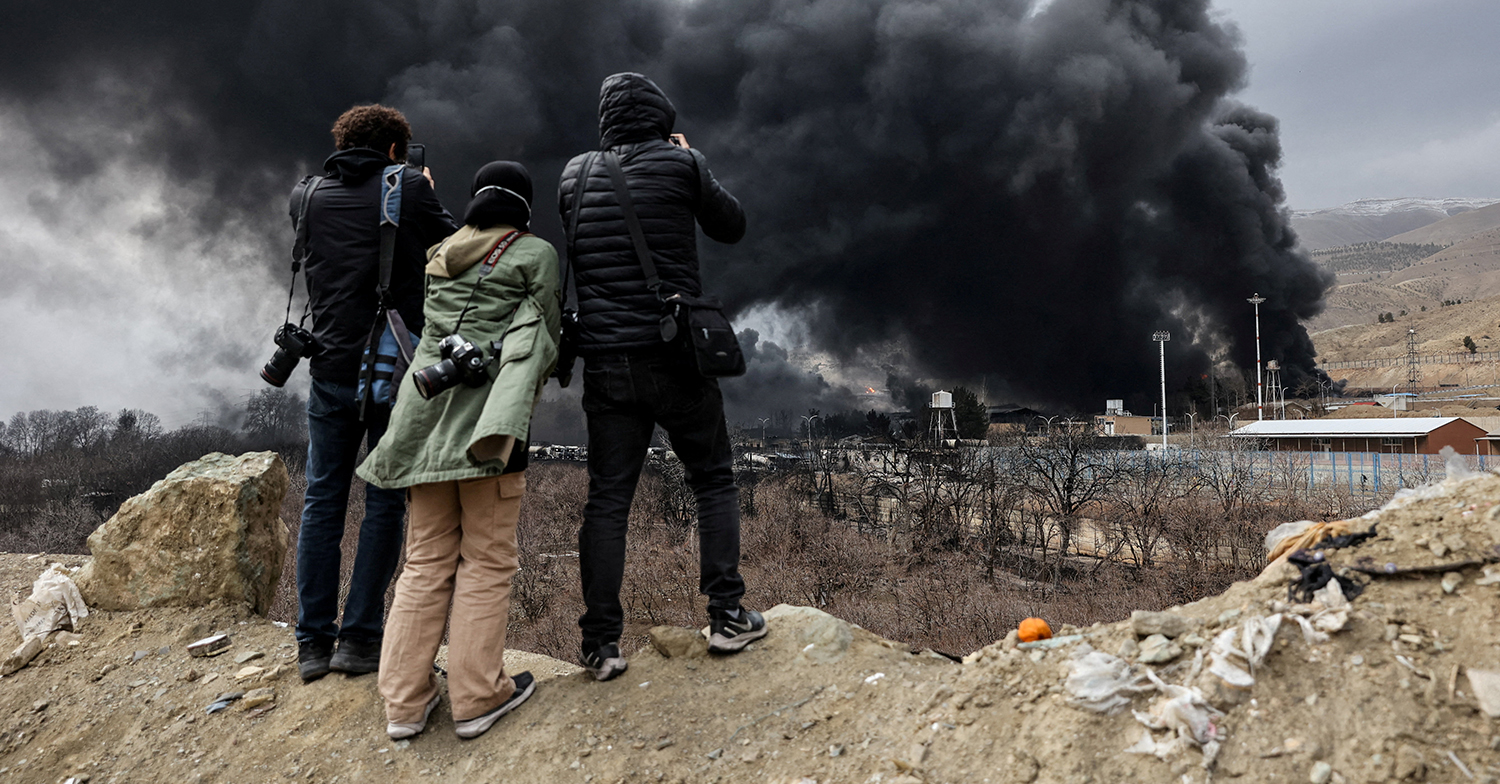
Image: People record smoke rising after a reported strike on Shahran fuel tanks in Tehran, Iran, on March 8, 2026. Photo via Majid Asgaripour/West Asia News Agency/Reuters.