

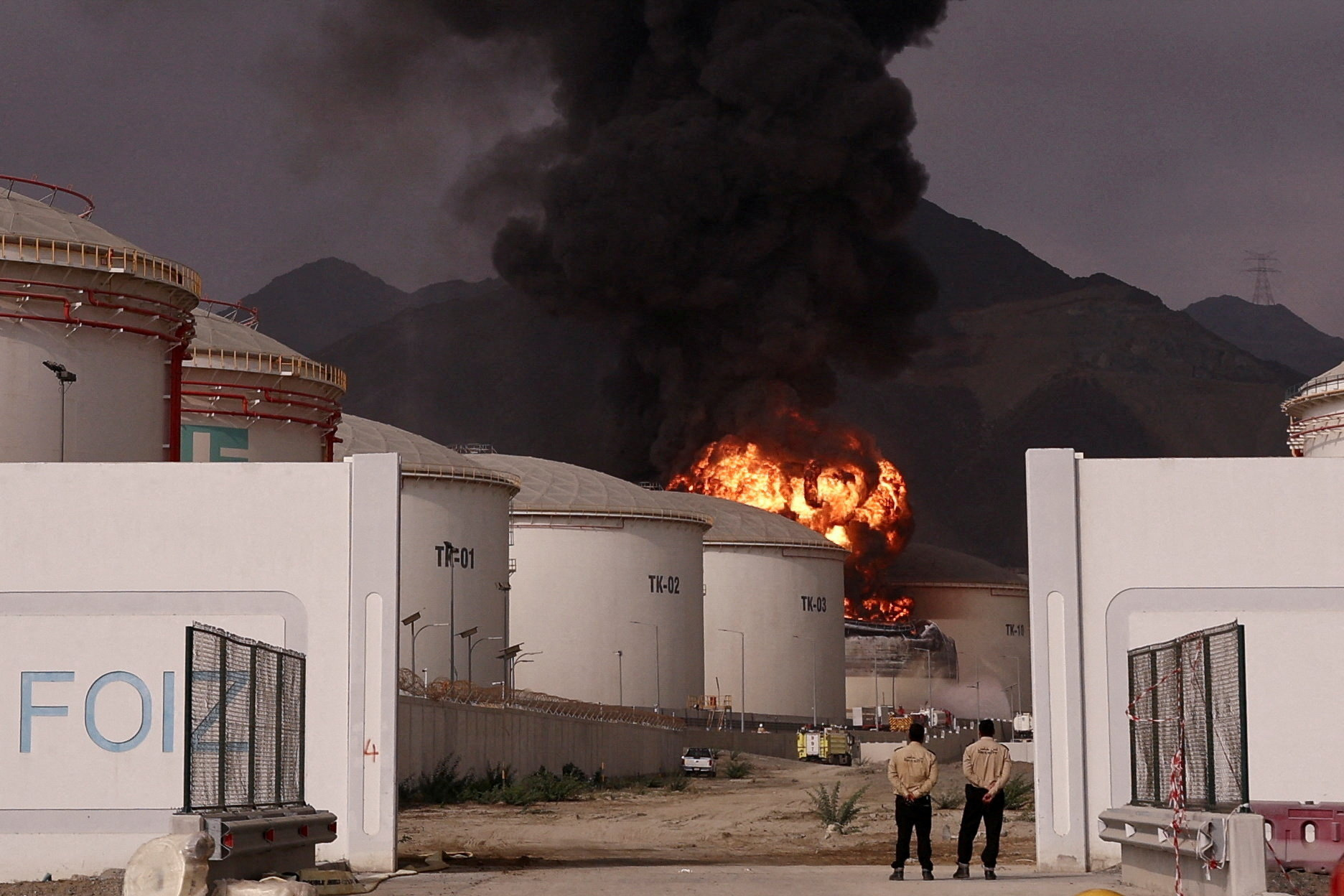
What frustrates senior Gulf officials, as Iran aims missiles and drones at their citizens and countries, is that too many in Washington are making the war a matter of US domestic politics and President Donald Trump. For them, what’s at stake is whether the Middle East moves in a uniquely positive direction or reverts to a more familiar, uglier one.
Over the past two weeks, I have spoken with a number of Gulf officials to better understand how leaders in the region view this ongoing war. The conversations have been strikingly consistent. For many of them, this conflict was not a matter of if, but when. One senior Gulf official told me that his country has long known its greatest danger lies in Iran and not in Israel—a reality made obvious in recent days.
The war’s inevitability was not due to any one factor, the officials told me. Rather, it was a cumulative consequence of a revolutionary regime that for nearly half a century built its power through murderous proxies, deadly missiles, nuclear aspirations, and relentless intimidation. Another senior Gulf official told me that his country had long argued to US negotiators from Democratic administrations that they were wrong to think that containing Iran’s nuclear capabilities was sufficient, as that failed to address the missiles and proxies that posed threats to its neighbors.
In the telling of Gulf officials, the region has been living in a form of shadow war for years. Proxy conflicts, cyberattacks, and military strikes on energy infrastructure were part of a sustained campaign designed by Iran to test and erode the Gulf’s security architecture. Look at Dubai, Abu Dhabi, and increasingly Riyadh. They reflect a degree of religious tolerance, political moderation, and economic modernization that contrasts sharply with Iran’s theocracy.
A regime down but not out
Some officials in these countries argued privately against Trump’s decision to go to war alongside Israel. Others argued in favor. But none of those I spoke with now want the United States to cut and run before the job is done. Even those Gulf officials wary of escalation (and that includes most of those I spoke to) see this war as the culmination of a long trajectory that required a response at some point—before the balance of power tilted irretrievably in Iran’s direction.
That doesn’t mean Gulf officials favor regime change in Iran, as no one can accurately calibrate how to pull that off. That needs to be a job for the Iranian people. However, it does mean, in their view, that the United States, Israel, and other willing partners should continue eroding the Iranian regime’s destructive capabilities—particularly as it now will be left in a vengeful state.
Their bottom line: If Iran comes out of this neutered and defanged, it’s better for everyone, even if the regime can’t be fundamentally changed from one that’s run through some combination of theocratic and Islamic Revolutionary Guard Corps leaders. Put more diplomatically, a senior Gulf official told me: “If Iran is incapable of inflicting harm and exporting instability to its neighbors, that will be a good thing.”
As for Iran’s leaders, they likely are betting that US domestic politics will save the regime from total collapse. For decades, the Iranian regime has believed that its 1979 revolution, including the taking of American hostages, embarrassed US President Jimmy Carter, weakening his political support and costing him the next election. Iranian leaders probably think that they can impose similar political pain on Trump through a drawn-out conflict and elevated gas prices. If that costs Trump’s party control of Congress in the country’s upcoming midterm elections, it would be Tehran’s “own form of regime change,” as the Atlantic Council’s Alex Plitsas put it to me.
The pivotal weeks ahead
My conversations with Gulf and US officials in recent days have reinforced many of my own views regarding the significance of this moment. There are plenty of pessimistic assessments of the war right now, but they obscure a historic opportunity. The conflict with Iran may prove a true inflection point. It could neutralize the Middle East’s greatest destabilizer over the past four decades, creating new openings for regional security and prosperity. And it could splinter the emerging Axis of Aggressors comprised of China, Russia, North Korea, and Iran. The White House estimates that Iran, through its direct actions and proxy networks, has been responsible for the deaths of hundreds of Americans—including US service members, diplomats, and civilians—since the 1979 Islamic Revolution.
So how can the United States get from here to there? Through military resolve, strategic patience, and diplomatic cunning. Above all, the United States should not end its military campaign early. That could inadvertently strengthen the position of a weakened Iranian regime. And the regime is weak; its attacks on its neighbors are more the desperate flailing of a failed regime than the resurgence of the revolution. Even now, it will be years before Iran can rebuild its navy and missile capabilities, or again aspire to a nuclear-weapons arsenal. But the next two to three weeks will be critical, as the United States continues to target Iranian capabilities.
“The good news is that the US military is on course over the next few weeks to achieve the stated objectives to destroy or severely degrade Iran’s missiles, drones, the associated industrial base, navy, and nuclear program,” Plitsas, a former Pentagon official, told me. What’s most likely to result in “failure to complete the military operation in Iran is ending it early due to economic pressure from the risk-based closure of the Strait of Hormuz, which is Iran’s objective.”
That is why the United States and its partners must get control of the strait, enable freedom of movement, and prevent economic damage that could give Iran greater leverage.
US officials have told their Gulf partners that they have made progress in bringing together a coalition of countries to escort ships through the strait, despite several countries publicly refusing to contribute to that effort. More US military assets are arriving in the region to provide protection for shipping while continuing to strike at Iran’s ability to disrupt that traffic.
Even as US forces pursue these objectives, Americans should not lose sight of the larger opportunity. This past week, one Trump administration official spoke to me about a longer-term vision harbored by some in the White House of a Middle East where not only moderate Arab and Israeli leaders normalize their relations—as they have done through the Abraham Accords—but a new Iranian government and Arab leaders eventually do so as well, ultimately leading to Israeli-Iranian normalization.
At this time of war without an obvious end, that vision sounds fantastical. But it is seemingly impossible developments like this one that could become reality, serving both US interests and those of its regional partners, if the Trump administration sees through the mission in Iran that it has set out for itself.
Frederick Kempe is president and chief executive officer of the Atlantic Council. You can follow him on X @FredKempe.
This edition is part of Frederick Kempe’s Inflection Points newsletter, a column of dispatches from a world in transition. To receive this newsletter throughout the week, sign up here.
