
The clarity of the law differential: Channels to prosperity across income groups
This issue brief is part of the Freedom and Prosperity Center’s “Voices of the Future” series, which highlights how graduate students are using the Freedom and Prosperity Indexes to explore pressing governance and development challenges across the world.
Introduction
Clarity of the law is a measurement of how transparent, consistent, and predictable a country’s legal framework is, and it underpins every economic transaction, from small-business loans to cross-border investments. It is an integral component of the rule of law, and recent research has highlighted its centrality to achieving prosperity. Despite this, comparative analysis of clarity of the law across development stages remains scarce.
This brief fills that gap by investigating the channels through which clarity of the law drives prosperity, and how they differ by income group, as observed in the Atlantic Council’s Freedom and Prosperity Indexes. The brief conceptually aims to distinguish between two distinct mechanisms toward prosperity: a linear channel that affects prosperity through credibility and signaling gains, and a quadratic channel that increases prosperity through endogenous productivity gains. The findings reveal distinct institutional dynamics at each development stage, suggesting the need for tailored policy strategies for each income group.
Methodology
This analysis drew on a balanced panel of 179 countries from 1995 to 2023, segmented by World Bank income groups (high income, upper middle income, lower middle income, low income) to capture institutional variation. Using the Atlantic Council’s Freedom and Prosperity Indexes, the model identified the optimal lag structure according to the trade-off between fit and complexity given Akaike Information Criterion and Bayesian Information Criterion tests. Subsequently, we tested for the relationship between lagged clarity of the law and prosperity, controlling for other relevant subindexes. To test nonlinear effects, the specification incorporated squared and interaction terms clarity and clarity × economic freedom, following well-established empirical design in institutional economics and endogenous growth theory.
After clustering by country, we employed nested country and year fixed effects to control for country- and time-invariant unobserved heterogeneity. Lastly, we estimated the regression separately for each country income group. Thus, this paper estimates the following fixed-effects panel model separately by World Bank income group:

Where β1 aims to capture signaling and/or credibility gains, β2 addresses endogenous growth, μ_(i ) and λ_(i ) are sets of time—and country—fixed effects, and X_(i,t-1) is a vector of controls that includes relevant elements of the lagged economic subindex, political subindex, and legal freedom (excl. clarity).
The theoretical mechanism the linear interaction aims to capture is that predictable rules reduce transaction costs and perceived institutional risks, thereby encouraging investment. For a given increase in clarity of the law, this should appear as a one-off increase in contemporaneous inflows of capital and/or other forms of investment, eventually leading to higher prosperity under an appropriate lag specification. Research shows that legal uncertainty reduces credit market size substantially, with loan volumes falling by 0.63 percent for every 10 percentage-point decrease in legal certainty.
Respectively, the quadratic channel functions through nonlinear gains in productivity, technology improvements, knowledge spillovers, and additional entrepreneurship, which create endogenous growth. This growth should then lead to gains in prosperity both directly and by increasing the demand pool and retention rate of foreign direct investment (FDI). A crucial characteristic of informational improvements in clarity of the law is that they are a nonrival, nonexcludable public good, meaning they can lead to pareto optimal outcomes for actors operating within the margins of the law and yield convex returns to economic growth under the right underlying institutional conditions.
To mitigate dynamic endogeneity and reverse causality, the model employed lagged prosperity as an independent control. Subsequently, to avoid the Nickell bias, the model instrumented lagged prosperity using system Generalized Method of Moments (GMM) with year dummies and confirmed with Wooldridge and Durbin-Watson tests the absence of higher‐order serial correlation. Under these conditions, the estimated linear term is interpreted as the credibility or signaling channel (reducing uncertainty and facilitating capital flows), and the quadratic term as the marginal productivity channel (unlocking innovation and efficiency gains). This allows stronger inference vis-à-vis traditional cross-sectional analysis.
Findings
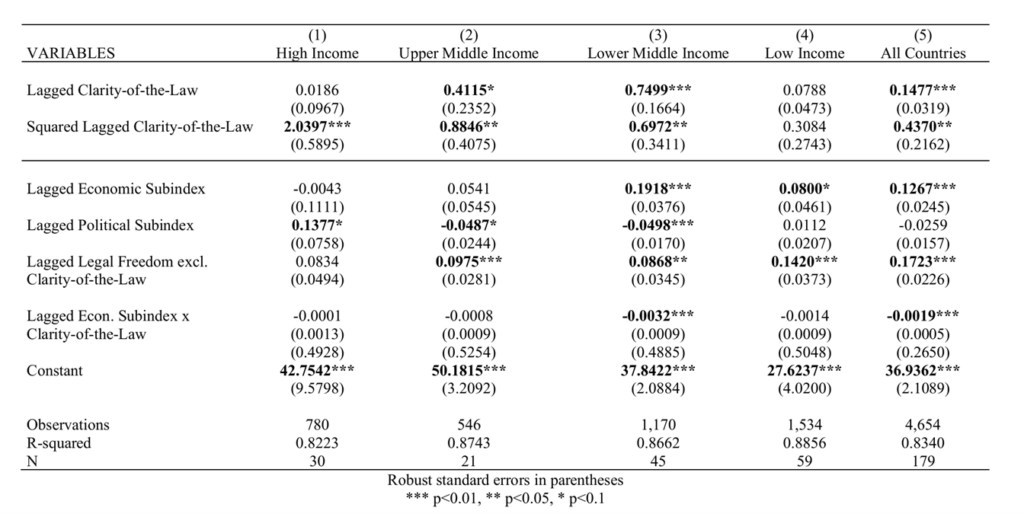
The results reveal a heterogeneous significance of different channels across income brackets. By disaggregating countries into high-, upper-middle-, lower-middle-, and low-income groups, and comparing these against the full sample, the analysis uncovers interesting underlying dynamics guiding the relationship between clarity of the law and prosperity. Across the entire sample, lagged clarity (0.1477, p < .01) and its squared term (0.4372, p < .05) both play significant roles, demonstrating that clarity improvements foster prosperity in general, not only linearly, but also nonlinearly, in accord with relevant scholarship.
The differentiated effects show that a one-size-fits-all approach to clarity of the law is suboptimal. Instead, policymakers should tailor strategies to their income group’s institutional stage. As shown in Table 1, high-income countries benefit primarily from quadratic gains in clarity of the law, upper-middle-income countries benefit from linear and quadratic alike, those in the lower-middle-income category benefit mostly linearly, whereas low-income nations show only marginal linear benefits.
These findings are consistent with endogenous growth theory, which suggests that low- and lower-middle-income countries often see the largest gains from capital accumulation, whether through foreign aid, infrastructure investments, or credit expansion, because they start far below the technological frontier. In contrast, economies approaching the frontier must rely on productivity enhancements, like innovation, efficiency gains, and institutional quality, to power further growth.
In low-income contexts, where much external financing arrives as humanitarian or development aid, legal clarity alone yields limited returns without concurrent productivity-oriented reforms. As countries ascend into higher-income brackets, however, incremental clarity reforms can unlock bottom-up innovation and efficiency gains critical for sustaining growth beyond the initial capital boost. This perspective may explain why clarity’s impact intensifies nonlinearly in more advanced economies while remaining modest in poorer ones.
The strong and significant coefficients on legal freedom excluding clarity of the law across most income groups further indicate that broader institutional quality contributes meaningfully to prosperity outcomes. This suggests clarity-of-the-law effects might operate in complementarity with supporting legal infrastructure and not in isolation.
Table 1. Results from the main regression analysis
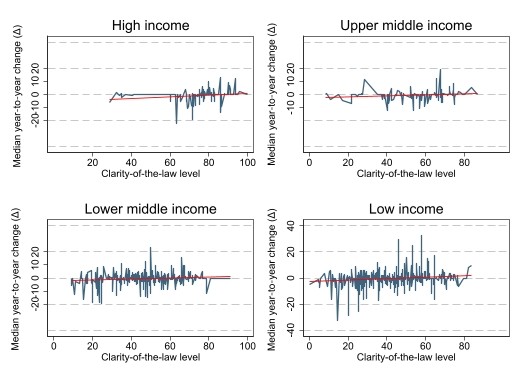
Moreover, comparing the volatility of clarity of the law by income group reveals a clear inverse relationship between average national income and the year-to-year fluctuation in clarity of the law. In low- and middle-income countries, legal clarity is more volatile, largely due to political transitions and institutional instabilities. By contrast, in upper-middle- and high-income countries, law-clarity metrics remain largely stable over time. The reduced volatility of legal clarity at higher income levels thus underpins a self-reinforcing cycle: Stable institutions promote prosperity, which in turn enables further institutional refinement. This empirical finding is consistent with Acemoglu et al.’s central hypothesis that stability is a fundamental element of successful institutions.
Figure 1. Volatility of clarity of the law by income group
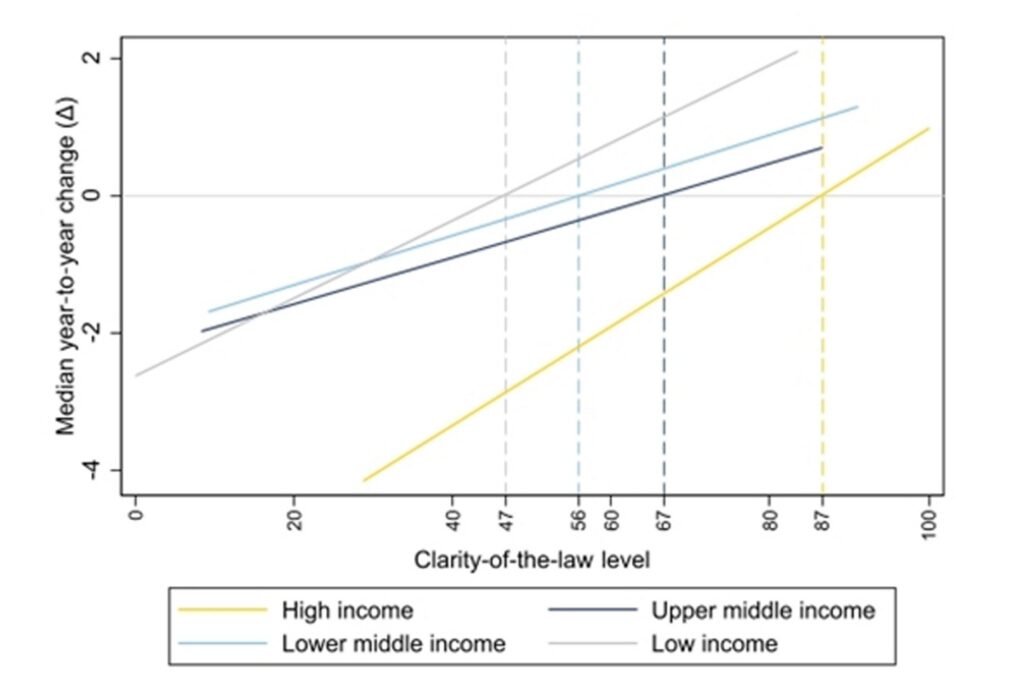
Further, for each income group it is possible to calculate a critical threshold, representing the point above which, on average, the median year-to-year change becomes self-sustaining. We find this threshold at forty-seven points for low-income countries, fifty-six points for lower-middle-income countries, sixty-seven points for upper-middle-income countries, and eighty-seven points for countries in the high-income bracket. These points can serve as potentially useful benchmarks for policymakers in sequencing efforts, allocating resources efficiently, and tracking progress against concrete, self-reinforcing benchmarks.
Figure 2. Ordinary least squares fit and critical thresholds by income group
Comparative observations across income groups
1) In high-income countries, clarity of the law offers productivity gains
In advanced economies, the impact of legal clarity on prosperity follows a quadratic, convex form. The linear term for lagged clarity (0.0111) is small and statistically insignificant, whereas the squared term (2.0397, p < .01) is highly significant (at the 99 percent confidence interval [CI]). The data show that a 1 percent increase in the squared clarity of the law is on average associated with a 2.03 percent increase in prosperity, holding the control variables constant. This indicates that once a country’s clarity score surpasses a certain threshold, additional improvements are associated with accelerating gains in gross domestic product per capita and productivity. The inflection point is located at approximately 75.3 clarity points, and marks where marginal returns begin compounding. Above this level, incremental regulatory refinements do less to raise baseline outcomes and more to fortify and accelerate existing prosperity trajectories.
For policymakers in high-income settings, this underscores the importance of continuous legal innovation. Even modest enhancements near the institutional frontier can generate outsized economic dividends by reinforcing investor confidence, reducing policy uncertainty, and solidifying rule-of-law gains. In practice, this would reflect that in environments of high clarity of the law local innovators are more willing to launch new ventures, experiment with business models, and invest in workforce development, activities that cumulatively drive productivity and aggregate demand.
2) Upper-middle-income countries benefit from productivity and signaling gains alike
Upper-middle-income countries are a particular case study as they represent a transitional phase where both linear (0.1115) and squared (0.8249) clarity terms achieve statistical significance, albeit at the 10 percent level. This dual significance suggests that these nations experience moderate threshold effects while maintaining roughly proportional returns to clarity-of-the-law investments. Unlike high-income peers, upper-middle-income states have not fully developed the complementary governance structures required to trigger exponential returns. This results in more predictable, linear prosperity gains from institutional reforms, as they aim to attract international capital and promote FDI. The lack of decisive results (statistically significant at the 95 percent CI) might also reflect the multiple pathways through which upper-middle-income countries achieve prosperity, particularly the association (statistically significant at the 99 percent CI) between economic freedom and prosperity in that group.
Moreover, the coefficient on broader legal institutions (0.0939, significant at 1 percent) underscores that clarity improvements must be embedded within comprehensive institutional reforms. A good country case of this complementary mechanism between prosperity gains and clarity-of-the-law improvements is Estonia. From 1995 to 2009, the country invested heavily in digital governance, rationalized business registration, and secured judicial independence, aided largely by international organizations and through European Union accession. Over this period, Estonia’s clarity-of-the-law score rose from 58.4 to 91.5 points, with corresponding steady increases in prosperity indicators.
3) Lower-middle-income countries rely on clarity of the law for credibility
Lower-middle-income economies derive the largest marginal benefits from legal clarity. The linear clarity coefficient (0.2519, p < .01) is the highest among all groups, and the squared term (0.6881, p < .05) confirms accelerating returns after meeting basic thresholds. This reflects clarity’s role in reducing perceived political and enforcement risks, thereby lowering sovereign borrowing costs and unlocking capital inflows. Countries in this income bracket are heavily reliant on foreign liquidity for 15-20 percent of their total credit.
Georgia is an interesting case study of a country that followed the above dynamic. After the Rose Revolution of 2003, President Mikheil Saakashvili launched an ambitious reform agenda aimed at dismantling entrenched corruption and overhauling state institutions. Within a single year, clarity of the law rose from forty-two to fifty-nine points as the government introduced transparent business registration, streamlined judicial procedures, and strict anti-corruption measures. These reforms helped improve investor confidence, resulting in a sharp increase in FDI and significantly lower sovereign borrowing costs. Indicatively, between 2003 and 2007, Georgia’s FDI inflows surged from approximately $340 million to over $2 billion. Economic freedom similarly increased, particularly after 2005, reinforcing the hypothesis that clarity of the law yields positive results in conjunction with economic freedom when it precedes it.
4) In low-income countries, clarity of the law’s impact remains limited
In low-income settings, clarity alone has limited immediate effects on prosperity. The linear term (0.0875, p < .1) is marginal, and the squared term (0.3105) is statistically insignificant. This corroborates that in high-uncertainty and high-risk environments, secondary reforms such as clarity of the law do not translate reliably into economic gains without foundational infrastructure.
This finding is consistent with the model’s theoretical expectations. In environments where basic institutions are underdeveloped, marginal gains in legal clarity cannot overcome structural inadequacy. Thus, low-income countries must first invest in foundational capacity-building to create the conditions for clarity reforms to take hold.
Conclusion
This brief demonstrates that the prosperity gains from clarity of the law are deeply conditioned by a country’s income stage and institutional maturity. While legal clarity universally impacts growth, the mechanisms differ: In lower-middle-income economies, improvements primarily operate through a credibility channel, reducing perceived risks, lowering sovereign borrowing costs, and attracting foreign capital. In upper-middle-income countries, clarity drives both linear and nonlinear effects, balancing capital inflows with emerging productivity gains. Among high-income economies, clarity’s role shifts toward endogenous growth dynamics, where marginal legal refinements amplify entrepreneurship, innovation, and knowledge spillovers. Conversely, in low-income contexts, legal clarity alone is insufficient without complementary reforms.
These findings highlight the need for sequenced, income-sensitive policy design: While early-stage reforms should prioritize establishing credibility, advanced economies must leverage clarity to unlock innovation-driven growth. Policymakers should sequence clarity reforms strategically, prioritizing risk-reduction and credibility gains in lower-income economies while leveraging productivity-enhancing legal refinements in wealthier contexts to sustain long-run prosperity.
about the author
Achilles Tsirgis is a visiting fellow at the Atlantic Council’s Freedom and Prosperity Center and a graduate student at the London School of Economics and Political Science.
Explore the data
Stay connected
Explore the program
The Freedom and Prosperity Center aims to increase the prosperity of the poor and marginalized in developing countries and to explore the nature of the relationship between freedom and prosperity in both developing and developed nations.
Image: Jemaa el-Fnaa market just before sunset pawel-wieladek-OiMnZOe01bA-unsplash
For the latest updates, follow us on social media with #FutureOfDemocracy