
Iraq’s government formation process following November’s parliamentary elections has dragged on for more than four months, in part due to the Iran war, which has put negotiations on hold. When hostilities subside—a growing prospect—and talks resume, the gridlock is likely to persist in the months ahead. The primary obstacle, however, may not be the controversy over whether Nouri al-Maliki should serve a third term as prime minister amid US opposition. Instead, it is likely to be the deepening dispute between the Kurdistan Democratic Party (KDP) and the Patriotic Union of Kurdistan (PUK) over power-sharing in the Kurdistan Region. Under Iraq’s constitutional framework, electing a president is a prerequisite for designating a prime minister, and by unwritten power-sharing norms, the presidency is reserved for a Kurd.
The argument over Maliki is loud and politically charged. The intra-Kurdish rift has been quieter—but is a far more structural issue.
The deadlock over the premiership is, at its core, a matter of internal balance within the Coordination Framework, the governing coalition of Shia parties that nominated Maliki, and Maliki’s personal ambitions. But in the end, the chosen prime minister must serve the interests of the Coordination Framework. The Iran war, and the existential threat it posed to the Islamic Republic, made Tehran’s allied militias in Iraq more insistent on having a prime minister they approve of. That can be anyone among many candidates in the Coordination Framework’s political ranks. Whether Maliki, caretaker Prime Minister Mohammed Shia’ al-Sudani, or another Coordination Framework figure becomes prime minister matters—particularly for Iraq’s relations with Washington and the tone of its governance. But it is not a fundamental question about the architecture of power in Baghdad.
The dispute between the KDP and the PUK, by contrast, strikes at the heart of a decades-old power-sharing arrangement that has underpinned Kurdish politics since the 1990s. That makes it a far bigger obstacle that must be overcome before Iraq can form a new government.
A deal that kept the peace
After the Kurdish civil war of the mid-to-late 1990s, the two rival factions in the conflict—the KDP and the PUK—emerged as uneasy equals. The peace that followed was not built on trust alone; it was built on a relative balance between the two sides’ territorial control, local support, and military strength.
That balance evolved into a strategic agreement signed in 2006 that lasted more than a decade and kept the peace in the Kurdistan region following the fall of Saddam Hussein. The understanding—essentially between Jalal Talabani of the PUK and Masoud Barzani of the KDP—was clear. The KDP would dominate the Kurdistan Regional Government (KRG) in Erbil, taking its presidency, but the PUK would nominate the region’s vice president. The PUK, in turn, would take the lead in Baghdad, with Talabani serving as president of the Federal Republic of Iraq. At the same time, the two parties would split the premiership and parliamentary leadership on a rotating basis and split the rest of the ministries and senior positions evenly.
This arrangement reflected the political reality at the time. The two parties were roughly equal in weight. Each controlled its own territory and security forces. Each commanded loyalty from a distinct constituency. The fifty-fifty split was not simply symbolic; it was an equilibrium that prevented renewed conflict. And for years, it worked.
New competition and electoral drift
That equilibrium began to erode in the aftermath of the 2009 Kurdistan regional elections and the 2010 Iraqi general elections. These elections marked the last time that the KDP and PUK formed a joint electoral alliance.
The rise of the Gorran (Change) Movement in 2009 marked a dramatic shift in the electoral landscape as it carved for itself a large chunk of votes and seats in both the Kurdistan regional and Iraqi parliaments. The PUK suffered splits and the emergence of new competition within its territory, since Gorran was a PUK offshoot, diluting its electoral weight. Meanwhile, the KDP retained cohesion and continued to perform strongly in regional and national elections, resulting in a steady divergence in electoral strength between the two parties. The KDP now consistently outperforms the PUK in both regional and national contests.
In regional elections, the KDP/PUK balance shifted from a parity of 30/29 in 2009 to 38/18 in 2013. The gap grew wider, to 45/21 in 2018 before settling at 39/23 in the latest election in 2024.
The national level showed a similar pattern. The balance changed from 25/21 in favor of the KDP in 2014, to 25/18 four years later in 2018. The KDP improved its standing again in 2021 as the balance reached 31/17. In the November 2025 election, the KDP outperformed the PUK 27/18.
From the KDP’s perspective, the logic is straightforward: Why maintain a fifty-fifty split when the numbers no longer justify it? The PUK sees things differently.
Two competing logics of power
For the KDP, elections are the metric that matters. Seat counts determine legitimacy. Deadlocks over the presidency should be resolved through votes—whether in the Kurdistan parliament or among Kurdish representatives in Baghdad—because the KDP knows it has the numerical advantage.
For the PUK, elections are only one dimension of power. Territorial control, military capability, and alliances matter just as much, if not more. Even if it were to lose every seat, PUK officials have suggested, it would retain security forces, territorial influence, and strategic partnerships. That, in their view, justifies preserving its share of power.
Within the Kurdistan region, this divergence spawned repeated troubles over the past decade. The regional premiership rotation system envisaged in the 2006 agreement collapsed after just one rotation in which the PUK’s Barham Salih was prime minister from 2009 to 2012. The KDP has refused to share the premiership ever since.
In 2015, this dynamic led to a regional government crisis when Barzani refused to step down from the presidency after his term expired. The electoral divergence also contributed to infighting over the Iraqi presidency in 2018. And it created today’s standoff over the formation of the national government.
This clash of logics is at the heart of today’s crisis. The KDP wants a recalibration based on ballots. The PUK wants continuity grounded in balance—based either on its historical strength or by reinvigorating itself through new alliances—and hard power. Neither side is inclined to concede.
Why this matters for Baghdad
Electing a president is a prerequisite for designating a prime minister. Kurdish parties are supposed to coalesce around a joint candidate for the Iraqi presidency. That was relatively easy when Talabani was alive and the PUK and KDP adhered to their strategic agreement but has since become significantly more difficult. If the KDP and the PUK cannot agree on a candidate, the process stalls before it even reaches the premiership.
And the standoff in Kurdistan had already persisted for a full year before the current deadlock emerged in Baghdad. The Kurdistan region held parliamentary elections in October 2024 yet it still has not formed a new government. Almost eighteen months later, the region continues to operate under a caretaker cabinet, and its parliament has struggled to convene. The paralysis in Erbil and Sulaymaniyah feeds directly into the paralysis in Baghdad.
Indeed, the KDP’s surprising decision not to object to Maliki’s nomination despite their long history of hostility—helping set the stage for the current standoff—may well have been based on the expectation that Maliki would return the favor by backing the KDP’s presidential candidate, Fuad Hussein.
This is not a temporary disagreement over personalities. It is a renegotiation of the fundamental terms of Kurdish power-sharing. Such renegotiations are slow, fraught, and potentially destabilizing.
Maliki: Loud but manageable
Contrast this structural political conflict with the controversy over Maliki. His nomination drew criticism domestically and abroad, raised concerns in Washington, and stirred anxieties about Iraq’s political direction. But procedurally, it is easier to resolve than the Kurdish dispute. US President Donald Trump’s public repudiation of Maliki created an awkward situation. Maliki and the Coordination Framework risk losing face if they acquiesce to Trump’s demand to replace Maliki. There is, however, a fairly easy offramp—let parliament end Maliki’s third term before it begins.
The prime minister-designate must form a cabinet and win parliamentary approval. If negotiations fail, the nominee can fall in parliament, as happened in 2020 with Mohammed Allawi and Adnan al-Zurfi. In such a case, the system can simply absorb the failure and move on to another candidate without losing face. In any case, the controversy over Maliki does not threaten to fundamentally alter the distribution of power between Iraq’s main political factions. The Kurdish dispute does.
If the KDP and the PUK cannot agree on the basic rules of coexistence—on how to divide authority in the region and how to represent Kurdish interests in Baghdad—then every subsequent step in the federal process becomes more complicated.
The risk of prolonged stalemate
The longer this standoff continues, the greater the temptation for some actors to seek pathways to bypass consensus arrangements that have defined, and at times paralyzed, Iraq’s post-2003 politics. For better or worse, that could destabilize this system.
Resolving the Kurdish impasse will require flexibility from both sides. The KDP may need to temper its maximalist reading of electoral gains. The PUK may need to acknowledge new political realities. Influential external actors, including Iran, which favors the PUK and distrusts the KDP, will also need to avoid obstructing compromise. None of that will be easy.
The argument over who becomes prime minister may dominate headlines. But the deeper story—the one that will determine how quickly Iraq forms a government—has been unfolding within Kurdish politics for nearly eighteen months. Until the KDP and the PUK settle their dispute over the terms of power-sharing, Baghdad will likely remain stuck in limbo.
Omar Al-Nidawi is a nonresident senior fellow with the Iraq Initiative in the Atlantic Council’s Middle East programs and the director of programs at the Enabling Peace in Iraq Center.
Related Reading
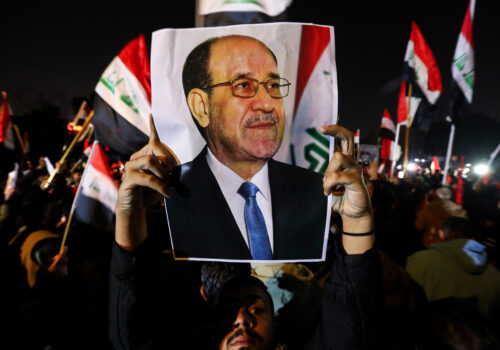
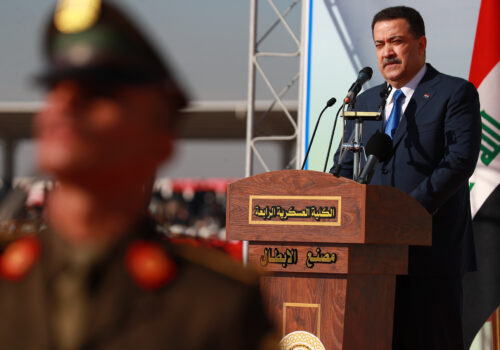
Image: Kurdish supporters of the Kurdistan Democratic Party (KDP or PDK) gather at the Duhok International Stadium during a campaign rally ahead of the Iraqi parliamentary elections, scheduled to be held on 11 November 2025.(Ismael Adnan/DPA via Reuters Connect)