
Amid the Hormuz crisis, an Iraq-Jordan-Egypt oil pipeline can no longer wait
In the summer of 1983, with Iranian missiles turning Gulf shipping lanes into something resembling a free-fire zone, Saddam Hussein’s government sat down to solve a problem that has never really gone away. Iraq’s oil, the lifeblood of its wartime economy, was moving almost entirely through the Strait of Hormuz—a narrow corridor that an emboldened adversary regularly threatened to close.
The solution his planners devised was elegant in its simplicity: a pipeline running southwest from the oil fields of Basra, through the Jordanian desert, terminating at the Red Sea port of Aqaba. From there, Iraqi crude could reach global markets without passing through a single contested chokepoint. The project was announced, studied, negotiated over, and quietly abandoned. It has been revived since but derailed at different moments by war, occupation, insurgency, and internal Iraqi politics. This cycle repeated itself, with remarkable consistency, for four decades—and the Basra-Aqaba pipeline was never built.
Now the bill for that failure is coming due. This time, Aqaba is not the end of the answer. So long as the Red Sea and the Strait of Hormuz remain similarly volatile, a pipeline that stops short of Egypt and the Mediterranean trades one vulnerability for another.
SIGN UP FOR THIS WEEK IN THE MIDEAST NEWSLETTER
A warning unheeded
When Iran moved to close the Strait of Hormuz following the outbreak of conflict with the United States and Israel, Iraq had to face what its planners had known since 1983: that an estimated 90 percent of its crude exports flow through a waterway it has no power to protect. The consequences cascaded almost immediately. Baghdad began shutting production at its largest fields—Rumaila and West Qurna 2—making the deepest cuts in a generation, not because of any direct military threat to the fields themselves, but because southern storage facilities (designed for operational throughput rather than long-term holding) simply ran out of space. In the absence of viable alternative export pipelines, estimates suggest that Iraq is losing between $260 million and $280 million in revenue each day.
Despite over a decade of talks, construction on the Basra-Aqaba pipeline never meaningfully advanced. The failure to advance the project had no single cause: It can be attributed to the Iran-Iraq War, the Gulf War, the US invasion, ISIS’s territorial expansion, and even resistance by pro-Iran Shia factions in Baghdad, who opposed the pipeline on the grounds that it would bring Iraqi oil into proximity with Israel.
Now, Baghdad is improvising. After acrimonious negotiations—and a formal threat of legal action from Baghdad accusing Erbil of breaching the Iraqi constitution—Iraq and the Kurdistan Regional Government struck a deal on March 17 to restart crude flows through the long-dormant Iraq-Turkey Pipeline to Turkey’s Mediterranean coast. Exports resumed at an initial capacity of 250,000 barrels per day, with the two sides agreeing to form a joint committee to oversee operations and return revenues to the federal treasury. That figure is a rounding error against the roughly 3.5 million barrels Iraq was exporting daily before the crisis.
With output from Iraq’s main southern fields having already plunged 70 percent, the northern pipeline restart, even if volumes climb in coming weeks, recovers only a fraction of lost export capacity. The Basra-Aqaba pipeline, had it been completed to its phase one capacity of 2.25 million barrels per day, would have offset the majority of what the Hormuz closure took offline, providing a genuine and immediate alternative without the dormancy, the standoff, or the frantic eleventh-hour diplomacy. A second phase, running from the Iraqi city of Haditha to Aqaba with an additional capacity of one million barrels per day, would have brought total corridor capacity to 3.25 million barrels—nearly matching Iraq’s pre-crisis export volumes in their entirety. Instead, with the northern pipeline restart, Iraq is celebrating a partial fix to a problem that should never have been left unsolved.
Egypt’s compound exposure
There is a dimension of this crisis that has received far less attention than it deserves, and it runs through Cairo. When the Basra-Aqaba pipeline discussions gained momentum in 2016, Egypt was formally brought into the conversation with the longer-term vision of positioning Cairo as an active hub in a land-based Gulf energy corridor reaching Mediterranean and global markets. The original Basra-Aqaba proposal, designed to terminate at Jordan’s Red Sea port, had by then been expanded to include Egypt—extending the corridor’s ambition westward to the Mediterranean. That vision was soon shelved along with everything else. Egypt now finds itself absorbing the costs of the current crisis from every direction at once, with none of the structural revenues that corridor integration would have provided.
The picture is one of compounding fragility. Suez Canal revenues, which had been projected to recover toward eight billion dollars in 2026 following the Gaza cease-fire, are once again under pressure as major carriers weigh the risk calculus of Red Sea routing against the longer but safer passage around the Cape of Good Hope. At the same time, Israel has halted natural gas flows from the Tamar and Leviathan fields to Egypt, a supply that the country had come to rely on for both domestic consumption and liquefied natural gas (LNG) re-export revenues. Egypt’s budget for this fiscal year was calculated assuming oil at seventy-five dollars per barrel, a figure that now bears little relationship to market reality, forcing the government to chase spot LNG cargoes at elevated premiums it can ill afford.
Meanwhile, Egypt faces $27 billion in external debt service due in 2026 against roughly $53 billion in international reserves. An estimated two billion to six billion dollars in foreign holdings of Egyptian government debt instruments has already exited the market, renewing pressure on a currency that took years of painful International Monetary Fund–guided adjustment to stabilize.
Against this backdrop, Egyptian Mediterranean ports have quietly become an improvised transit lifeline, with cargo being offloaded and moved overland to Red Sea ports for onward delivery to Gulf destinations. Egypt is already performing the corridor functions that a formal Basra-Aqaba-Egypt pipeline architecture would have institutionalized, only now it is doing so informally, without the infrastructure investment, long-term agreements, or revenue arrangements that would make the role sustainable. The country’s geographic value is being recognized in a crisis that its economy is simultaneously struggling to survive.
A foundation without a roof
The corridor logic, however, has never been purely theoretical—nor has it lacked institutional foundation. Since 2019, Egypt, Iraq, and Jordan have convened a series of trilateral summits under the Amman-Baghdad-Cairo framework, with energy integration and pipeline connectivity among the agreement’s explicit pillars. The precedent runs deeper than recent diplomacy. During the Iran-Iraq War, Jordan served as Iraq’s primary import-export conduit while Egypt supplied over a million laborers to fill jobs vacated by Iraqi conscripts—making Iraq, at that moment, Egypt’s single largest source of remittances. These three countries have an economic interdependence that keeps reasserting itself in moments of regional stress, and they have been trying, with the tools available to them, to give it permanent form. The summits exist. The framework exists. And the political will among the three governments, however constrained by Baghdad’s internal divisions, Amman’s fiscal limits, and Cairo’s institutional pressures, has proven more durable than the results suggest.
Iraq, Jordan, and Egypt should build the pipeline, extend it through Egypt to the Mediterranean, and treat it as the strategic infrastructure it has always been. The financing question, which has too often been regarded as a reason to delay rather than a problem to solve, is more tractable than it appears. It is the politics, not the funding, that has always been the harder obstacle. Iraq has already allocated federal budget funds for the first leg and structured the second phase for private investment. The missing ingredient is the sustained engagement of international partners—Gulf sovereign wealth funds, multilateral development institutions, and Western governments with a direct interest in regional energy stability—willing to bring the institutional weight that transforms a framework agreement into a pipeline in the ground.
Every year the Basra-Aqaba-Egypt corridor remains unbuilt is a year in which the region’s most crisis-tested economic relationships remain hostage to infrastructure that was never completed. Iraqi planners understood the problem in 1983. The pipeline that they all agreed was necessary has still never been built, and the region is paying the price. Until it is, the next crisis will find the same vulnerabilities in the same places.
Maisoon H. Kafafy is a senior advisor to the Atlantic Council’s Middle East programs, where her work focuses on Middle East and North Africa security, regional cooperation strategies, and geoeconomics.
Further reading
Tue, Mar 17, 2026
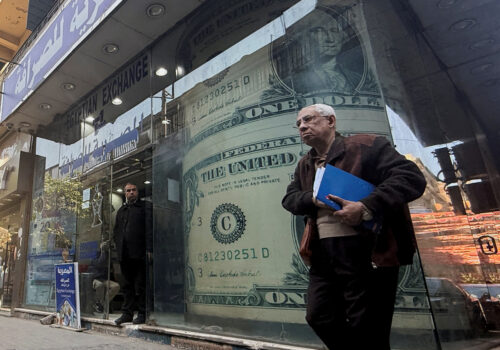
A crisis in Egypt could be a warning sign for the global economy
MENASource By Khalid Azim
Market watchers should keep an eye on Egypt as an oil shock could cause financial turmoil.
Thu, Mar 12, 2026
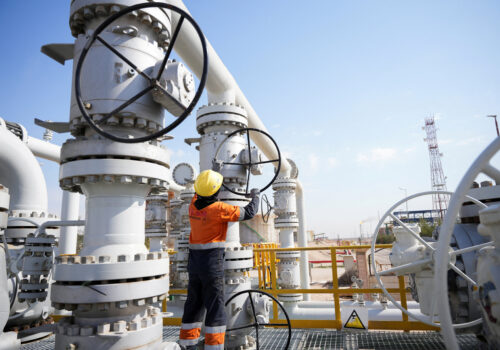
Energy under attack: What the Gulf can learn from Ukraine and Iraq
Dispatches By
In their successes and shortcomings, Iraq and Ukraine are cases worth studying by countries currently under attack from Iran.

Wed, Mar 11, 2026
Twenty questions (and expert answers) about the Iran war
Dispatches By
As the US-Israeli war against Iran reverberates across the Middle East and the globe, Atlantic Council experts bring clarity to the fast-moving events.
Image: A gas flare burns in the distance at the Rumaila oil field, amid nationwide output cuts following the closure of the Strait of Hormuz, in Basra, Iraq, on March 4, 2026. Photo via REUTERS/Essam Al-Sudani.