When President Trump returned the bust of Sir Winston Churchill to the Oval Office, I hope he might also have spent some time reading up on some of his most memorable quotes.
Two seem particularly relevant at this time. Speaking of the consequences of starting a war, Churchill wrote: “once the signal is given, he is no longer the master of policy but the slave of unforeseeable and uncontrollable events.” And more than a century ago, regarding fuel for the navy, he said that energy security comes from “variety and variety alone.” Both remain very relevant today.
One of the principal roles of energy policy is to protect a country and its citizens from massive, external, and unpredictable shocks. Without security, energy won’t be affordable and it certainly won’t be clean either. And while there is a cost to energy security, it is nothing like the cost of insecurity.
The lessons of inaction
Europeans are learning, for the second time in five years, that we have allowed ourselves to be too dependent on vulnerable supply routes. Europe paid a very high price for its overreliance on Russian gas. The argument had been that Russian gas was cheaper, which helped drive European economies, especially in Germany. That held good—until it went catastrophically wrong.
Now the world is seeing the economic threat from the overreliance on oil, gas, and their associated products through the Strait of Hormuz. It wasn’t as though there were no warnings about the risk. Over the past two decades, Iran has repeatedly threatened to blockade the Strait. When it didn’t happen, policymakers breathed a sigh of relief and did nothing more to address the long-term vulnerability it posed.
In the past couple of decades, the world has faced many massive energy shocks. The Fukushima disaster, which forced the world to consider whether it could safely keep its nuclear power plants open. The Macondo disaster, which led to doubts about the future of deep-sea drilling for oil and gas. Those past threats by Iran to blockade the Strait of Hormuz. Russia’s full-scale invasion of Ukraine, as well as an earlier Russian dispute, which stopped Russian gas transiting Ukraine to Europe. And, for the United Kingdom, the closures of the Lanegeled pipeline, which is our most important source of gas imports from Norway.
All of those crises were largely unpredictable and unexpected. The difference this time is that the consequences of war with Iran should have been better anticipated and the challenges the world has been facing from the closure of the Strait were far from unpredictable.
The energy crisis across regions
The degree of impact of the oil and gas blockage varies across regions. European and UK reliance on Qatari liquefied natural gas (LNG) has reduced in recent years, in part replaced by US LNG coming into the European market (which has increased four-fold since Russia’s invasion of Ukraine). However, the global impact is greater than ever, and after just a few weeks, Asia is seeing significant LNG supply shortages, and is taking steps to introduce rationing, reduce demand, or increase the use of coal. Fuel is being rationed in a growing number of countries in Africa, and may be required in Australia to prevent panic buying. Pakistan is cuttingsupplies to industrial customers, and Bangladesh is imposing temporary blackouts. With nearly 20 percent of the world’s LNG coming through the Strait of Hormuz, Europe will certainly also be impacted, as US LNG is pulled toward Asia.
To put it in a stark comparison, world demand for oil dropped by 8 million barrels a day during the first year of Covid. The closure of the Strait of Hormuz has led to a loss of 11 million barrels a day, so the impact is potentially significantly worse.
All this means, regardless of how long this crisis lasts, global policymakers need to start planning now for how we reduce this dependency in the future—not just for oil and gas but also for associated products like fertilizer. Around one-third of global fertilizer supply is currently blocked, and a similar proportion of the world’s helium, a product of natural gas processing.
Europe’s path toward variety
Security of supply is multidimensional. It relates to the sources of supply, the diversity of the supply routes, and also the physical security of those routes. Countries that depend on imports need to look at how they reduce that dependency, and make routes to market more secure.
Europe needs to act collectively to hasten the opening up of other sources of crude oil, gas, and refined products, for example in Syria, which can start producing again after years in force majeure.
For the UK, it should also mean maximizing output from the North Sea—regardless of how much gas we will need, it must make sense that as much as possible should come from its own resources (which will also contribute taxes to the government and sustain jobs, even if not affecting prices).
Europe must look at creating new routes to market. New pipelines can be built to reduce pressure points, for example, from Saudi Arabia through Jordan and Syria, or to enable more gas from the Caspian to flow to Europe.
Moreover, Europe needs a strategy to revitalize its declining refinery capacity, rather than too often seeing it as a nice-to-have optional extra. Government strategy will be central to delivering this, but it can only happen if European countries become competitive once again as places to operate energy-intensive industries.
This is a global challenge where Europe must work with partners in the Gulf. Reducing over-dependency is as much in their interests as producers as it is in ours as consumers, and, ultimately, their security is inextricably linked to ours. The Gulf countries fully understand that they need to be reliable partners, where supplies cannot be interrupted at catastrophic cost, and have a vested interest in working with Europe to deliver a more secure and sustainable model.
Let this crisis be a wake-up call
European governments want to reduce exposure to volatile global gas prices by shifting the economy further away from hydrocarbons. While this crisis brings home the risks of being dependent on imports, especially where there are geopolitical risks and natural pain points, we need to be honest in recognizing that, even with a transition away from hydrocarbons, we will be using oil and gas for many years to come.
Regardless of how long this crisis lasts, Europeans need to see it as a wake-up call and, when it is over, we cannot just go back to business as usual. Our energy security, our critical national infrastructure, and our vital energy industries are just too important to be left to the market.
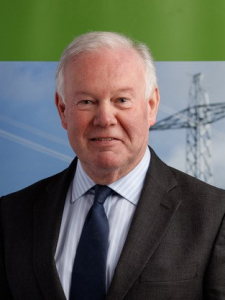
Charles Hendry is a distinguished fellow of the Atlantic Council Global Energy Center and a former UK minister of state for energy.
about the author
stay connected
Sign up for PowerPlay, the Atlantic Council’s bimonthly newsletter keeping you up to date on all facets of the energy transition
related content

our work

The Global Energy Center develops and promotes pragmatic and nonpartisan policy solutions designed to advance global energy security, drive economic opportunity, and foster a sustainable energy future.
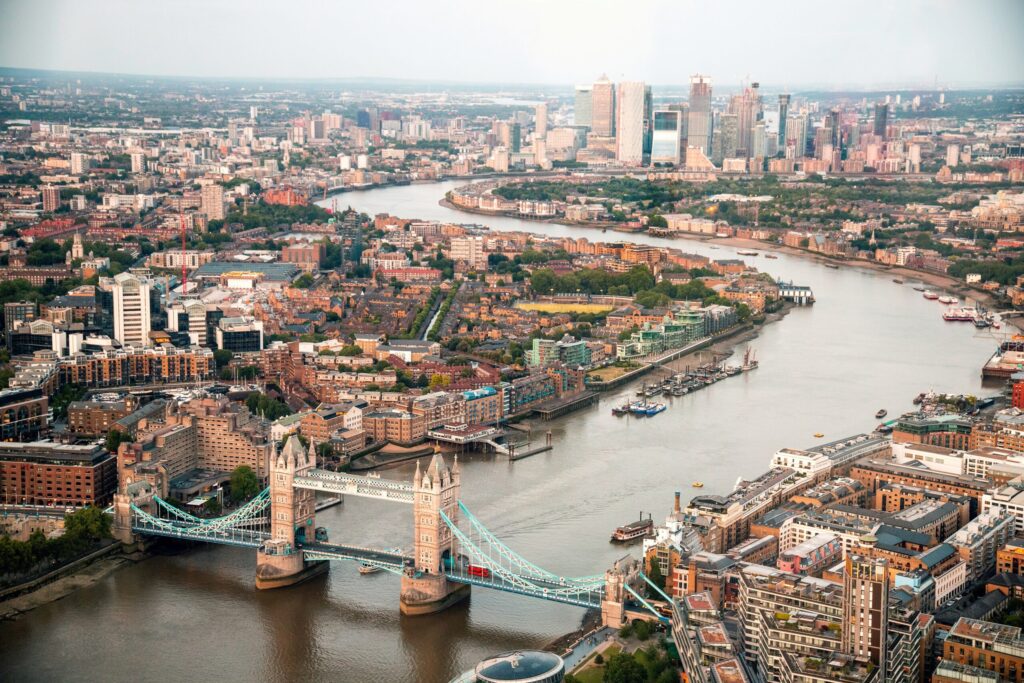
Image: London (Sander Crombach, Unsplash, https://unsplash.com/photos/the-shard-skyscraper-in-london-england-6b3r1WAjPBI)
