
Sri Lanka needs a development plan, not just a recovery narrative
Bottom lines up front
- Sri Lanka’s gains over the past thirty years have been episodic and reversible, because governance has been neglected.
- The impact of Sri Lanka’s 2022 debt crisis on real wages, employment, poverty, and pensions, showed how fiscal crises are ultimately social crises.
- Sri Lanka needs four things working together: macroeconomic discipline, institutional reform, ethnic reconciliation, and an effective export-led growth strategy.
This is the eleventh chapter in the Freedom and Prosperity Center’s 2026 Atlas, which analyzes the state of freedom and prosperity in ten countries. Drawing on our thirty-year dataset covering political, economic, and legal developments, this year’s Atlas is the evidence-based guide to better policy in 2026.
Evolution of freedom
Sri Lanka entered the period covered by the Freedom Index with a paradoxical institutional profile. By the mid-1990s, the country had already achieved levels of education, health, and basic social development that far exceeded what its income level would suggest. At the same time, its institutional framework was under severe strain. A protracted armed conflict, a highly centralized state, and recurrent policy reversals had already begun to erode confidence in governance. As a result, the evolution of the country since 1995 is a story of sharp swings, missed opportunities, and fragile gains that repeatedly failed to consolidate.
Looking at the aggregate Freedom Index, Sri Lanka’s trajectory is marked by volatility rather than steady progress. Freedom as it is measured by the index declined in the early 2000s, recovered strongly after the end of the armed conflict in 2009, improved further through much of the next decade, and deteriorated again during the period of political instability and economic crisis that followed. Despite these fluctuations, the country’s overall freedom score today remains higher than it was in 1995. Yet this headline improvement conceals two underlying problems: First, gains in individual dimensions of freedom were rarely synchronized, and advances in one area were often undermined by weaknesses in others; and second, improvements have not been consistent but have oscillated significantly with changes in political leadership. This lack of complementarity and consistency is central to understanding Sri Lanka’s institutional evolution.
Trying to build economic progress on top of poor governance is like building a house upon the sand.
The subindex on economic freedom illustrates this pattern. From the late 1990s onward, Sri Lanka maintained a broadly liberal economic framework, with relatively open trade policies and a formal commitment to secure private property and market-based systems. This economic framework, however, was not adequately supported by a stable and predictable policy and governance framework. This could explain why the index shows economic freedom fluctuating over time. The key learning from Sri Lanka, evidenced in many other countries as well, is that durable economic freedom grows in the soil of solid institutions and governance. Neglecting governance makes economic progress unstable and unsustainable. This problem surfaced in a calamitous way in the mid-2020s when Sri Lanka faced the most severe economic crisis in its post-independence history. The index shows economic freedom in the 2020s largely returning to its mid-1990s level. This reversal supports a growing understanding: that trying to build economic progress on top of poor governance is like building a house upon the sand.
Investment freedom has similarly been sensitive to political stability. The index shows the highest levels on record between 2001 and 2003, when active efforts to settle Sri Lanka’s violent conflict through peace negotiations were underway. The lowest levels were in 2009 at the height of the violent conflict (which ended in May of that year). The fluctuations after that track a mixture of deficits in social peace and predictability of policies. The picture that emerges suggests that investor response is highly sensitive to perceptions of political and economic stability, which are reflected through the overall climate of peace and governance.
The subindex on trade freedom was at its highest level just prior to the political change that accompanied the 2004 elections and dropped to its lowest as Sri Lanka experienced a currency crisis in 2021. The country’s trade freedom index seems to be tracking its political cycles. These have fluctuated between two major polarities—inward-facing political ideologies, where trade openness is seen as a threat to protect against, and outward-facing ideologies where global integration is seen as an opportunity. In keeping with these cycles, Sri Lanka’s trade freedom shows steady progress all through the 1990s up to 2003, when a new government came to power. It then went into a steady decline until 2014, when it started to improve following another change in government; trade freedom fluctuated with the shorter political cycles thereafter.
Building economic progress on top of poor governance is like building a house upon the sand.
The sharp dip observed at the cusp of the economic crisis reflects not a structural reversal, but the vulnerability of openness in the absence of adequate buffers and professional governance. The trade freedom index also reflects that, despite relative openness to international trade in the past, with fewer formal barriers than many countries in the South Asia region, Sri Lanka’s openness did not translate into deeper global integration or export dynamism. Trade freedom coexisted with a stagnant export basket and repeated episodes of import compression during times of crisis.
One of the more stable indicators within the economic subindex has been women’s economic freedom, which measures the parity in legislative treatment of men and women. Legal equality in economic rights improved over time, supported by reforms that strengthened women’s ability to work, own property, and engage in business on equal terms with men. The most recent improvement to the index in 2022 resulted from an amendment to the law on the rights to use state land, which removed the preference given to sons over daughters in the inheritance of such rights. These gains built on long-standing social investments in education and health that were equally available to men and women.
At the same time, however, improvements in formal rights did not automatically translate into commensurate labor market outcomes. Sri Lanka has a large gender gap in employment among prime working-age adults (25 to 54): Over 90 percent of men are employed, compared with fewer than 45 percent of women. While Sri Lanka has laws requiring that women receive three months of maternity leave, it is among a minority of countries globally where the state does not fund maternity leave. Consequently, the data shows that younger women face discrimination in the private sector job market. This is a reminder that parity under the law, while necessary, is not sufficient for advancing women’s economic freedom.
Political freedom reveals an even more pronounced pattern of disruption and recovery. During the years of active conflict, political institutions operated under exceptional circumstances. Governance was shaped within an atmosphere of security-based fear: The use of emergency powers was normalized, and democratic space was squeezed. The end of the armed conflict in 2009 marked a turning point in beginning to reverse these trends, but the political freedom index seems to track leadership cycles. While political freedom improved gradually in the years after the conflict ended, the sharp and decisive improvement took place only when the government changed in 2015, creating greater space for electoral competition, civil liberties, and political participation.
The index registers a decline in 2019 following a “constitutional coup”—when the president attempted, illegally, to oust the elected government—and a subsequent change in the president and the government that led to a more centralized authority and the use of exceptional legal frameworks. The improvement in the index in 2022 tracks yet another change in political leadership—when mass protests caused the president to resign. The overall pattern suggests that democratic practices in Sri Lanka remain highly contingent on leadership and context, rather than firmly institutionalized.
The component that provides the starkest evidence of this fragility is legislative constraints on the executive. This indicator shows some of the largest swings across the entire Freedom Index. This index also tracks political cycles closely—especially changes to the constitution within those cycles that significantly expanded and contracted executive power as a result of four constitutional amendments. When the parliament majority is from the same party as the president, its ability to effectively oversee and restrain the executive has remained weak and inconsistent. The cycles of expansions in executive power have had serious negative consequences, not only for political freedom but also for the quality of economic decision-making in the country.
The legal subindex, much like the political subindex, tracks the changes in political cycles. While it suggests that the rule of law in Sri Lanka has improved overall since the mid-1990s, it also shows those improvements have been inconsistent. This means that the rule of law in Sri Lanka is not adequately institutionalized and depends heavily on the personalities and practices of its political leaders.
Clarity of the law has some of its lowest scores during periods of conflict and the COVID-19 pandemic. During what was deemed emergency periods, the executive had some measure of authority to ignore laws, enforce them selectively, or override them through exceptional measures. These were periods in which the fabric of democracy was destabilized. The period between the end of the conflict and the onset of the pandemic brought some relief and recovery in this category, especially during a change in the political cycle from 2015 to 2018, during which judicial independence and effectiveness improved significantly. But there too, consistency remained a problem as gains in judicial independence reversed when executive assertiveness had social support and political incentives shifted.
The security component of the legal subindex, unsurprisingly, tracks periods and episodes of conflict. The index improved dramatically when the armed conflict was suspended in 2002 with a strong initiative to negotiate a political settlement. The index declined steadily as that initiative failed and conflict escalated until 2009 when it ended through violence rather than negotiation. For much of the following decade, the security measure improved dramatically. Any setbacks during that time can be traced to episodes of religious violence against Muslims and Christians in Sri Lanka’s social context of a majority Buddhist population.
The improvement in security after the end of the armed conflict was based on negative gains—a reduction in violent events rather than positive gains such as greater safety and protection under the law. Many of the extrajudicial means the state used against its armed opponents were in some measure deployed against its political and civil society critics as well. Draconian laws such as the Prevention of Terrorism Act continued to be used, and laws drawn up to protect civil rights, such as the law designed to give effect to the International Covenant on Civil and Political Rights, were abused to suppress democratic opposition. It is therefore apparent that political cycles also had an impact on the security context.
Bureaucracy quality and control of corruption in Sri Lanka has consistently been higher than the regional average as it is measured by the index, but they have moved in opposite directions. Sri Lanka’s index has followed an oscillating and declining trajectory, while the regional index has been improving steadily in the last decade. Moreover, Sri Lanka’s higher index values, relative to the rest of the region, should be evaluated with caution. Sri Lanka may have avoided some of the extreme governance failures seen elsewhere, but bureaucratic effectiveness was undermined by politicization, weak incentives, and limited accountability.
Taken together, the evolution of freedom in Sri Lanka since 1995 reinforces a central lesson: Freedoms do not accumulate automatically with increases in GDP. Gains in political rights, economic openness, or security can be real, but they remain vulnerable when not supported by a stable and credible rule of law. Sri Lanka’s experience illustrates the costs of imbalance. Without durable legal foundations and effective constraints on executive power, advances in freedom proved episodic rather than transformative. This institutional fragility would go on to shape not only the country’s democratic trajectory, but also the nature and sustainability of its economic and social outcomes, as shown in the next section.
From freedom to prosperity
The Prosperity Index captures the cumulative outcomes of a country’s institutional framework on quality of life, not just the increase in overall incomes. Sri Lanka entered the 1990s with a level of prosperity well above the regional average, largely because of its early and sustained investments in health, education, and basic social infrastructure. Yet, over time, that initial advantage eroded, not because Sri Lanka’s rate of GDP growth was significantly lower but because growth came with increased inequality and without concomitant improvements in overall social infrastructure. Consequently, Sri Lanka’s prosperity, as measured by the index, grew much more slowly than the average among its regional peers in South and Central Asia.
The income dynamics in Sri Lanka illustrate both the achievements and the vulnerabilities of its development model. Since 1995, real income per capita rose steadily, apart from a short recession in 2001 as Sri Lanka responded late to the aftereffects of the East Asian economic crisis. Growth was consistent despite internal armed conflict and various shocks from natural disasters to global markets. But growth relied heavily on domestic demand, government spending, and external borrowing, rather than on productivity gains or export expansion. By 2020, along with major tax cuts, the interest cost on debt as a ratio of government revenue reached 70 percent. These unsustainable dynamics triggered a full-blown debt crisis in Sri Lanka in 2022. Consequently, the country’s GDP contracted by 10 percent, and it is expected to return to its 2018 level only in 2026.
The structure of Sri Lanka’s growth helps explain this fragility. Over time, services became the dominant driver of economic activity, while agriculture remained at low productivity subsistence levels and industry expansion was narrowly focused and anemic. The export basket remained remarkably static for decades, dominated by clothing, tea, and a small number of primary or low-value-added products. Goods exports as a share of GDP fell from 33 percent to 12 percent between 2000 and 2020. Tourism and worker remittances increasingly compensated for the shortfall, providing foreign exchange and supporting consumption, but neither could substitute for a diversified and competitive tradable sector.
Health outcomes represent one of Sri Lanka’s most enduring strengths. Life expectancy has remained high relative to income, reflecting long-standing public investment in universal health care and early successes in combating communicable diseases. Although the data shows sharp dips during destabilizing events such as the tsunami, the final phase of the war, and the COVID-19 pandemic, the underlying trend remains positive. Sri Lanka’s experience during the pandemic, in particular, demonstrates the resilience of its health system, as the decline in key indicators was smaller than in many comparable countries. That said, headline indicators mask persistent challenges, including child malnutrition and uneven quality of care, which are not fully captured by aggregate measures.
Education outcomes follow a similar pattern of early strength and later a plateau. Universal access to schooling, compulsory education, and the absence of gender discrimination produced high average years of schooling and placed Sri Lanka well above the regional average. Education became deeply embedded in social norms as the primary path to upward mobility. However, progress slowed as the system approached its natural ceiling in basic education. This is due to Sri Lanka not being able to expand access or improve the quality of its university education, even compared to the region. As a result, high levels of basic education did not translate into a sufficiently high-level workforce for a more complex, knowledge-driven economy. This lack has become more critical as the country seeks new sources of growth.
Sri Lanka combined rising incomes with limited redistribution, allowing disparities to persist even as the economy expanded.
Income inequality presents a more troubling picture. Inequality started high in 1995 and has systematically worsened over the last three decades, as measured by the index. Growth disproportionately benefited better-connected regions, while other areas lagged. Although progress was made in poverty reduction, and extreme deprivation remained limited by regional standards, the distribution of gains was uneven. Weak income taxation and heavy reliance on consumption taxes meant that the better-off contributed relatively little to financing public goods and social protection. As a result, Sri Lanka combined rising incomes with limited redistribution, allowing disparities to persist even as the economy expanded. The 2022 debt crisis exacerbated these dynamics, with poorer households bearing a disproportionate share of the adjustment. Sri Lanka also became the first country in the world to exclusively target its workers’ retirement funds in domestic debt restructuring. These dynamics point to a significant capture by elite interests of the Sri Lankan state and its policy choices.
Minority access to public services and opportunities improved markedly after the end of the war, as conflict-affected regions reconnected with the state and the economy. At the same time, the data shows episodic volatility tracking changes in the political space afforded to majority nationalist movements that spread ethnic and religious hostility, which affected perceptions of access and inclusion. These fluctuations highlight the continued sensitivity of social outcomes to political cycles in Sri Lanka.
Taken together, Sri Lanka’s prosperity record underscores the limits of partial institutional progress. The country converted early social investments and episodic freedom gains into real improvements in living standards, but it failed to build an economic model and the institutional depth required to sustain a path of improvement. Low bureaucratic capability, policy volatility, hostile cycles of nationalist politics, and weak rule of law constrained the translation of freedom into inclusive and sustainable prosperity. When shocks arrived, these weaknesses magnified their impact. Understanding this link between institutional fragility and prosperity outcomes is essential for assessing Sri Lanka’s future trajectory, which turns on whether the country can move beyond picking itself up in the wake of crises and embrace a more durable development path.
The path forward
Looking ahead to the next five to ten years, Sri Lanka stands at a critical juncture shaped as much by accumulated institutional weaknesses as by a rare moment of social and political clarity. The recent crisis exposed deep failures in governance, policy design, and implementation. At the same time, it generated a strong societal rejection of the practices that led to collapse and a growing demand for competent, professional, and accountable government. Whether this moment becomes a genuine turning point will depend on how decisively the country addresses the structural constraints identified in the preceding sections.
A central challenge for Sri Lanka is conceptual rather than technical. For decades, governance has been dominated by crisis management. Political instability, security threats, fiscal pressures, natural disasters, the pandemic, and the debt and currency crisis forced governments into short-term, reactive decision-making. Crisis management narrows vision. It prioritizes immediate stabilization over long-term strategies for success, and encourages a focus on headline macro indicators rather than underlying vulnerabilities in the real economy and social infrastructure. Avoiding a repetition of this cycle requires a shift from managing crises to addressing the deeper institutional conditions that make crises so damaging in the first place.
Treating [the IMF stabilization program] as an endpoint rather than a foundation would risk repeating past mistakes.
This distinction is particularly important in how the current stabilization effort is understood. The IMF-supported program has played a crucial role in restoring macroeconomic order. Foreign exchange reserves have been rebuilt, fiscal balances have improved, and immediate systemic risks have receded. But the program, by design, is a crisis response rather than a comprehensive development strategy. Treating it as an endpoint rather than a foundation would risk repeating past mistakes. Over the coming decade, Sri Lanka needs to embed stabilization within a broader, domestically articulated development framework that aligns macroeconomic discipline with social recovery, institutional reform, and export growth.
There is also a significant risk of premature success narratives. GDP may eventually return to its 2018 level, but this recovery will have taken far longer than in comparable countries. Inflation was reduced quickly but at the cost of extraordinarily high interest rates that inflicted lasting damage on large segments of the business sector. Real wages remain well below pre-crisis levels, employment is at a twenty-year low, and poverty has risen sharply by both historical and international standards. Among recent debt restructuring episodes, Sri Lanka ranks poorly in terms of protecting social outcomes. If recovery is assessed only through fiscal and monetary indicators, these human costs risk being obscured rather than addressed.
Against this backdrop, one of the most urgent reform priorities for the next decade is the restoration of professional competence in economic governance. Sri Lanka has repeatedly announced ambitious aspirational targets but has struggled to put in place real plans to execute them. This failure is most evident in export performance. While countries across the region transformed their export sectors, Sri Lanka’s exports remained largely stagnant. This outcome reflects not an absence of opportunity but weaknesses in policy design, coordination, and institutional learning. The current positive developments in anti-corruption efforts in Sri Lanka are a welcome and essential prerequisite, but they don’t go the full distance in solving the core problem. For that, Sri Lanka must also reverse the long-term erosion of technical analytical capacity, evidence-based policy formulation, and effective implementation capability across the state.
Professionalism in governance also requires a risk management approach to future consequence contingencies arising from present actions and unplanned events. External shocks—whether climate-related, geopolitical, or financial—are inevitable. The critical question is not whether shocks will occur but how prepared institutions are to absorb them. Well-governed economies build buffers in advance and plan for uncertainty. Sri Lanka has too often responded only reactively after those events have come home to roost, magnifying the economic and social costs of the problem. Institutionalizing risk management within economic and social planning is therefore essential to minimize the destabilizing effect of future shocks.
The critical question is not whether shocks will occur but how prepared institutions are to absorb them.
Sri Lanka’s development strategy over the next decade will also struggle, as it has in the past, if it does not confront the country’s unresolved national question: how to build a political community in which minorities feel not merely tolerated but equal, secure, and able to belong without fear. Ethnic reconciliation is often treated as a “peace” agenda, separate from “economic progress,” but in practice it is integral. It is not a separate goal but an integral part of rebuilding legitimacy, reducing political volatility, and creating the stable social foundation without which long-term investment, policy credibility, and national development will remain structurally fragile.
While Sri Lanka has been exemplary in holding regular elections and peaceful transitions of political power, democracy does not mean only that decision-makers get elected. Democratic governance requires public understanding and acceptance of the decisions that are being made. Therefore, strengthening openness and answerability of government are also crucial elements of the governance solution. Openness (or transparency) is allowing society to see correctly and easily what decision-makers are doing, and answerability is the obligation of decision-makers to explain their reasoning and justify their choices. These two aspects are particularly powerful in improving decision quality. Embedding these norms across economic institutions, parliament, and the bureaucracy will be essential for building effective governance in Sri Lanka.
Looking further ahead, Sri Lanka must also adapt to profound structural changes. Digitalization and artificial intelligence are reshaping labor markets and production globally. Limited access to the digital economy will increasingly resemble illiteracy in its effects on opportunity and inclusion. Expanding digital access is therefore a development imperative rather than a discretionary policy choice. At the same time, demographic pressures, gender gaps in labor force participation, and the demands of an aging society will require more sophisticated and coordinated policy responses than those of the past. Ultimately, the development vision for the next decade must move beyond GDP growth. As the preceding sections have shown, prosperity depends on outcomes that are embedded in governance and are broad-based and sustainable. Reducing poverty, restoring real wages, expanding employment, improving and expanding public transport, health care, tertiary education, digital adoption, and export capability, and strengthening institutions are not peripheral concerns; they are central to building an economy that can break from the cycles of the past and set itself on a trajectory of success. Sri Lanka has, at moments in its history, demonstrated the ability to make strategic breaks from the past. It now finds itself at a pivotal moment when it can decide to do so again. The choices made this year will determine whether the path in the coming decade leads to repeating cycles of recovery and crisis or will take a new direction that delivers steady and sustainable progress. That new trajectory will require a new approach to governance, grounded in institutional renewal, social reconciliation, anti-corruption, professionalism, and purpose.
about the author
Nishan de Mel is the executive director of Verité Research and a former lecturer in economics at the University of Oxford. An economist with extensive experience spanning academic research, public policy, and the private sector, he has played an instrumental role in shaping national policy in social and fiscal governance in Sri Lanka. He has served on various presidential commissions and as member of the regulatory commission for public utilities in Sri Lanka. Recently de Mel was involved in developing the first ever governance linked sovereign bond in the ESG space, which is now traded in global markets.
Explore the data
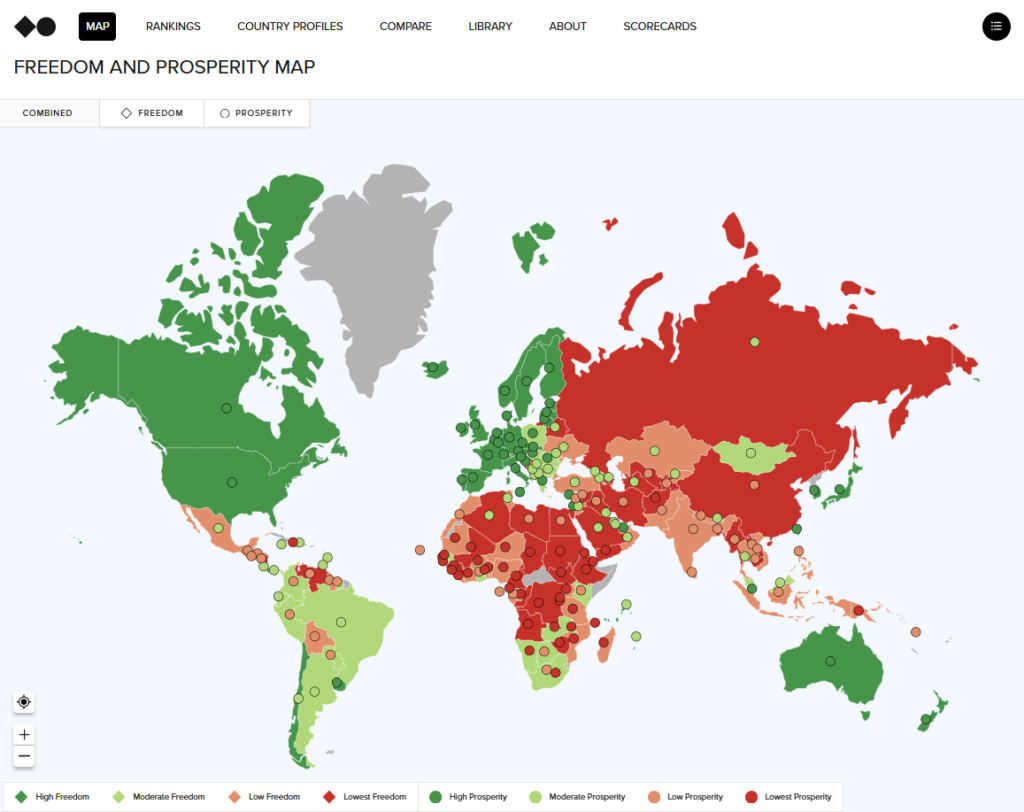
The Indexes rank 164 countries around the world. Use our site to explore thirty years of data, compare countries and regions, and examine the subindexes and indicators that comprise our Indexes.
Stay Updated
Get the Freedom and Prosperity Center’s latest reports, research, and events.
Stay connected
Read all editions
2026 Atlas: Freedom and Prosperity Around the World
Against a global backdrop of uncertainty, fragmentation, and shifting priorities, we invited leading economists and scholars to dive deep into the state of freedom and prosperity in ten countries around the world. Drawing on our thirty-year dataset covering political, economic, and legal developments, this year’s Atlas is the evidence-based guide to better policy in 2026.
2025 Atlas: Freedom and Prosperity Around the World
Twenty leading economists, scholars, and diplomats analyze the state of freedom and prosperity in eighteen countries around the world, looking back not only on a consequential year but across twenty-nine years of data on markets, rights, and the rule of law.
2024 Atlas: Freedom and Prosperity Around the World
Twenty leading economists and government officials from eighteen countries contributed to this comprehensive volume, which serves as a roadmap for navigating the complexities of contemporary governance.
Explore the program
The Freedom and Prosperity Center aims to increase the prosperity of the poor and marginalized in developing countries and to explore the nature of the relationship between freedom and prosperity in both developing and developed nations.
Image: Sri Lankan Army personnel lower the national flag at Galle Face Green in Colombo, Sri Lanka, on July 10, 2025. The military carries out this task every day at the urban coastal park. (Photo by Isura Nimantha/NurPhoto)NO USE FRANCE

Keep up with the Freedom and Prosperity Center’s work on social media