
Making aid work in the new geopolitical era will be an uphill battle
Bottom lines up front
- Short-term wins for aid can weaken state capacity and entrench dependency.
- Aid works where governments are committed, not just where poverty is highest.
- The technocratic era is over; aid is reverting to a geopolitical tool, not a neutral development instrument.
This paper expands on ideas first developed in Stefan Dercon, “Rethinking Aid in a Contested World,” Working Paper No. 2301 (Kiel Institute, October 2025).
The recent shift in the traditional donors’ approach to development aid reflects aid’s essential political nature, temporarily obscured during a technocratic period of aid in the late 1990s to mid-2010s. That era, enabled by unipolarity and globalization, has collapsed. The record of development aid in recent decades is mixed: It supported good deeds and sometimes supported transformation in countries with elite commitment to development, but it also held back the poorest countries where such commitment was absent. Without aligned incentives, aid prolongs the status quo. Today’s multipolar configuration increasingly resembles the 1980s, when aid served primarily as a geopolitical instrument. This trajectory risks giving rogue governments and elites more space to prolong stagnation. Simply pleading for more financial resources for development is risky. Supporting change in the developing world must be based on deep understanding of global and local political economy, finding ways to cautiously support those governments genuinely committed to their populations while avoiding the provision of legitimacy to those who cherish the status quo for their own purposes. Creating space for this in the current global configuration will be an uphill battle for local civil society organizations, international NGOs, bilateral agencies, and multilateral organizations alike, even when they have the best of intentions.
Aid has always been political
Development aid has always been political.1This paper uses aid and development aid interchangeably and refers to what is defined as official development assistance by the OECD: support from governments directly or via multilateral bodies to promote economic development and welfare in developing countries in the form of grants or loans with advantageous financial terms. The Marshall Plan rebuilt Europe not from pure altruism but to shore up postwar Western influence. During the Cold War, aid allocations followed alliance politics and colonial legacies far more than poverty or governance. Even multilateral institutions responded more to historical ties and political loyalty than to need alone. Yet for a brief period from the late 1990s to the mid-2010s, this political nature seemed to fade. Aid appeared to drift toward a more technocratic model, ostensibly driven by development goals, poverty reduction, and measurable outcomes.
That period is over. Official development assistance from OECD countries is projected to fall by up to 25 percent from its 2023 peak, returning aid per capita to 1990 levels in real terms. More revealing than the decline in volume are the shallow political foundations. The elite coalitions that defended aid across foreign policy, security, and business establishments have fragmented. The global context that made technocratic aid possible has collapsed. What remains is a return to aid’s political essence.
This paper argues that understanding this shift requires examining both the history of aid as a foreign policy tool and the political economy of how aid works in recipient countries. The recent technocratic period was an anomaly, made possible by specific geopolitical conditions: unipolarity, globalization, and broad elite consensus in donor countries. Those conditions no longer hold. Today’s emerging multipolar configuration increasingly resembles the 1980s, when aid served primarily as an instrument of geopolitical competition. It is important to learn the lessons of what went well in aid for development in recent decades, but they must be applied in this new reality.
Unless aid actors recognize this reality and adapt, aid risks becoming a mechanism for prolonging the status quo rather than a lever for development.
The anomalous technocratic period
Toward the turn of the century, an unusually permissive environment for aid emerged. The Cold War had ended, and the West faced no serious geopolitical rival. This was the age of unipolarity. Globalization was actively promoted. Countries like Bangladesh, China, India, and Indonesia used global integration to lift hundreds of millions out of poverty. Aid aligned with broader economic and political goals and was no longer seen as charity but as investment in the global liberal order.
Aid also took on a security dimension after 2001. Fragile states came under sharper focus, and aid was increasingly seen as a stabilization tool. These dynamics created rare alignment. Economic, military, and development interests converged. Between 1997 and 2023, the total of official development assistance nearly tripled in real terms.
More importantly, the nature of aid shifted. The United Nations’ Millennium Development Goals (2000) and Sustainable Development Goals (2015) introduced a new narrative: aid framed not as a tool of national interest but as a shared response to global challenges. Evidence suggests that since the early 2000s, major donors began directing larger shares toward poorer countries. In 2000, just 17 percent of total aid was directed to low-income countries; by 2020, that share had risen to 36 percent.
Aid became more tightly focused on delivering measurable outcomes. New delivery mechanisms emerged: President’s Emergency Plan for AIDS Relief (PEPFAR) for HIV/AIDS, the US Millennium Challenge Corporation, and new multilaterals like Gavi and the Global Fund. The outcome was a larger, more technocratic aid system focused on measurable outcomes and operational delivery.
This shift was a political recalibration. Coalitions in donor countries saw development spending as aligned with their own interests. But that alignment was made possible by a unique international moment—understanding that period as an anomaly helps explain why that alignment has fractured.
The 1980s return
By the early 2010s, the world of unipolarity and globalization was already under pressure. Limited growth in median incomes and job losses across OECD countries fed growing discontent. Globalization, particularly trade with China, was quickly blamed. Evidence shows the tangible effects of Chinese import competition on manufacturing jobs in the United States. Yet, the broader picture was more complex: In Germany, trade with Eastern Europe expanded manufacturing, and even in the United States, the impact on jobs from trade was far smaller than those from automation.
Still, perceptions outran evidence. Public sentiment framed China as a threat, reshaping Western foreign policy. Under the first Trump presidency and then the Biden administration, US foreign policy shifted decisively toward strategic competition. Europe and the UK followed suit. China became a rival challenging the Western-led order. This emerging multipolarity undermined the political foundations that positioned aid as complementary to broader foreign policy goals.
The parallels to the 1980s are striking. During the Cold War, aid served primarily as a pawn in geopolitical competition. Strategic objectives such as access to natural resources, military alliances, or vote alignment in multilateral institutions played defining roles. Aid was tied to political conditionality aimed at fostering liberal democracy, often in service of Cold War objectives and with limited success. The approach was selective: Western governments used aid to prop up authoritarian regimes like Mobutu’s Zaire when strategically convenient. Economic reforms were pushed at speeds not politically feasible in richer economies, leading to local contestation and endless policy reversals in developing countries.
Today’s configuration shows similar patterns. China began playing a larger role in development finance, offering infrastructure loans with competitive terms and fewer conditions. Between 2008 and 2019, China’s two main policy banks lent $462 billion, nearly matching total World Bank lending. Migration concerns in response to the 2015 refugee crisis and climate change further complicated the political consensus.
The consensus that once underpinned aid has frayed. By 2025, aid per capita to developing countries has returned to 1990 levels in real terms. The share going to low-income countries has fallen from 36 percent in 2020 to 27 percent in 2022. With rapidly declining US support for multilateralism, the share channeled through multilaterals is expected to shrink. For the remaining amount, donor interests will play a more decisive role.
Doing good vs. driving development
As seen from the point of view of recipient countries and their populations, aid’s record in recent decades is genuinely mixed.
On economic growth, the literature suggests modest impacts: Aid contributes to growth but not by very much. The evidence base is stronger for narrowly defined interventions. For example, PEPFAR shows clear evidence of lives saved. Gavi demonstrates measurable success in vaccine delivery. Aid has yielded undeniable benefits. Lives have been saved, children educated, diseases prevented. These are real achievements. The geopolitical authorizing environment since the late 1990s, with unipolarity and globalization, created space for these achievements; it allowed aid to become more technocratic, focusing on actual need, with a stronger expectation of aid effectiveness.
Yet a deeper challenge emerged, not least in poorer countries, when donors took responsibility for essential services. The result was a fundamental problem: Giving aid creates negative incentives that must be offset by significant positive impact just to break even. When donors fund high-return activities like vaccines or education, governments no longer need to raise taxes for those services, and they can be less concerned with delivering them. The distinction between doing good and driving development matters profoundly.
This plays out visibly in a setting like Nigeria. Despite having a GDP per capita similar to Ghana, Nigeria spends significantly less per person on health, and its infant mortality rate is more than twice as high. Yet by 2023, 44 percent of Nigeria’s public health spending per capita came from aid; in Ghana, that figure was closer to 12 percent. In Malawi, before the abolition of USAID and the aid freeze in 2025, US spending on health care exceeded the Malawian government’s total health budget by more than twofold. This level of dependence after 65 years of assistance points to design failure. Aid has done good in these countries—people have received health care who otherwise would not have, but it has not driven development.
The more effective aid is at doing good in the short run, the more it may undermine development in the long run.
The problem is structural. Donors’ insistence on funding only the highest-return activities has measurable consequences. Doing good can become doing too much, crowding out local systems. When USAID cuts were announced in 2025, critical health services disappeared almost overnight in many countries. The sudden change showed that when donors prioritize short-run, visible results, there is little impetus for the harder work of building sustainable systems financed by the local governments. This creates a difficult reality: The more effective aid is at doing good in the short run, the more it may undermine development in the long run. The reason is that aid becomes part of the recipient country’s political economy—it is never neutral.
Why commitment matters
Development is not merely a technical puzzle, but a political choice as well. Over the past few decades, some countries managed to grow substantially: Bangladesh, China, Ethiopia, Ghana, India, Indonesia, and Vietnam. These countries share little in terms of political systems, state capacity, or colonial legacies. In fact, many appeared, broadly speaking, institutionally similar to countries where growth had stalled, like Nigeria, Malawi, Pakistain, or South Korea.
What made the difference was the presence of relatively stable elite coalitions committed to development: powerful political, business, civil society, military, media, and other leaders going beyond their own narrow interests to drive progress. This commitment was reflected in policy choices: backing sensible economic policies, ensuring public spending had a developmental tilt, and a willingness to learn and adjust. In less successful countries, such coalitions either never formed or formed with priorities centered on preserving power. Growth and development are politically disruptive. For many elites, choosing development is a gamble. Some coalitions have been willing to take that risk. Others prefer stasis.
Once aid enters this political context, it cannot be neutral. In countries where elites are committed to development, aid can work as intended, accelerating progress. This has been the experience in Bangladesh, Ethiopia, Ghana, parts of India, and Vietnam during key reform periods. In these settings, aid helped strengthen underlying systems.
But when governments do not allocate budgets toward development priorities, when bureaucracies only function as vehicles of patronage, when elites fail to build basic coalitions for stability, delivering visible results seems like the only option for donors. This is closer to the experience of Malawi, Nigeria, or South Sudan.
The need remains urgent, but the path out of aid dependency remains elusive. At worst, attempts to support locally owned systems amount to little because domestic political commitment is absent. At best, aid delivers short-run gains while tolerating long-run distortions, reinforcing the very incentives that make real development difficult.
Aid responding to need alone can inadvertently reinforce conditions that undermine development. Prioritizing saving lives today can weaken political incentives for building systems that save far more lives tomorrow. Even humanitarian aid may have negative effects, including undermining peace and stability. There is evidence that US food aid increases conflict in recipient countries. The point is not to abandon life-saving support, let alone aid, that delivers results for those in need, but to recognize the long-term risks when aid displaces domestic responsibility and entrenches dysfunctional politics.
Four key lessons from the past
Even if the geopolitical shifts had not materialized to the extent they now have, recent decades would have led to several key required shifts. First, development aid should become more selective, prioritizing countries that demonstrate genuine political commitment to development. Without a domestic coalition that owns and drives the reform agenda, large-scale sustainable progress will not happen. Multilateral banks function as cooperative banks, providing broadly equal access regardless of political incentives. In 2019-20, among the top borrowers from the World Bank’s concessional lending window, the International Development Association, were Nigeria, Pakistan, and The Democratic Republic of the Congo, cases where neither sound economic policy nor elite commitment to development were obvious.
Second, aid should not respond to need alone. While morally compelling, need-based aid can inadvertently reinforce conditions that undermine development. This means recognizing that the basis for sending aid to countries like Malawi or Nigeria in recent decades may not have been sufficient.
Third, the drive for short-term, measurable results must be balanced against risks of undermining long-term institutional development. Favoring interventions with clean evidence risks crowding out investments in longer-term systembuilding where impact is harder to measure. What looks effective on a spreadsheet may deepen aid dependency and make future progress harder to sustain.
Fourth, if political commitment is essential for progress, aid should support and strengthen those who are genuinely trying to drive change in the recipient countries. That means backing reformers with resources, ideas, and expertise, but also helping to build broad-based coalitions for development. One of aid’s most useful roles may be de-risking reform. Real change creates winners and losers, and entrenched interests will push back. Aid can lower the cost of commitment, for example by crowding in other finance or helping to stabilize fragile transitions.
This is a far cry from the old model of aid conditionality, where donors imposed economic or political reform as a prerequisite for disbursement, a hallmark of the 1980s and 1990s. That model sought to impose commitment rather than support it, and history has shown that it often failed to deliver meaningful reform. The better approach is to support domestic processe.
The narrow scope for mutual interest
It is not clear these lessons will be learned; if anything they were barely absorbed in recent times. Instead, even in this period of more technocratic aid, there were mounting pressures for many aid donors in another direction: to spend aid in service of narrow donor interests. Recent evidence explores whether such aid successfully delivers on donor objectives while still supporting recipients’ development. The temptation is strong. China’s growing presence had already reinforced the impulse to use aid as an instrument of strategic competition.
The evidence is sobering. Transactional aid such as vote-buying or tied procurement delivers modest donor-side returns but often at the expense of recipient outcomes. Countries occupying rotating UN Security Council seats receive more aid. The volume of food aid rises when donors are experiencing domestic agricultural surplus, serving farm lobbies as much as humanitarian goals. While China is criticized for tied aid, traditional donors are no different: Japan, the United States, and many European countries continue to make extensive use of tied aid, imposing significant efficiency costs on recipients.
Some instruments offer more potential for genuine mutual benefit if they are carefully designed. Trade facilitation can increase donor exports while supporting export-led growth that creates jobs and reduces poverty. Stabilization efforts may reduce violence, easing migration pressures. Targeted programs have reduced violence in conflict settings like Iraq and post-conflict Liberia when other strategies achieved little.
Migration control has become a prominent objective, but evidence that aid reduces migration is at best mixed. Pandemic preparedness offers obvious returns, yet the record there is uneven. Investments after the 2014-16 Ebola crisis offered limited value when COVID-19 struck, in part because preparedness plans tended to be influenza-specific. In summary, the scope for mutual interest aid to align with developmental incentives is narrow. Too often, confidence in aid instruments that reflect shared interests outpaces evidence of their success.
The status quo trap beckons
If the current multipolar configuration takes hold as a new model reminiscent of the 1980s, with aid driven by geopolitical and donor interests, this would be bad news for development and those committed to providing aid with the best of intentions.
Despite the evidence presented in the previous section on the relative ineffectiveness of aid driven by transactional donor interests, this shift is bound to happen. For example, natural-resource-rich countries will get increased attention, not to help them diversify away from natural resources but to intensify their focus on it. This will likely yield deeply negative macroeconomic and political economy effects. Despite a boom in natural resource prices between 2004 and 2014, Africa’s natural-resource-rich economies were significantly outperformed by African countries without resources in terms of growth in the last two decades and are now home to 62 percent of the world’s extreme poor.
Behind this picture is elite capture: Those in power in natural-resource-rich economies— whether in politics, business, or the military—have few incentives to grow and diversify their economies, as they can control the use of rents from natural resource revenues to satisfy those that can keep them in power. At the same time, it can fuel conflict between elite groups over the control of these resources, making these economies more fragile. The apparent intensification of the geopolitical quest for oil and minerals, without much regard to the countries involved, must be seen as bad news for those who promote global development, without even considering the longer-term impacts of global warming on the developing world.
It is unlikely to be any better in non-resource-rich economies: With trade opportunities and global competitiveness undermined by new tariff and other measures provoked by political hegemonic battles rather than mutual benefit, the countries, particularly in Africa, that failed to prosper during the earlier benign global trade environment will have fewer options. For example, generous trade preferences such as those enshrined in the US African Growth and Opportunity Act are unlikely to be as unilateral as before. Outward orientation in trade, a proven policy to sustain growth and lock in sensible economic policies, and a driver behind the faster growth of many developing countries in recent decades, may become less effective, leaving fewer options for fast growth. It will also undermine support for reform-minded coalitions, locking countries into inward-looking policies and increasing the scope for elite capture and the status quo.
Between hope and illusion
What role can aid play in this new environment? It will have less funding to start with. Most resources in the aid system will still come from the same donors, but with shifting interests, how those resources can be used is changing rapidly. The push for more of the aid to align with donor interests, under the euphemism of mutual interest, will no doubt accelerate. Aid will no doubt be used as transactional soft power within domestic political realities and to try to bind friendly recipient governments. Aid conditionality may well reappear, but similar to the 1980s, it will be more focused on political aims than well-intentioned development or reform aims. The risk is clear: embedding the status quo in countries without development commitment while undermining local ownership in countries where there is development commitment.
However, there may still be scope for aid, building on the technocratic progress of the last few decades. Aid is nevertheless going to be more limited in its ambition and limit the lesson-learning from recent decades as suggested earlier. Aid will be more linked to donor and geopolitical interests—not to local political commitment to growth and development. Aid will likely be less focused on transformational change; instead it will feed the status quo and at best aim to do good in response to need with a focus on short-term results, but not driving system change that may challenge the status quo. The hope that aid can be used to support systemic change may become an illusion.
Protecting the status quo naturally creates risks for well-intentioned development actors. Simply pleading for more financial resources for development without addressing underlying political economy dynamics risks entrenching the status quo further. Even worse, it could provide resources and legitimacy to actors with no genuine commitment to development where most of the need is.
What next for aid?
The recent shift in traditional donors’ approach to development aid reflects aid’s essential political nature, which was temporarily obscured during the anomalous technocratic period of the late 1990s to mid-2010s. That period, enabled by unipolarity, globalization, and elite consensus in donor countries, allowed aid to appear driven primarily by development goals. Those conditions have collapsed. The current multipolar configuration increasingly resembles the 1980s, when aid principally served as a pawn in geopolitical games.
Without alignment between aid and local political incentives for development, aid merely prolongs the status quo.
The record of development aid in recent decades is genuinely mixed. Aid has done good—lives saved, children educated, diseases prevented. In countries with elite commitment to development, aid sometimes supported transformation, helping to strengthen systems in Vietnam, parts of India, Ethiopia, Ghana, and Bangladesh during key reform periods. But aid also may well have held back the poorest countries that lacked such commitment. In places like Malawi, Nigeria, and South Sudan, decades of assistance created dependency without driving sustainable development. Without alignment between aid and local political incentives for development, aid merely prolongs the status quo, whether by actively supporting it or legitimizing existing power by taking over its role.
The change in geopolitics is a major concern for anyone committed to development and growth, especially in the poorest countries. Geopolitical interests related to natural resources and political alliances will increasingly dominate donor relations with poorer countries. Rogue governments or elements with little interest in development will have more space to extend their hold on power and drive agendas in the interest of the few, prolonging stagnation, provided they can align with geopolitical interests, not dissimilar to the 1980s. Even well-intentioned governments will be pushed toward more transactional arrangements. The flow of aid may be reduced to direct responses to need and short-term results, and away from system building and a genuine drive for longer-term change in the poorest countries.
That outcome is contrary to what is needed: aid informed by a clear, strong understanding of the local political economy, with a goal of supporting governments with their citizens’ best interests in mind, while refusing to grant legitimacy to those who favor the status quo over domestic development. What is needed demands selectivity in terms of the countries supported and how aid is spent, balancing short-term results against long-term system building, and supporting domestic reformers and coalitions willing to challenge the status quo.
Navigating the political economy realities while maintaining developmental effectiveness will be ever more difficult.
Embracing this approach in the current global configuration will be extremely difficult. Local civil society organizations in many countries operate in shrinking public spaces. International NGOs are increasingly constrained by donors’ strategic priorities that may not align with local needs. Bilateral agencies are subject to political pressures that push them toward transactional, short-term decisions. Even multilateral organizations, despite their ostensibly developmental mandates, are not shielded from the political pressures exerted by their major shareholders. For all these actors, navigating the political economy realities while maintaining developmental effectiveness will be ever more difficult.
Simply pleading for more financial resources for development is not the answer. It is even risky. Only by acknowledging aid’s political nature and working within that reality can aid remain a vital component of development rather than becoming part of the problem.
about the author
Stefan Dercon is professor of economic policy at the University of Oxford’s Blavatnik School of Government and the Economics Department. He also directs Oxford’s Centre for the Study of African Economies. He previously served as chief economist of the United Kingdom’s Department for International Development and as advisor to the foreign secretary at the Foreign, Commonwealth and Development Office. He is the author of “Gambling on Development: Why Some Countries Win and Others Lose,” published in 2022.
This is the foreword chapter in the Freedom and Prosperity Center’s 2026 Atlas, which analyzes the state of freedom and prosperity in ten countries. Drawing on our thirty-year dataset covering political, economic, and legal developments, this year’s Atlas is the evidence-based guide to better policy in 2026.
Explore the data
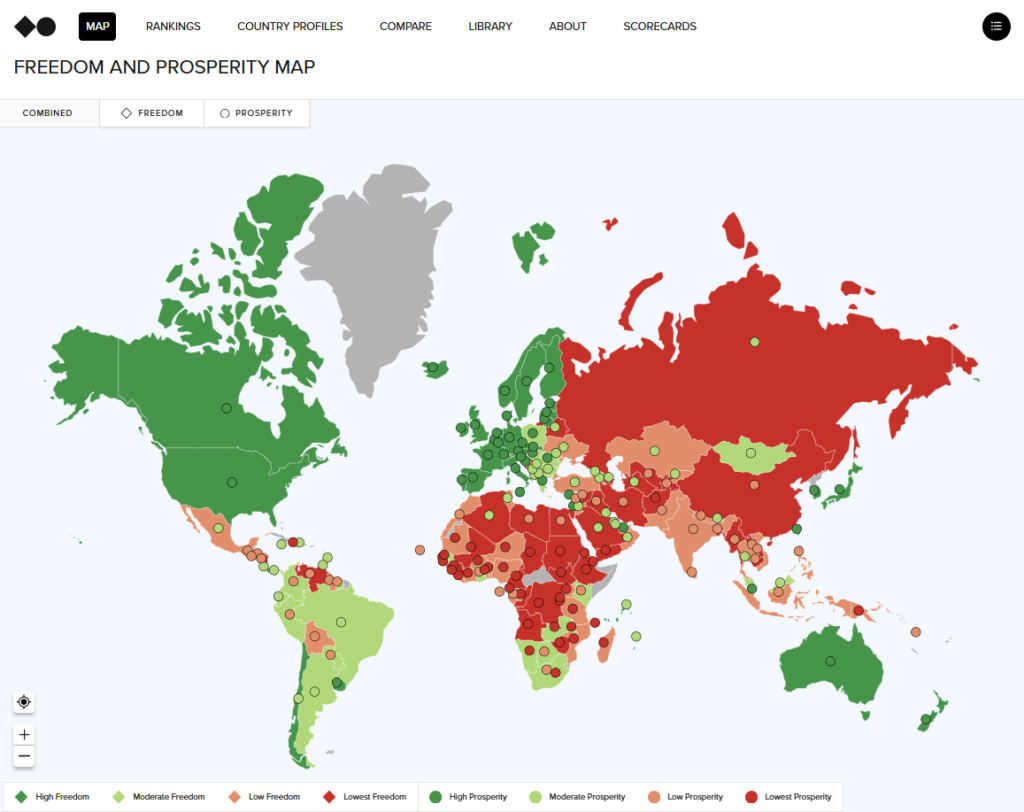
The Indexes rank 164 countries around the world. Use our site to explore thirty years of data, compare countries and regions, and examine the subindexes and indicators that comprise our Indexes.
Stay Updated
Get the Freedom and Prosperity Center’s latest reports, research, and events.
Stay connected
Read all editions
2026 Atlas: Freedom and Prosperity Around the World
Against a global backdrop of uncertainty, fragmentation, and shifting priorities, we invited leading economists and scholars to dive deep into the state of freedom and prosperity in ten countries around the world. Drawing on our thirty-year dataset covering political, economic, and legal developments, this year’s Atlas is the evidence-based guide to better policy in 2026.
2025 Atlas: Freedom and Prosperity Around the World
Twenty leading economists, scholars, and diplomats analyze the state of freedom and prosperity in eighteen countries around the world, looking back not only on a consequential year but across twenty-nine years of data on markets, rights, and the rule of law.
2024 Atlas: Freedom and Prosperity Around the World
Twenty leading economists and government officials from eighteen countries contributed to this comprehensive volume, which serves as a roadmap for navigating the complexities of contemporary governance.
Explore the program
The Freedom and Prosperity Center aims to increase the prosperity of the poor and marginalized in developing countries and to explore the nature of the relationship between freedom and prosperity in both developing and developed nations.
Image: Photo by Red Zeppelin on Unsplash

Keep up with the Freedom and Prosperity Center’s work on social media