
On Friday morning, Iran announced that it had agreed to reopen the Strait of Hormuz, a critical artery for supplying the world with oil, liquefied natural gas, and other commodities from the Gulf, resulting in an immediate drop in the price of oil. US President Donald Trump declared his support for the move, but he added a caveat: The US naval blockade of Iranian ports would remain in place pending the completion of a final political deal with Iran. Trump also said this week that the next round of US-Iran talks could begin in days. But if these talks drag on or fail, then the US military might be tasked with continuing this blockade. With so much still uncertain, we set out to answer the pressing questions about the blockade.
How did the blockade begin?
On April 12, Trump announced a naval blockade of the Strait of Hormuz after negotiations between Iran and the United States failed to produce an agreement. Two days later, Admiral Bradley Cooper, commander of US Central Command, announced that a “blockade of Iranian ports has been fully implemented.”
After Trump’s initial announcement, the US military clarified that it would enforce a blockade against vessels of all nations that leave or enter Iranian ports or the Iranian coastline, including in the Gulf of Oman and Arabian Sea. On April 17, Trump said the blockade would remain “as it pertains to Iran, only,” though it was not immediately clear whether that would change the military’s enforcement strategy.
Can the United States sustain a prolonged naval blockade?
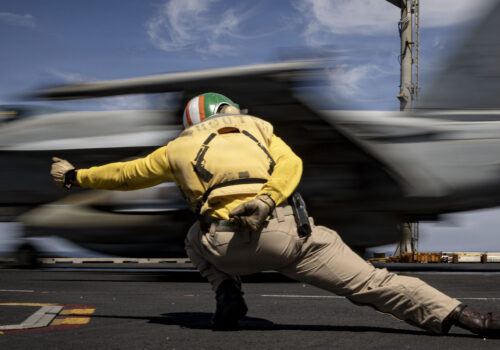
Yes, the United States can conduct this blockade for an extended period, if necessary, by accepting risk to other strategic priorities. According to open-source reporting, the United States has deployed more than ten thousand troops and sixteen warships—eleven destroyers, an aircraft carrier, a littoral combat ship, and three amphibious assault ships—to support the blockade. At present, this blockade accounts for 15 percent of the total deployed US Navy fleet. These ships are reportedly supported by over a hundred fighter jets; unmanned autonomous vehicles; intelligence, surveillance, and reconnaissance (ISR) aircraft; and tankers.
The United States has a dynamic force management process that allows for the rapid movement of forces around the globe. In theory, ships devoted to homeland defense, deterrence of China, or other global missions could be reallocated at risk to those missions. The Scowcroft Center’s Forward Defense program has provided weekly updates on how Operation Epic Fury has already strained US forces and assets that are relevant in other parts of the world, and the blockade will likely further aggravate the problem with near- and long-term impacts to military readiness.
How will the United States enforce the blockade?
The United States has positioned its forces outside of the Gulf and the Strait of Hormuz and will enforce the blockade from a distance, as it can monitor ships leaving ports from afar while operating from the Arabian or Mediterranean seas. There is no need to send Navy ships through the strait or into the Gulf to enforce the blockade. This considerably reduces risk, as forces are neither exposed to the danger of striking a mine nor vulnerable to the same Iranian assets that have been the biggest risk to US forces throughout the entirety of the war so far: missiles, drones, and fast attack craft.
Blockades are primarily enforced through visit, board, search, and seizure (VBSS) operations, which can be conducted by the Navy, Marine Corps, and Coast Guard, respectively. There are important differences between the services. The Navy conducts unopposed VBSS, meaning operations where the vessels are compliant and/or not actively resisting. Marine Expeditionary Units (MEUs)—one of which is already in the theater, with another one reportedly joining at the end of the month—can provide capabilities to conduct opposed VBSS operations. Finally, this blockade may have Coast Guard elements on Navy and Marine Corps ships, as they have law enforcement capabilities outside of Title 10 of the US Code, which governs all other services. However, there is no reporting supporting this so far.

A VBSS operation begins with radio communication. During a press conference on April 16, General Dan Caine, chairman of the Joint Chiefs of Staff, explained that US forces, primarily aboard destroyers, transmit warnings when a ship attempts to run the blockade line, announcing interdiction and seizure if the ship will not turn around. Such warnings were issued thirteen times from when the blockade began to the morning of April 16, and there have been no reported cases requiring US forces to board a ship after these initial warnings.
To board a vessel, US sailors and marines may approach either by combat rubber boats or by transport aircraft, especially Ospreys, descending onto ships via fast ropes. Caine emphasized that the US military’s trained boarding tactics include a series of “escalation force options,” such as warning shots.
What are the risks?
Escalation. One risk is that Iran attacks US forces or Gulf states in response to the blockade. Thus far, Iran has refrained from retaliating and appears willing to engage in talks, particularly with its April 17 announcement that it will allow shipping to resume on Iran-designated routes. But this is an area to watch as the April 22 cease-fire expiration date approaches.
VBSS operations. These operations are dangerous. In January 2024, two US Navy SEALs drowned during a boarding operation off the coast of Somalia. In addition, the boarding party is small, operates in a confined space, and might face hostile resistance. No VBSS has occurred to date as vessels are making what Caine called a “wise choice” to comply with the blockade.
Legal parameters. The legal foundation for a blockade is extremely complex, not only because there are many different types of blockades, but also because they serve different purposes and rely on different legal foundations. The Commander’s Handbook on the Law of Naval Operations, jointly released by the US Navy, Marine Corps, and Coast Guard, defines a blockade and the criteria it has to meet. A blockade needs to be established by the belligerent state—here the United States—including details on the time it starts, its location, and a grace period. The enforcing state also has to notify all affected states. In addition, a blockade needs to be effective, i.e., forces need to be able to enforce the blockade, which would otherwise be an illegal paper blockade. It needs to be impartial and enforced against vessels of all nations, including its own. And it must have clear limitations; for instance, it cannot restrict access to neutral ports and coasts or serve the sole purpose of starving a population.
International law considers a blockade as an act of war that is deemed lawful when meeting certain conditions, including notification, effectiveness, impartiality, and other requirements discussed above. Moreover, any blockade must comply with international humanitarian law (IHL) and its principles of military necessity, distinction, and proportionality. If a civilian population has inadequate food, medical, or other supplies, IHL requires the blockading party to permit the free passage of humanitarian relief.
Allies and partners. The blockade might further strain relations between the United States and its allies and partners. So far, no US ally or partner outside of Israel has publicly supported the blockade, while NATO allies and Australia have explicitly refused to participate, and Japan and South Korea have expressed nuanced positions that do not commit to supporting the blockade.
US military readiness. The USS George H.W. Bush aircraft carrier is en route to the region. Once it arrives, 75 percent of all available US carriers will be committed to Operation Epic Fury, in addition to 66 percent of available littoral combat ships with mine countermeasures mission packages, 50 percent of available Avenger-class MCM ships, and 75 percent of available E-3 Sentry AWACS. By consuming these assets, this blockade will create further operational risk in other theaters and impact long-term readiness.
To illustrate, on April 15, the aircraft carrier USS Gerald R. Ford broke the post-Vietnam deployment record, reaching 296 days at sea. The USS Tripoli amphibious ready group and Marine expeditionary unit (ARG/MEU)—one of only three currently deployable in US inventory—is intended to operate in the Indo-Pacific but has instead been sent to the Middle East. It may soon be joined by a second ARG/MEU, led by the USS Boxer. Under current maintenance and training realities, deploying the USS Boxer ARG/MEU is a surge of US capabilities, limiting availability in the future and preventing the United States from achieving a sustainable and ready plan to have three forward-postured ARG/MEUs that can respond quickly to crises.
The strain on forces is compounded by the extended transit routes that ships must make. While vessels leaving the US east coast would normally transit through the Mediterranean and Red seas, the USS George H.W. Bush carrier strike group is currently in transit to the region via the Cape of Good Hope, as the Houthis are holding the Red Sea at risk. These extended deployments and capability surges have cascading and long-term effects on maintenance, training, and deployment cycles across services.