They won’t say it in public. But in private conversations since the February 28 outbreak of war in the region, Gulf officials tell me that they have absorbed Iranian retaliation for hosting a US-Gulf security architecture they were never permitted to name. The current terms are no longer acceptable.
They are not threatening to walk away. They’re doing something far more serious; they are pricing their options and actively recalibrating how much of the arrangement’s risk they are prepared to absorb without a structural change in their role in it.
What is at stake in the on-again, off-again US-Iranian negotiations is not just a sustainable deal or a nuclear timetable. It is whether the informal strategic system the United States assembled with its Gulf partners and Israel over two decades was designed to survive a real war, or whether it was always a fair-weather arrangement dressed up as an alliance.
This war answered one question that those years of ambiguity had left open. The United States, Saudi Arabia, the United Arab Emirates, Qatar, and Israel are not separate players with overlapping interests. They share a common threat assessment, integrated basing and logistics infrastructure, and decades of quietly coordinated operations—the functional definition of a single operating system, even if they spent two decades pretending otherwise, and that pretense has become its principal weakness.
The arrangement was not dishonest, just convenient. Gulf governments could not be seen as hosting an explicitly American alliance: the costs to domestic legitimacy with publics that were hostile to US-Israeli military options would have been severe. Washington could not commit to one. Israel could not admit it belonged to one. The arrangement suited everyone until Tehran stopped striking symbols and began targeting the machinery.
SIGN UP FOR THIS WEEK IN THE MIDEAST NEWSLETTER
Gulf states endured retaliation for hosting a deterrent they could not openly acknowledge. The term for such an arrangement, where one party bears the risk while another claims the credit, is asymmetric dependence. It’s not an alliance. The conflict has made that clear.
The predictable response has been to cast the Gulf states as reluctant passengers swept into conflict by an impulsive president. This flatters everyone and accurately describes no one.
Saudi Arabia, the United Arab Emirates, and Qatar calculated, correctly, that no power other than the United States can deliver the missile defense and extended deterrence that the Iranian threat demands. China will not. Europe cannot.
Washington’s leverage is real. What it does not produce is deference. Leverage is not the same as control, and governments with alternatives use them. The sovereign wealth reorientations underway in Riyadh and Abu Dhabi, the acceleration of investments in European defense industries, and the quiet expansion of non-dollar settlement arrangements represent negotiating positions expressed through portfolios rather than press conferences.
The architecture has two cracks that Washington considers as one.
Militarily, the challenge is interoperability under real pressure. Gulf air defenses, Israeli early warning, and US theater systems lack a common operational picture once the missiles are flying. Against a coordinated Iranian attack involving ballistic missiles, drones, and mines, the gaps that seem manageable in drills become critical.
Politically, the challenge is even more stark. The Gulf states took the retaliation but had almost no say in the decisions that put them in the line of fire. Tehran saw this weakness before Washington did and has exploited it ever since. This open invitation cannot be considered effective management.
The obvious answer is formalization, treaty commitments, integrated command, and consultation before the shooting rather than briefings after. Formal alliances bind the stronger partner as well as the weaker, and many such arrangements have eventually been used by smaller members to pull larger ones into conflicts they would have preferred to avoid.
Two obstacles predate this war and will survive it. The Palestinian issue remains a significant obstacle: No Arab government will publicly sign a defense treaty with Israel as long as the prospects for Palestinian statehood remain as bleak as they are now and domestic public opinion is so set against Israel that open alignment presents a legitimacy risk at home.
Additionally, Washington’s tendency to propose partnership while retaining unilateral decision-making authority compounds the problem. To offer the appearance of an alliance without the substance of it—meaning a genuine consultative role before operational decisions are made—is to offer management, not partnership. Gulf governments have absorbed enough Iranian retaliation to understand the difference precisely.
Even if the United States and Iran strike a deal that includes favorable terms for Iran’s nuclear program and the Strait of Hormuz, it would buy the current architecture of the US-Gulf relationship only a pause. That pause needs to be used to rebuild the arrangement properly: unified command structures, real consultative authority before operations commence, and a political framework that does not require Arab partners to treat the Palestinian question as permanently shelved.
If the talks collapse and the war resumes, none of that becomes easier. A Congress focused on American casualties in a renewed Middle East conflict will not approve new security agreements. And if Saudi Arabia endures a second wave of Iranian strikes, it will not wait for Washington to act and will accelerate every hedging strategy already underway. There is an opportunity for the United States to forge a lasting solution from a position of strength, but it is fleeting.
China understands the geometry better than most. It bought 90 percent of Iran’s pre-war crude and publicly encouraged Pakistan’s mediation effort, while sanctioned tankers quietly ran the blockade. More importantly, Beijing is studying a precedent—sovereign toll collection over a global chokepoint—for potential application in the Taiwan Strait. The Gulf architecture is a standing US argument that Washington underwrites the global commons. Once that argument is up for negotiation, it weakens everywhere simultaneously.
The parties built this system because each concluded that the alternative—an Iran with regional hegemony, unconstrained nuclear capability, and an uncontested stranglehold on global energy transit—was worse. That conclusion will survive the war. But the fiction that the current terms can hold will not survive.
From Abu Dhabi, the choice is not abstract. The officials I speak with want the relationship to work. They have always wanted it to work. What they will no longer accept is wanting it more than Washington does.
Eric Alter is a nonresident senior fellow with the Scowcroft Middle East Security Initiative at the Atlantic Council’s Middle East Programs. He is also the dean of the Anwar Gargash Diplomatic Academy in Abu Dhabi, a professor of international law and diplomacy, and an attorney-at-law (Paris Bar).
Related Reading


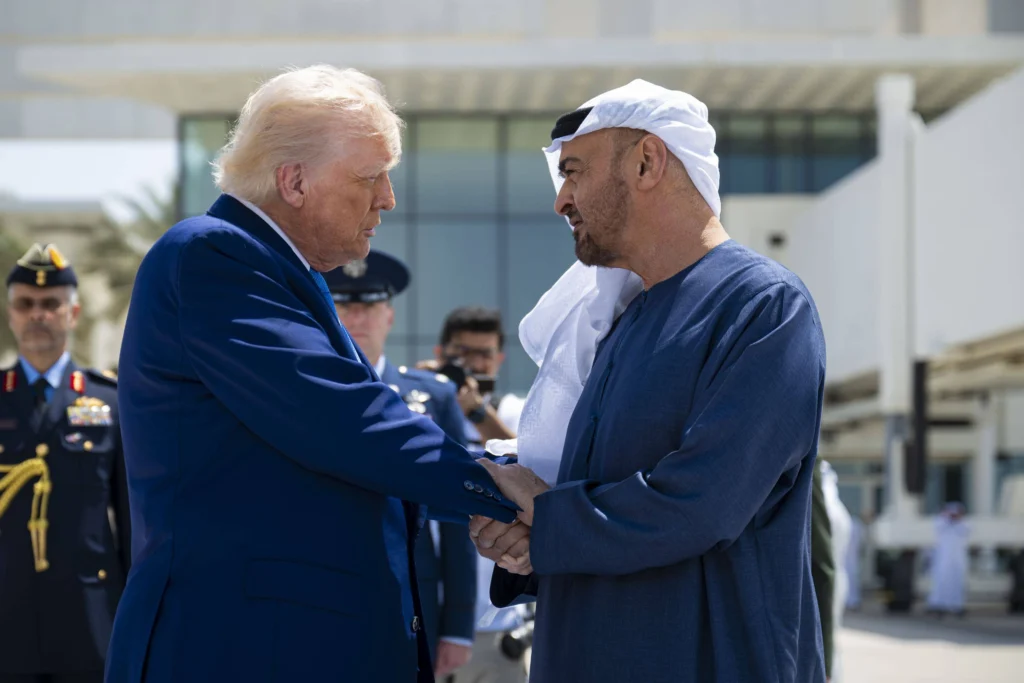
Image: US President Donald Trump departs Abu Dhabi at the conclusion of a state visit to the UAE US President Donald Trump departs Abu Dhabi at the conclusion of a state visit to the UAE. Sheikh Mohammed bin Zayed Al Nahyan, President of the UAE, bid farewell to the US President and his accompanying delegation at the Presidential Airport in Abu Dhabi, United Arab Emirates, on May 16, 2025. (Emirates News Agency/APA Images via Reuters Connect)