
Does liberal democracy drive inequalities?
This issue brief is part of the Freedom and Prosperity Center’s “Voices of the Future” series, which highlights how graduate students are using the Freedom and Prosperity Indexes to explore pressing governance and development challenges across the world.
Introduction
Trends of widening income, wealth, and other categorical gaps have been observed in many countries in the past half-century. In terms of political responsibility, debates have proliferated, and fingers have been pointed at various agents. Among them, the perception that liberal democracy, at least its mainstream form, has failed to check the growth of inequalities is turning out to be one of the most popular narratives. There is a tremendous amount of neoliberalism critique, plus the clichéd depiction of the West as plutocracies under the manipulation of small groups of corrupt and unaccountable elites (opposed to the “healthier” people or national state) by authoritarian states like Russia and China. Beyond ideological debates, rising inequality plays a concrete role in democratic backsliding. Early evidence suggests that economically deprived voters tend to become cynical and withdraw from participation, undermining civic engagement and political trust; at its worst, resentment and disillusionment can turn voters away from constructive politics and fuel anti-democratic sentiments as mass phenomena. Recent empirical research confirms the correlation between democratic erosion and rising inequality. These serious challenges to political and economic freedoms should not be so easily dismissed and need to be answered with theories and rationality.
Liberal democracy possesses theoretical weapons to defend itself. There are academic and political stances demonstrating the positive correlation between democracy and equality, which I term the democratic equality theory. Equality in this sense is not metaphysical, which might be innately combined with the notion of mass democracy and make a circular argument, nor normative, as the doctrines of social democracy, but empirical, such as income, wealth, social, and gender equalities that can be quantitatively measured and confirmed. This theory posits that liberal democracies, by granting individual citizens the same categorical rights in politics and providing an institutionally neutral framework for aggregating and expressing the interests of individual voters, can help mitigate the influence of personal wealth and resources in politics and reduce inequalities through redistributive and affirmative measures more effectively than non-democracies.
This paper offers critical reviews of the academic critique of neoliberalism on the one hand, and the various literature and authors supporting democratic equality theory on the other. Then, it utilizes the data collected by the Atlantic Council’s Freedom and Prosperity Indexes to test which theory holds greater truth in empirical analysis. Finally, the paper discusses the implications of findings and provides policy recommendations in light of resurgent authoritarianism and antidemocratic sentiments.
The critique of neoliberalism and liberal democracy
The widening economic gaps in the domestic economies of industrialized societies since the 1980s are an undeniable phenomenon. In the eyes of some critics, this was primarily the result of a systematic shift in the economic, political, and ideological frameworks in the developed world, above all, the United States, which they term neoliberalism. It is defined as an economic-political doctrine and worldview that revives the laissez-faire tradition of classical liberalism and advocates for fewer state interventions in the economy, the principle of the rule of law, and a sacrosanct, inviolable stance on the protection of private property to achieve higher capital accumulation and economic growth. In practice, this usually involves the contraction of the welfare state, privatization, deregulation, and the introduction of private-sector managerial methods, which are accused of widening the income gap, among other injustices, while not producing the economic growth expected by its proponents.
But what does this have to do with liberal democracy, then? Critics of neoliberalism cannot be blamed for neglecting the same paradigm in authoritarian states. They are keen to list Chile under Augusto Pinochet, Peru under Alberto Fujimori, and sometimes post-1978 China as examples in the literature. These examples are certainly not liberal democracies. To clarify further, most critics in the West are not against democracy but for democracy against neoliberalism, and they are right to accuse several early neoliberal proponents of seeking to insulate economic affairs from public will or even placing private freedom above political democracy. Indeed, it has been noticed that political accountability has been undermined following new public management-style civil service reforms. Thus, in their opinion, Western democracies since the 1970s have been more or less “neoliberalized,” and radical actions need to be taken to resist the process and reinstate democracy. This reductionist and uncompromising will to confront the other side, however, might put them into conflict with the principle of liberal democracy, which demands a neutrally bounded system of political contestation as well as mutual, moderated deliberation, and enhances their moral urge to lend support to neoliberalism’s nominal enemies. Last but not least, some of them have challenged the conventional idea of liberal democracy itself, arguing that the depoliticization of economic affairs under liberal democracy creates a selective affinity that allows the rise of neoliberalism, thus quelling “the democratic politics that once gave credence to it.” These indictments serve to question the validity of (economic) freedom, disentangling democracy from liberalism.
Moreover, voluntarist explanations for the spread of neoliberal paradigms where the United States and the West serve as the primary agents of promoting this framework to maintain their “imperialist” global exploitative system have been emphasized over structural factors (e.g., the stagflation crisis, the breakdown of the Bretton Woods system, the increase of capital mobility, the demographic change in the labor market, and post-industrial transformation) in some of the most popular literature. This voluntarist and particularistic critique can easily lend support to non-Western authoritarian states that undergo similar processes, which care much less for social justice than for power domination. For example, the Chinese state media and academics have produced articles criticizing neoliberalism as a Westernized (Xihua) phenomenon, borrowing from the discourses of left-wing scholarship, while presenting the “Chinese Way” as an alternative combining economic growth and equality, contrary to its social reality. Worse still, this neo-orientalist imagination is echoed by some neoliberal critics in advanced democracies, who present the “Chinese Way” as the solution to the West and the Global South alike out of desperation.
Democratic equality theory
It is a curious fact that there exists no term for the hypothesis that political democracy leads to greater equality, and here I name it the democratic equality theory after the popular democratic peace theory. As a discourse, it has a long and tumultuous history. Surprisingly, early proponents came not from the liberal tradition, which had not yet fully embraced mass democracy in the nineteenth century, but from socialism. Ferdinand Lassalle, the founder of the German labor movement, was one of the keenest supporters of universal suffrage at his time. In his political economy analysis, universal suffrage would be a vital step in establishing a “people’s state” that abolishes feudal and bourgeois privileges. One can also find Keir Hardie and Jean Jaurès as complements, and even Karl Marx and Friedrich Engels have treated political democracy and universal suffrage within a representative system as a necessary and immediate goal, and a potential path to socialism in industrial countries. Their ideas of democracy may differ from the specific form of liberal democracy that became dominant after World War II, yet in institutional features, both share much greater affinity than with illiberal, authoritarian forms of government. These political traditions channeling democracy and equality remained for a long time influential in European workers’ movements.
Political-economic discipline has produced arguments expounding the democratic equality theory since the behavioral revolution. The classical argument rests on the median voter model, which presumes that the social status of the median voter plays a decisive role in the policies of majoritarian rule, and universal suffrage would unavoidably lead to redistributive policy when the median of the income distribution is poorer than the average (a revised game theory brand of the model suggests that in terms of the electoral system, proportional systems lead to greater redistribution than majoritarian ones because the middle-income group feels less threatened when allying with the poor in the former situation). As to why democracies perform better than autocracies in redistribution, one can include the selectorate theory in the picture: Since liberal democracy is institutionally defined by majority rule, which denotes a large selectorate as well as a large winning coalition, it will more likely distribute resources in an inclusive manner, instead of awarding them disproportionately to political elites when the winning coalition is small and patronage is prized.
However, the old wisdom of the median voter has been challenged in recent political economic literature, and empirical research has shown contradictory or ambivalent conclusions. These research pieces have emphasized the distortion of majoritarian incentives by institutional barriers and the advent of adverse factors for redistribution in recent decades. Despite their contributions, these revisions have their own analytical constraints in terms of democratic equality theory. For example, they lack an aggregate conceptualization of equality and focus solely on economic redistribution, neglecting the status of women, minorities, and affirmative measures, all of which are indispensable components of equality in the modern sense. Most of them are limited to Organisation for Economic Co-operation and Development countries, lacking external validity. Last but not least, the authors separate the dimension of economic freedom from democracy, whereas in the mainstream idea of liberal democracy, they are innately intertwined.
Freedom and equality in empirical analysis
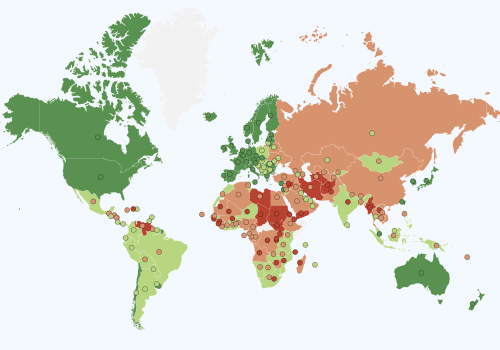
Utilizing the Atlantic Council’s Freedom and Prosperity Indexes, this section provides an empirical analysis of the correlation between liberal democracy and equality. The two separate indexes rank 164 countries around the world according to their levels of freedom and prosperity, espousing a more expansive understanding of what freedom and prosperity are. The Freedom Index encapsulates the legal, political, and economic dimensions of freedom, accurately reflecting the multiple features of modern liberal democracy (rule of law, democratic selection of executives, and open, competitive access to the market). The Prosperity Index covers aspects of human well-being from income to inequality, health, environment, and minority rights (note that the subindex of minority rights includes gender equality).
I used the Freedom Index to measure liberal democracy and the two components (inequality and minority rights, which are weighed equally) within the Prosperity Index to measure equality. First, I will discuss the correlation between liberal democracy and equality. Then, I will test how changes in liberal democracy across the globe affect dynamic trends of inequality. The analysis covers all 164 countries with data from 1995 to 2024, with the first part measuring the status in both 1995 and 2024, and the second part tracking changes taking place during this period.
Figure 1. Equality and freedom around the world in 1995
Figure 2. Equality and freedom around the world in 2024
As expected, the empirical analyses of data in 1995 and 2024 both show a significant correlation between the extent of liberal democracy and the degree of social and economic equality. Some highly authoritarian countries display relatively higher equality compared with their freedom indexes, which might be attributed to patrimonial ideals of premodern politics or high social integration in some (post) totalitarian states. Still, their states of equality lag significantly behind the cohort of liberal democracies. Among the countries ranking middle in terms of freedom, most score significantly lower in equality indexes than average, a sign of the institutional weakness of anocracies. In countries where liberal democratic institutions are most robust, equality is also best guaranteed, confirming the fundamental hypothesis of the democratic equality theory. The correlation appears to be weaker, however, in 2024 than in 1995, confirming the suspicion within recent scholarship about the declining redistributive ability of liberal democracies.
Figure 3. Change in freedom and equality, 1995-2024
As to the effect of the strengthening or weakening of liberal democracy on equality, the correlation is weaker—but still positive. The main deviators come from the major cohort of countries that experience no seismic changes in freedom, yet widespread shifts in equality, a sign that economic and social conditions possess their own dynamics beyond the influence of political institutions. It should be noted, however, that changes in freedom usually take time to reflect fully in prosperity, a lag that can be more than ten years, according to the Atlantic Council’s Freedom and Prosperity Indexes report. By all means, this correlation is too weak to support the allegation that liberal democracy drives inequality, and that the world should turn to authoritarian states for an answer, if not impressive enough to demonstrate that increasing liberty automatically leads to greater equality.
Discussion of implications
The empirical data largely uphold the core proposition of the democratic equality theory—namely, that liberal democracies are generally better equipped to promote equality, both economically and socially, than non-democratic regimes. While the data do not show a perfect correlation and recent years suggest a weakening relationship, the positive trend remains robust, especially when measured longitudinally. This substantiates the idea that liberal democratic institutions—characterized by legal accountability, electoral representation, and individual rights—are conducive to building more inclusive and equitable societies.
However, the weakening of this relationship over time should not be dismissed. It reflects real-world developments where liberal democracies have struggled to maintain their redistributive functions amid globalization, capital mobility, labor transformations, and political polarization. The rise of populism, democratic backsliding, and institutional gridlock has further complicated the ability of democracies to adapt effectively. This erosion opens the door to the critique that liberal democracies are either complicit in or powerless against rising inequality—a critique that authoritarian regimes are eager to exploit for ideological legitimacy.
Yet, as this paper has shown, the problem is not inherent to liberal democracy, but to specific circumstances of policy and institutional developments. Contrary to authoritarian allegations, liberal democracies still perform better than non-democracies when it comes to equality, and democratization can help mitigate inequalities even when new adverse elements have weakened state capacities. The path forward, therefore, is not to abandon liberal democracy in favor of more authoritarian models (which may promise equality but often fail to deliver both freedom and equality), but to reinvigorate democratic mechanisms to provide better social outcomes.
Policy recommendations
Democratic institutional reform: Rising inequalities endanger both political and economic freedom. To counter this trend, strengthening democratic accountability and responsiveness, such as through proportional representation, participatory budgeting, and campaign finance reform, can help realign policy outcomes with the preferences of broader electorates.
Social investment: Democracies must renew commitments to public education, health care, and housing, not merely as welfare provisions but as means to equalize opportunity and empower citizens.
Affirmative and inclusion policies: Promoting gender and minority equality through legal protections and social programs enhances not only equality but also civic trust and political participation, elements crucial to democratic resilience.
Seize initiative in political narrative: As authoritarian regimes increasingly present themselves as better alternatives to liberal democracies, democracies must go beyond concerns of geopolitical security and actively engage with global demands of justice and equality. Democratic societies should assert their normative and empirical strengths, which are grounded in facts, evidence, and rational discourse, in contrast to the conspiracy theories, scapegoating, and paranoia often used by authoritarian regimes to justify their rule. By reclaiming the narrative and emphasizing their capacity to deliver both freedom and fairness, democracies can not only counter authoritarian influence abroad but also expose the fragile legitimacy of regimes that preside over deeply unequal and unjust societies.
About the author
Yi Zhou is a visiting fellow at the Atlantic Council’s Freedom and Prosperity Center and a graduate student in the Democracy and Governance program at Georgetown University.
explore the data
stay connected
explore the program

The Freedom and Prosperity Center aims to increase the prosperity of the poor and marginalized in developing countries and to explore the nature of the relationship between freedom and prosperity in both developing and developed nations.
Image: The evolving Byculla and Saat Rasta skyline in Mumbai, viewed from The Baya Victoria in Byculla West. January 19, 2026. Zoshua Colah/UNSPLASH.
For the latest updates, follow us on social media with #FutureOfDemocracy