Europe’s security environment has undergone a profound transformation over the past decade. Russia’s annexation of Crimea in 2014 and its full-scale invasion of Ukraine in 2022 have reshaped threat perceptions across the continent, while growing doubts about the reliability of US security guarantees have deepened this shift. Together, these developments have led European policymakers to reconsider the foundations of deterrence.
Against this backdrop, debates over a European nuclear deterrent—long considered politically unrealistic—have regained traction. France stands at the center of this discussion, increasingly seeking to “Europeanize” its nuclear doctrine. Yet a fundamental question remains: is a European nuclear deterrence framework becoming a strategic reality or does it remain largely aspirational?
The path to European nuclear deterrence
In an article published by Foreign Policy entitled “The Covert French Connection,” Richard H. Ullman details the process that led France to develop its own nuclear capability in the early 1960s. He asserts that the Eisenhower administration was not inclined to assist France in developing its nuclear enterprise and was hesitant to share its nuclear weapons information. Successive US administrations’ reluctant cooperation with the French force de frappe, alongside shifts in US strategic doctrine, reinforced President Charles de Gaulle’s longstanding commitment to strategic autonomy and France’s pursuit of an independent nuclear posture. It also ultimately contributed to France’s withdrawal from NATO’s integrated military command in 1966 and its decision not to participate in NATO’s Nuclear Planning Group.
France and other European NATO members largely neglected defense investments from the 1990s to 2020, assuming that a major crisis in Europe was unlikely due to the so-called “peace dividend” of the post-Cold War era. European actors have had to challenge this assumption due to the deterioration of the global and European security environment since 2014 and Russia’s full-scale invasion of Ukraine in 2022. Due to these increasing threats and European leaders’ declining confidence in the United States as a reliable security guarantor, European leaders have renewed efforts to achieve strategic autonomy to the highest degree possible. Alongside accelerated investments in conventional defense, this shift has also reopened debates on the role of nuclear deterrence in European security.
France has positioned itself at the center of the debate. Since 2020, President Emmanuel Macron has consistently advocated for a European dimension to France’s nuclear deterrent, emphasizing the need for strategic dialogue with European partners. While maintaining the principle of full national control over nuclear decision-making, French proposals have gradually sought to expand consultation, coordination, and potential participation by European allies. France has dubbed this strategic discourse as “forward deterrence”—a strategy that can be seen as a revival of Gaullist thinking, albeit under markedly different international conditions.
Concurrently, the debate has begun to resonate more broadly across Europe. The 2025 UK–France Northwood Declaration marked a significant step toward closer nuclear coordination between Europe’s two nuclear powers, signaling a willingness to assume greater responsibility within and alongside the Alliance framework. Germany, in particular, has shown increasing openness to engaging with French proposals, as reflected in the establishment of a Franco-German high-level steering group on nuclear deterrence in 2026. Other European states including Poland, the Netherlands, Belgium, Denmark, Sweden, and Greece have also expressed interest, albeit with varying degrees of caution. These differences reflect varying threat perceptions, ranging from front line concerns about Russia, to indirect or regionally diversified security priorities, to political sensitivities regarding nuclear policy.
France’s evolving “forward deterrence” concept is an adaptive and phased approach aimed at gradually Europeanizing its nuclear posture without relinquishing its sovereign control. Its success will ultimately depend on the extent to which it can accommodate the strategic priorities and concerns of a broader set of European actors.
How to achieve it
The fundamental question is how to fulfill a credible and reliable European nuclear deterrence. The French nuclear capability rests on two main pillars: sea-based and airborne nuclear forces. Europe may also need to eventually consider whether a land-based component should complement these existing capabilities in order to strengthen the credibility and resilience of a future deterrence posture. This would require European states to address a number of sensitive political, legal, and operational questions, including where such systems could be based, how participating states would share responsibilities, and how any future arrangement would remain compatible with existing non-proliferation commitments.
In a future triad of nuclear strategy, the division of labor should be divided between those who will contribute nuclear assets (France and the United Kingdom) and who will take part in conventional roles to support nuclear missions. Such a design will initially have to mimic NATO’s procedures and arrangements.
If France fulfills its intention to deploy its dual-capable aircraft (Rafales) to any other European nation, host countries will also have to delineate what type of facilities and capacities. Will France, for instance, be ready to preposition its airborne nuclear bombs in select European allies like the US and share its financial burden with them?
From the very outset, the aircraft to carry French gravity bombs should be identified and made available for dual use. To what extent France is ready to share the costs involved in advancing such an arrangement needs clarity. How would European allies share the burden? Which alert measures will be adopted to undergird European nuclear deterrence? How will this all be paid for?
One possible outcome of these discussions could involve the joint financing of French and British deterrent capabilities by participating European states. Such an arrangement would expand the resource base of existing nuclear forces while preserving national ownership and decision-making authority in Paris and London. This model also raises questions about how financial and conventional contributions relate to political influence over nuclear decision-making. At present, discussions regarding joint financing or shared nuclear responsibilities have gained only limited traction. Moreover, France has traditionally maintained that its nuclear deterrent remains an exclusively sovereign capability, meaning that financial contributions from partners would not necessarily translate into participation in nuclear decision-making processes.
Beyond questions of financing and governance, the operational and political credibility of a European nuclear deterrence framework would also depend on sustained coordination among participating states. European nuclear deterrence must be exercised regularly to make it sound and credible. Comprehensive coordination and consultation is required to determine a robust exercise cycle.
In addition to the technical and operational considerations, the long-term credibility of such a system will depend on political factors. Extended or forward deterrence ultimately rests on the willingness of the guarantor to act in a crisis. Reliance on national decision-making processes introduces an inherent degree of uncertainty, as changes in domestic political leadership or priorities could affect the consistency of commitments over time. A structured approach is needed to overcome the challenge of participation in decision-making.
The issue of complementarity with NATO also brings forth the challenge of how to dovetail European nuclear deterrence with that of the Alliance. European leaders need to clarify which structure (i.e. permanent or informal) is best. This should also incentivize France to join NATO’s nuclear planning group, if it is sincere in making European nuclear deterrence complement NATO’s nuclear dimension.
In parallel with these technical and institutional challenges, the effectiveness of any European nuclear deterrence framework also depends on its inclusivity. A model that remains confined to a limited group of European countries risks undermining both its credibility and its coherence within the European pillar of the Alliance. In this respect, the role of key non-EU NATO members becomes increasingly relevant.
Turkey and the European deterrence debate
In this regard, Turkey’s role warrants closer, coherent, and more systematic consideration. As a longstanding NATO ally and a participant in the Alliance’s nuclear-sharing arrangements, Turkey occupies a distinctive position within the Euro-Atlantic security architecture, including through its role in hosting US nuclear assets under NATO arrangements.
Turkey’s strategic relevance is reinforced by its location at the intersection of Europe and the Middle East, regions that are increasingly interconnected in terms of security and connectivity dynamics. In the context of Russia’s war against Ukraine, instability in the Middle East, and evolving security risks in the Black Sea region, Turkey functions as a critical geopolitical hub linking multiple domains of deterrence. Its control of the Turkish Straits under the Montreux Convention also gives it a unique role in regulating military access between the Black Sea and the Mediterranean. As NATO’s second-largest military, Turkey’s operational experience, forward presence, and ability to project power across adjacent regions contribute to the broader credibility of NATO’s deterrence posture. At the same time, its expanding defense-industrial base, notably in areas such as unmanned systems, missile technologies, and ammunition production, positions Turkey as an increasingly important contributor to Europe’s defense ecosystem and supply resilience.
At the political level, recent statements by senior officials in Turkey indicate growing concerns regarding the reliability of existing security guarantees and the risks of nuclear proliferation in its surrounding regions. These concerns reflect a reassessment of the strategic environment in light of uncertainties attributed to US commitments and the evolving and elusive balance of power in neighboring regions. Nonetheless, as long as the United States’ nuclear umbrella over NATO remains in place, it simply would not be feasible for Turkey to develop its own nuclear weapons capability. Instead, the most rational option for Turkey is to seek ways to participate in future European nuclear deterrence complementary to that of NATO.
Ankara appears to prioritize maintaining strategic flexibility while strengthening its defense-industrial and military capabilities, rather than pursuing an independent nuclear weapons capability. Turkey is also a party to the Treaty on the Non-Proliferation of Nuclear Weapons, which further underscores its formal commitment to nuclear non-proliferation. Turkey’s position reflects a calibrated approach aimed at preserving autonomy within the existing Alliance framework while retaining the benefits of extended deterrence.
Despite its longstanding integration into NATO’s nuclear architecture through its participation in the Alliance’s nuclear-sharing arrangements and the Nuclear Planning Group’s High Level Group, Turkey is not directly involved in the emerging European-centered deterrence initiatives, including the Franco-German steering group and the evolving UK–France framework under the Northwood Declaration. This deliberate exclusion of Turkey from the nuclear deterrence discussions risks reinforcing fragmentation within the Alliance at a time when cohesion is increasingly critical and defies the principle of complementarity with the Alliance. A European deterrence architecture, including a nuclear dimension, that remains limited to EU-centric or narrowly defined coalitions may struggle to achieve credibility across the full spectrum of regional threats. A more inclusive approach that incorporates Turkey’s conventional assets and capabilities into strategic consultations, planning processes, and defense-industrial cooperation would strengthen both the effectiveness and the legitimacy of an evolving European deterrence framework. For instance, Turkey could dedicate part of its DCA aircraft for the European nuclear enterprise.
The role of the US (or lack thereof)
The thrust and initial components of a European nuclear deterrence initiative led by France are legitimate and deserve support from the European pillar of the Alliance. Given the present attitude of the Trump administration, it seems unlikely that the US would impede the evolving process toward the build-up of a European nuclear deterrent.
Debates on European nuclear deterrence are closely linked to uncertainties surrounding the long-term trajectory of US security commitments. Discussions within Europe increasingly reflect the view that greater responsibility in the nuclear domain may be necessary, even if such efforts are designed to complement existing transatlantic arrangements.
Looking ahead, more structured forms of cooperation could emerge among groups of European states with similar threat perceptions. In the medium term, this could take the form of regionally organized frameworks facilitating coordination in planning, capabilities, and support functions. Over the longer term, these initiatives could evolve into a more integrated European deterrence architecture, including a nuclear dimension, although such an outcome may face political and institutional constraints during the build-up period.
Creating such a nuclear enterprise is now at its infancy, and it would take at least a decade or more to bring together the pieces of the puzzle with resolve and determination. Nonetheless, European nations should push ahead not only to define milestones for such an endeavor but also to demonstrate sustained political and military will to achieve it, respecting the fundamental principle of indivisible security.
Mehmet Fatih Ceylan is the president of the Turkish Atlantic Council Association and Ankara Policy Center. He served as Turkey’s ambassador to NATO from 2013 to 2018.
Ece Şolendil is a PhD researcher in Politics at the University of Edinburgh.
The views expressed in TURKEYSource are solely those of the authors and do not necessarily reflect the views of the Atlantic Council, its staff, or its supporters.
Explore the program
Within the Atlantic Council’s longstanding commitment to strengthening the transatlantic relationship, the Atlantic Council Turkey Program conducts research, provides thought leadership, and offers a platform for strategic dialogue between the US, Turkey, and NATO allies to address the region’s toughest challenges and explore opportunities, including in the fields of energy, business & trade, technology, defense, and security.
Related Reading
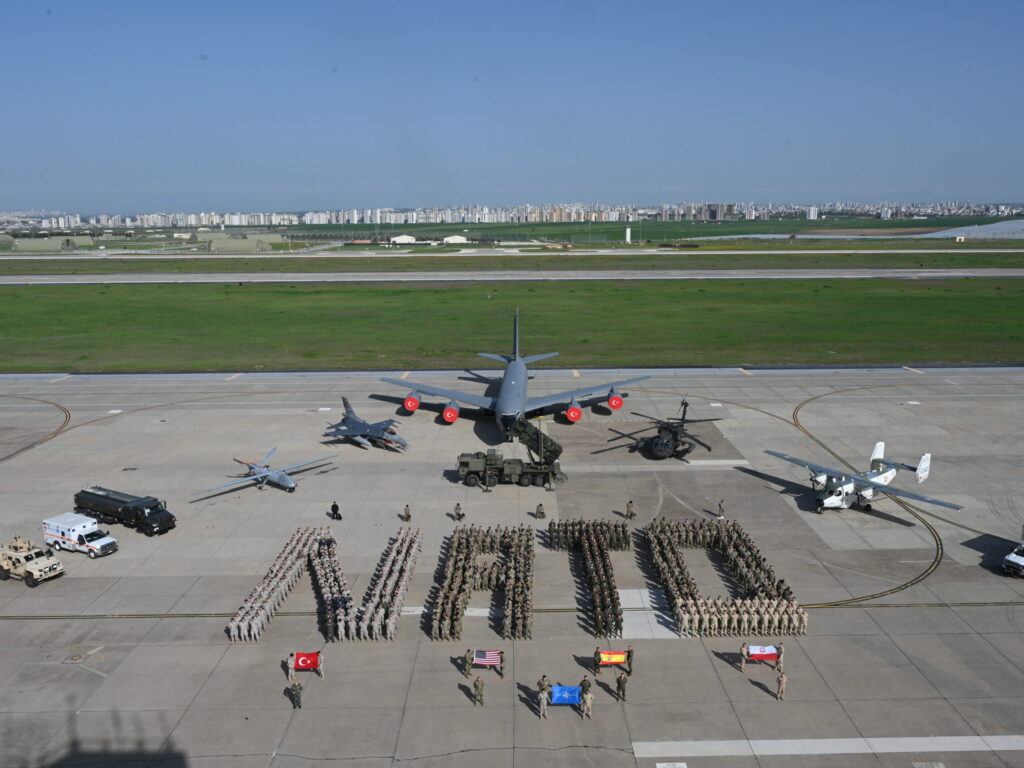
Image: NATO partners from Turkey, the US, Poland and Spain stand together to celebrate NATO’s 75th founding anniversary, at Incirlik Air Base, Turkey, March 28, 2024. US Air Force photo by Senior Airman Essence Myricks
