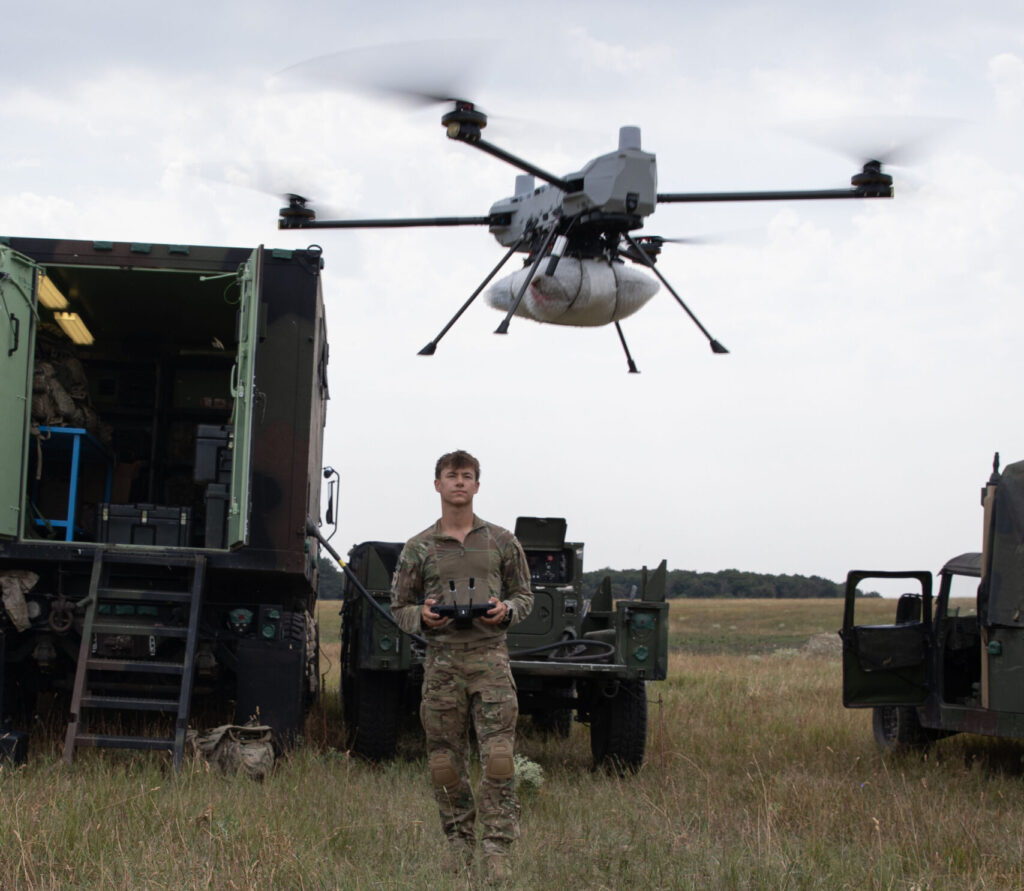
Batteries are powerful military and strategic enablers that the United States cannot afford to let China dominate. The technology is not just used in the civilian sector: It is also a military technology, powering drones, sensor arrays, radio equipment, and robotics. Given batteries’ dual-use implications, the United States cannot afford to let China dominate their supply chains, as Beijing has already shown a willingness to weaponize them.
In response, the United States should develop a national strategy to seize leadership in batteries and ensure that its own military capabilities don’t depend on imports from China. Such a program will likely include leapfrogging past current battery technologies to develop solid‑state and lithium‑sulfur batteries that are less reliant on Chinese-dominated supply chains and that have the potential to give the United States a technological and operational edge, mitigating China’s production scale.
Beijing’s industrial policy playbook: A global battery monopoly?
China dominates global battery production today, making over 80 percent of the world’s battery cells. For lithium-iron-phosphate (LFP) batteries, which are quickly becoming the industry standard for electric vehicles (EVs) and energy storage systems, China’s control is even more striking, with 98 percent of the world’s LFP battery cathode production.
Batteries for military applications often use a different chemistry than LFP, but China’s mastery of LFP chemistries and dominance of related commercial supply chains enables it to make important technical advances that can lead to an edge in defense capabilities. For example, energy density and charging/discharging speeds matter greatly on the battlefield. Faster charging speeds can increase sortie rates for various systems, including bomber-style quadcopters that Ukraine is employing effectively; faster discharge rates are also critical for directed energy weapons that could be used for great effect against missiles, drones, and speedboats. Chinese companies have gradually expanded energy density within the LFP chemistry and greatly reduced charging times such that electric vehicles can charge as quickly as some cars can fuel. China’s thriving civilian battery sector bolsters its dual-use capabilities.
Another critical factor in battery dominance is scale. Although many of the early scientific breakthroughs in lithium batteries came from the United States and Japan, including in LFP batteries, China became the undisputed global leader in battery supply chains through a familiar industrial policy playbook that it has used for other sectors, such as steel, shipbuilding, and solar energy.
China deployed state support to lock down access to battery-related critical minerals. Generous subsidies and protectionist policies gave Chinese battery makers a leg up over competitors. And a nationwide push into EVs created a massive customer base for Chinese battery makers to scale up and expand globally. As a result, Chinese firms dominate virtually every part of the battery supply chain, including material refining, anodes, cathodes, cells, and battery packs.
Now a wave of Chinese battery exports is putting pressure on the rest of the industry. In 2023, China accounted for 74 percent of global exports of battery packs and battery components. China’s pure lithium-ion battery exports—which can be used abroad for manufacturing electric vehicles (EVs), energy storage systems, consumer electronics, or defense applications—continue to set records in value terms, even as per-kilogram prices have fallen rapidly. In addition, China’s exports of battery electric vehicles (BEVs)—which are deeply entwined with the battery sector—are setting new highs in terms of both value and units sold.
Notes: Li-ion batteries (HTS Code: 85076000); Battery electric vehicles (HTS codes: 87038000 and 87038010)
Dropping battery component prices have further aided growth in the scale of China’s exports. In 2024, the price of LFP battery cells in China dropped 51 percent from the previous year; China’s average battery pack prices fell 13 percent in 2025 from prior-year levels. Beijing has frequently promoted battery exports as one of China’s “new three” growth drivers, alongside EVs and solar panels. Looking ahead, China’s projected battery production capacity is expected to more than double over the next five years, reaching 4,800 gigawatt-hours by 2030. China’s growing battery production capacity, combined with its entrance into even South Korea, arguably the world’s second-most capable battery player, may allow it to establish a near-monopoly in existing chemistries like LFP, and heightens risks it will also control advanced battery supply chain.
The importance of batteries in military operations is rising
Batteries already power military drones and electronic‑warfare systems. Korea and Japan are fielding manned diesel‑electric submarines employing lithium‑ion chemistries, Chinese battery champion CATL is widely believed to be helping the People’s Liberation Army Navy secure an advanced‑battery submarine, and the mine-laying capabilities of battery-powered Extra Large Unmanned Undersea Vehicles (XLUUVs) could be a game-changer.
In the future, battery-powered robotics are expected to shape conflicts. Ukraine is already demonstrating the importance of the battery-robotics nexus. About 80 percent of casualties in a particular unit, for example, are evacuated by ground-based, battery-powered robots. The robots’ electric motors emit little noise, providing a significant tactical advantage over noisier internal combustion engine-powered vehicles. Meanwhile, about 90 percent of all supplies in the Pokrovsk frontline were delivered by unmanned ground vehicles (UGVs). Militaries are taking notice and planning a growing role for robotics in defense strategies. China’s military, for example, is publicizing its use of UGVs in military exercises in state media.
As batteries’ importance on the battlefield grows, so does the risk of the United States ceding battery dominance to China.
How the US can surpass China in crucial dual-use technologies
While the United States will find it difficult to match China’s scale by itself, it can mitigate this disadvantage by working with allies like South Korea, Japan, NATO countries, and Australia to jointly research, develop, and produce batteries. Reestablishing allied technological dominance in batteries could reduce the advantage China can accrue via scaling.
Breakthroughs in new battery technology will therefore prove highly consequential and could tilt the playing field in favor of the United States and its allies. Batteries with higher energy density and power output than those China is producing would greatly enhance platforms’ capabilities by increasing platform payloads and extending range, enabling units to gain tactical advantages.
Advances in high-energy-density and high-discharge-rate batteries could enable directed energy weapons, including counter-drone lasers and, eventually, higher-powered systems useful for intercepting incoming missiles. In addition, XLUUVs and coalitional diesel-electric submarines’ endurance is limited by battery recharging; more energy-dense batteries could enable submarines to avoid snorkeling for longer. Similarly, US Army soldiers typically carry about 21 pounds of batteries for a 72-hour mission; advanced batteries could reduce thermal risk, lower weight requirements, or enable soldiers to carry more advanced equipment—such as first-person view drones.
The United States has been losing the battery competition with China across many dimensions. Doubling down on the current, implicit strategy of only resourcing lithium-ion projects—a chemistry China already dominates—is almost certainly a mistake.
The United States and allies should formulate a plan to catch up to, and surpass, China across batteries and robotics. This could include a moonshot program, for example, to spur the commercialization of advanced chemistries with greater energy densities, such as solid-state or lithium-sulfur.
Different battery chemistries and characteristics
Leapfrogging to next-generation battery technologies could allow the United States and its allies to lean on their innovation advantages rather than play a losing hand in the scaling game. Crucially, a battery breakthrough could limit Beijing’s minerals leverage, as solid-state and lithium-sulfur chemistries are not reliant on graphite, a commodity where China is dominant.
Beijing is winning the battery race largely because the United States has been slow to grasp the strategic importance of batteries, and it has yet to formulate a comprehensive national strategy examining potential gains from leapfrogging. Previous strategic plans have been fragmented, treating military and commercial applications separately rather than comprehensively.
It’s time for the United States to stand up a national battery strategy, determine in unclassified environments where leapfrogging to more advanced chemistries will help ensure the United States outcompetes its most formidable rival, and resource the plan effectively. To repurpose an old proverb, the best time for a national battery strategy was a decade ago. The second-best time is now.
Joseph Webster is a senior fellow at the Atlantic Council Global Energy Center, a non-resident senior fellow at the Atlantic Council Indo-Pacific Security Initiative, and editor of the China-Russia Report newsletter.
Kyle Chan is a fellow at the Brookings Institution who focuses on technology and industrial policy in China. He also writes the High Capacity newsletter on the same topics.
The authors would like to thank Fabian Villalobos of RAND, Alvin Camba of Lyvi/the Atlantic Council, and Nathaniel Horadam, president of Full Tilt Strategies for providing feedback on the draft, and to Tony Jing of the University of Wisconsin for quantitative support. Any errors are the authors’ alone.
stay connected
Sign up for PowerPlay, the Atlantic Council’s bimonthly newsletter keeping you up to date on all facets of the energy transition
related work

our work

The Global Energy Center develops and promotes pragmatic and nonpartisan policy solutions designed to advance global energy security, drive economic opportunity, and foster a sustainable energy future.
Image: U.S. Army Spc. Max Boatner operates the PDW C100 drone during a field demonstration at Norio Training Area, Georgia, Aug. 2, 2025, as part of Agile Spirit 25. Boatner, assigned to Hawkeye Platoon, Headquarters and Headquarters Troop, 1st Squadron, 91st Cavalry Regiment, 173rd Airborne Brigade, manually controls the drone to execute an aerial delivery mission using a 3D-printed payload attachment. The demonstration highlights the unit’s integration of unmanned systems into tactical sustainment operations. (U.S. Army National Guard photo by Sgt. 1st Class Brittany Conley)
