
All across Europe, governments are rushing to increase defense budgets, sign new security pacts, and warn of the growing threat posed by Vladimir Putin’s Russia. According to some European leaders, the continent is presently entering the most dangerous period since World War II.
Not everyone is convinced. In fact, a significant portion of the European population appears to be unimpressed by the current talk of an imminent Russian threat. While relatively few people actually support or condone the Kremlin’s criminal actions in Ukraine, there are plenty of doubters across Europe who question whether Putin’s territorial ambitions extend beyond the limited confines of the former Soviet Empire.
Others are openly dismissive of Moscow’s ability to menace Europe. Skeptics typically point to Putin’s lack of progress in Ukraine as proof that modern Russia is a paper tiger and does not deserve to be taken so seriously. “Russia can’t even beat Ukraine,” they contemptuously declare. This argument may appear persuasive at first glance, but it represents a fundamentally flawed assessment of the security situation that risks fueling complacency at a time when a sense of urgency is required.
While it is true that the Russian army has failed to achieve any of the key objectives set at the start of the invasion, this underwhelming outcome reflects Ukrainian strength rather than Russian weakness. However, the Ukrainians are not superheroes and their ability to withstand the onslaught of a far larger opponent is limited. If Ukraine’s remarkable resistance eventually falters, Europe will find itself face to face with a formidable fighting force that it is utterly unprepared to confront.
Stay updated
As the world watches the Russian invasion of Ukraine unfold, UkraineAlert delivers the best Atlantic Council expert insight and analysis on Ukraine twice a week directly to your inbox.
It is easy to see why some international observers have been lulled into a false sense of security regarding Moscow’s military capabilities. After all, when Putin launched the full-scale invasion of Ukraine in February 2022, many predicted a complete Russian victory within a matter of days. Instead, more than four years on, the Russian army has seized less than 20 percent of Ukrainian territory and is still struggling to advance.
Ukraine’s success in stemming the tide of Russia’s invasion is a military miracle that will be studied for decades. It is the collective achievement of a society that has mobilized since 2022 to an unprecedented degree. Everyone has played their part, from the huge numbers of men and women in uniform, to the incredibly innovative Ukrainian defense tech industry, and all the ordinary folk who keep the country running in the most extraordinary of wartime conditions.
At the same time, it is vital to recognize that this success has come at a terrible cost. Hundreds of thousands of Ukrainians have been killed and millions have been forced to flee their homes. Countless Ukrainian families have been torn apart. Dozens of cities lie in ruins. The whole country has been left deeply traumatized by Putin’s invasion and will carry emotional scars for decades. Anyone who feels tempted to make light of the Russian threat should take this unbearable burden into consideration and keep in mind the price Ukraine has paid to limit Moscow’s gains.
Eurasia Center events

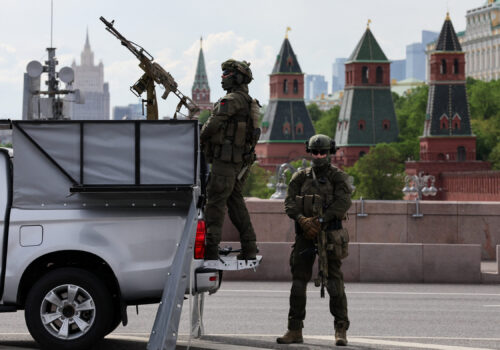
While there is no disguising the many setbacks Russia has suffered in Ukraine, it would be reckless to underestimate Moscow’s current military potential. Headlines about Russian human wave attacks, massive battlefield losses, and medieval discipline create the impression of a primitive barbarian horde, but this convenient caricature conceals the true picture of Putin’s rapidly evolving armed forces.
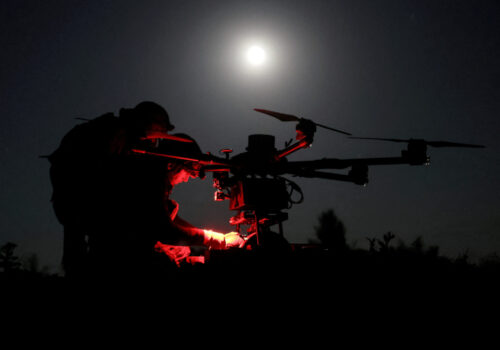
The Russian army today is significantly larger than it was in 2022. It is also infinitely more attuned to the demands of modern warfare. Crucially, Russia has emerged over the past four years as a world leader in drone warfare, and is now capable of launching sophisticated mass bombardments involving hundreds of highly destructive strike drones together with cruise and ballistic missiles.
In contrast, European defense doctrines lag far behind and have not adapted to the new realities of drone-based warfare. At numerous military exercises over the past year, Ukrainian drone crews have embarrassed their NATO colleagues and exposed shocking vulnerabilities that have yet to be adequately addressed. Europe’s major cities and key civilian infrastructure sites are even less prepared to cope with swarms of Russian drones.
Meanwhile, Russian industry has switched to a war footing and is now manufacturing drones and other armaments in record quantities. Last month, European Union Defense Commissioner Andrius Kubilius warned that Moscow was also outproducing Europe in a number of key munitions categories including artillery shells and cruise missiles. In other words, Putin has created an extremely powerful and technologically advanced war machine that Europe must contend with for the foreseeable future.
This does not necessarily mean that Russia is poised to launch an imminent offensive into Central Europe. For the time being, at least, Putin’s commanders still have their hands full in Ukraine. But if European support for Kyiv wavers and Ukraine finally succumbs, Russia would almost certainly seek to press home its considerable military advantage. Indeed, victory in Ukraine would dramatically strengthen Putin’s position, leaving him in control of Europe’s two largest and most battle-hardened armies. In such uniquely favorable circumstances, it is delusional to think he would not go further.
Putin’s ultimate political goals remain the subject of much debate. The one thing we can confidently say at this stage is that he shows virtually no interest whatsoever in peaceful coexistence with the rest of Europe. On the contrary, the Russian dictator’s uncompromising stance toward the invasion of Ukraine and his increasingly repressive policies on the domestic front are clear signals that he is preparing his country for a long war.
In all likelihood, Russia will remain a hostile power until Putin’s reign comes to an end, with an expansionist agenda and exceptionally well-armed military. Europe cannot afford to underestimate the scale of the security challenge this represents. Ukraine continues to stun the world with its resilience and heroism, but this should not be mistaken for evidence of Russian weakness.
Peter Dickinson is editor of the Atlantic Council’s UkraineAlert service.
Further reading
The views expressed in UkraineAlert are solely those of the authors and do not necessarily reflect the views of the Atlantic Council, its staff, or its supporters.

The Eurasia Center’s mission is to enhance transatlantic cooperation in promoting stability, democratic values, and prosperity in Eurasia, from Eastern Europe and Turkey in the West to the Caucasus, Russia, and Central Asia in the East.
Follow us on social media
and support our work
Image: ddp/Sven Simon via Reuters Connect
