
From diversification to integration: A market-based LNG coordination mechanism in Europe
For decades, European energy policy rested on a convenient assumption: that physical infrastructure and long-term supply contracts were, together, a sufficient basis for security. The gas crisis that followed Russia’s invasion of Ukraine in 2022 exposed that assumption at great cost. Europe moved quickly—diversifying suppliers, commissioning new LNG terminals, expanding regasification capacity across the Baltic, Adriatic, and Aegean coasts. That response was necessary and, by historical standards, impressively fast. But it was not enough.
In From Diversification to Integration, Michał Kurtyka, Marcin Gawęda, and Lisa Basquel argue that Europe has confused the first step in a sequence for the completion of a strategy. Infrastructure, they contend, is a precondition for a functioning market—not a substitute for one. What Central and Eastern Europe still lacks is the regulatory harmonization that converts physical connectivity into genuine cross-border trading, and the commercial depth that would allow fragmented, individually weak buyers to engage on equal terms with global LNG suppliers.
The report offers a forensic account of why AggregateEU—the EU’s first serious attempt at collective demand coordination—generated considerable activity and negligible commercial output. The lesson is not that coordination fails, but that coordination deployed before the underlying market exists will always fail. Price transparency, harmonized network access rules, and resolved transmission bottlenecks must come first. Voluntary buyer coordination can only emerge from a market that already functions.
This sequencing argument has practical consequences. The paper identifies specific infrastructure chokepoints, persistent pricing asymmetries, and governance gaps that determine whether the current wave of LNG supply expansion reaches the markets that need it most—or remains stranded at the coast.
view the full report
about the authors
Michał Kurtyka is a distinguished fellow with the Atlantic Council’s Global Energy Center and a former Polish minister of climate.
Marcin Gawęda is a Central and Eastern Europe–focused strategic advisor and policy practitioner specializing in energy security, gas infrastructure, LNG markets, and the geopolitical dimensions of strategic infrastructure development.
Lisa Basquel is the program assistant for European Energy Security at the Atlantic Council’s Global Energy Center.
related reading

explore the program
The Global Energy Center develops and promotes pragmatic and nonpartisan policy solutions designed to advance global energy security, drive economic opportunity, and foster a sustainable energy future.
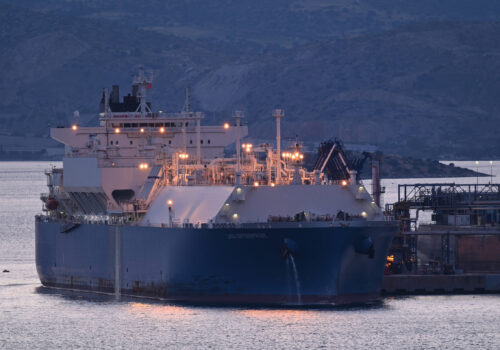
Image: The terminal of Spanish gas grid operator Enagas ENAG.MC at the port of Barcelona, Spain January 29, 2026. REUTERS/Nacho Doce
