For the past five years, I have had a front row seat to the most significant transformation of European security since the end of the Cold War.
I have witnessed this transformation from two very different vantage points. As a journalist covering Russia’s war against Ukraine, I reported from cities under missile attack, interviewed soldiers defending their country, and saw ordinary civilians become the backbone of Ukraine’s resilience.
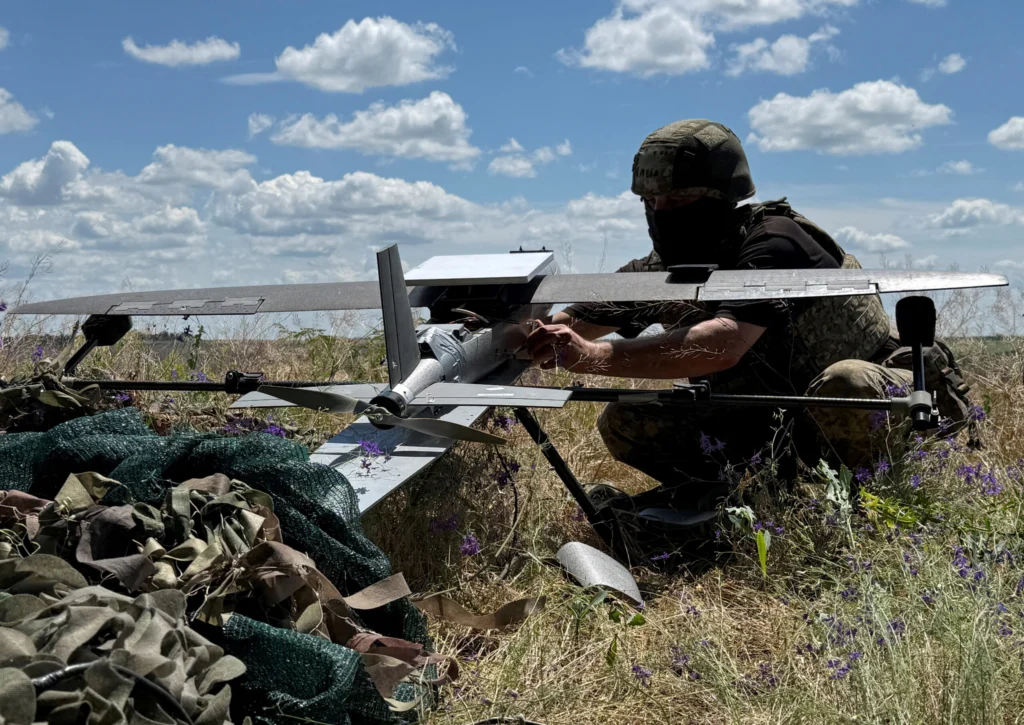
Musicians, poets, teachers, and entrepreneurs became soldiers, volunteers, and innovators. Factories that once produced furniture or household electronics began manufacturing drones and military equipment. A peaceful nation fighting for survival became one of the world’s leading defense industry innovators.
I can also remember attending NATO exercises following Russia’s full-scale invasion and watching Allied forces rehearse scenarios that still assumed technological superiority and uncontested logistics. In parallel, I was seeing Ukrainian soldiers improvise with commercial drones and software updates written overnight. It was already becoming clear that the future battlefield would look very different from the one NATO was trained for.
Stay updated
As the world watches the Russian invasion of Ukraine unfold, UkraineAlert delivers the best Atlantic Council expert insight and analysis on Ukraine twice a week directly to your inbox.
For decades following the end of the Cold War, Europe treated large-scale conventional war as a relic of the past. Defense spending declined, military industries contracted, and NATO’s focus shifted toward crisis management and expeditionary operations. When Russia launched its full-scale invasion in February 2022, few believed Ukraine could withstand the assault for more than a few days.
Ukraine proved all the skeptics wrong. The country’s remarkable resistance has forced NATO to confront a new reality. Every stage of the war has challenged long-held assumptions, from the defense of Kyiv and the importance of societal resilience, to the rise of drone warfare, electronic warfare, and the decisive role of defense industrial capacity.
Over five years of war, Ukraine has done more than expose Russia’s weaknesses. It has revealed the future of warfare. NATO leaders must now demonstrate at the coming Ankara Summit that they are ready for the new security environment.
Preparations for the Summit suggest the Alliance understands the scale of the challenge. NATO Secretary General Mark Rutte has deliberately shifted the conversation from defense spending alone to production, innovation, resilience, and implementation. This is more than a change in tone. It reflects a fundamental realization that deterrence in the twenty-first century depends not only on how much democracies spend, but also on how quickly they can produce, innovate, adapt, and sustain military capability.
Eurasia Center events

The transatlantic relationship is also evolving. The United States remains indispensable to European security, but it increasingly expects Europe to assume greater responsibility within the NATO framework. This should not be interpreted as American disengagement. It reflects a recognition that a stronger Europe is essential for a stronger NATO.
The political conversation in Washington is evolving in the same direction. For much of the current war, the central question was whether Ukraine could survive. Ukraine has answered that question on the battlefield and is now widely recognized as one of Europe’s leading military powers.
As Ukraine’s confidence has grown, so has confidence in Ukraine. The bipartisan passage of the Ukraine Support Act earlier this summer reflects a growing understanding in the United States that supporting Ukraine is not merely about helping one country resist aggression; it is an investment in the future security of the Euro-Atlantic community.
Meanwhile, efforts to deepen cooperation on drone technologies confirm that Ukraine is no longer viewed solely as a recipient of military assistance but as a source of battlefield innovation and operational expertise that can strengthen the United States, NATO, and the wider democratic alliance. This marks an important strategic shift. For decades, NATO exported military knowledge to its partners. Today, Ukraine is exporting hard-earned experience in drone warfare, electronic warfare, battlefield adaptation, intelligence integration, and civilian resilience.
The security conversation within NATO is already beginning to change. Rather than discussing whether Ukraine can defend itself, the emphasis is now on what NATO can learn from Ukraine. This is where the Ankara Summit can become an important milestone.
The political debate over possible future Ukrainian membership of NATO should not define the relationship between Kyiv and the Alliance. Instead, the priority should be strategic integration. Ukraine’s defense industry must become part of Europe’s defense industrial base. Ukrainian innovation should shape NATO’s procurement priorities. NATO doctrine must reflect Ukrainian battlefield experience.
For NATO, integrating Ukraine is no longer a question of geopolitical solidarity. It is a strategic necessity. NATO leaders now face an historic choice. They can continue adapting incrementally to each new crisis, or they can recognize that the post-Cold War security order has ended and adapt to the security environment that Ukraine has already revealed. If the Ankara Summit succeeds, it will mark the moment NATO stopped preparing for yesterday’s wars and began preparing for tomorrow’s.
Myroslava Gongadze is a nonresident senior fellow at the Atlantic Council’s Eurasia Center and a senior fellow for peace, security, and defense at Friends of Europe.
Further reading
The views expressed in UkraineAlert are solely those of the authors and do not necessarily reflect the views of the Atlantic Council, its staff, or its supporters.


The Eurasia Center’s mission is to enhance transatlantic cooperation in promoting stability, democratic values, and prosperity in Eurasia, from Eastern Europe and Turkey in the West to the Caucasus, Russia, and Central Asia in the East.
Follow us on social media
and support our work
Image: A serviceman of the 25th Separate Airborne Brigade of the Air Assault Forces of Ukraine prepares to launch a Hornet middle strike drone towards Russian troops from a position near a front line, amid Russia's attack on Ukraine, in Donetsk region, Ukraine June 23, 2026. Picture taken with a mobile phone. (REUTERS/Stringer/File Photo)