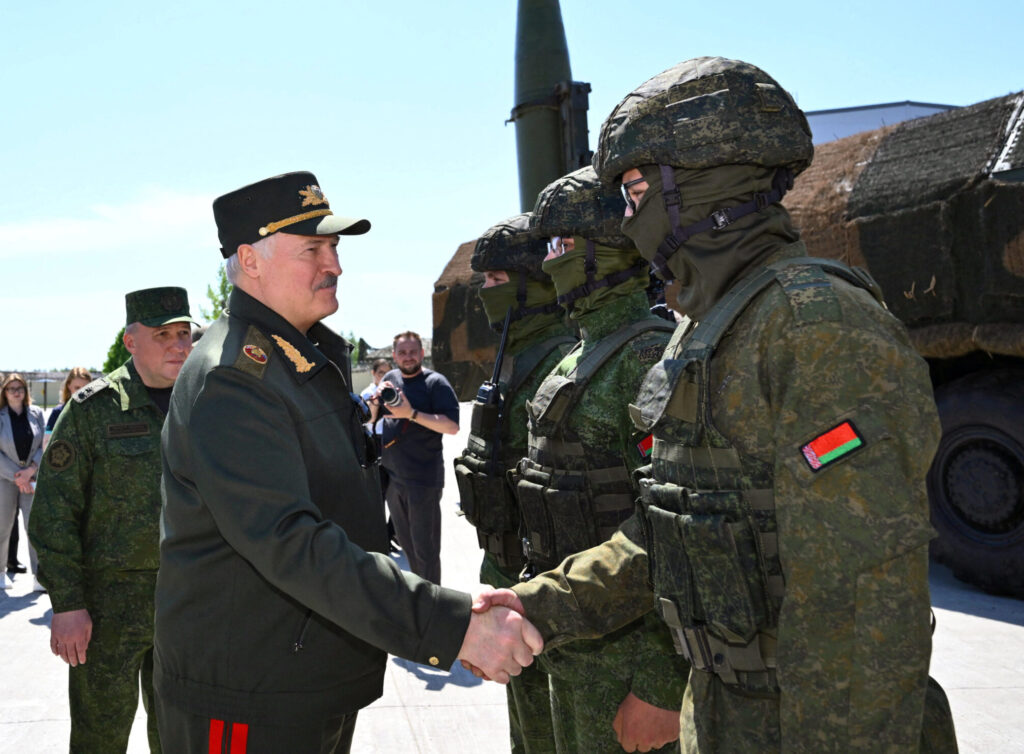
Belarus dictator Alyaksandr Lukashenka is not enthusiastic about the prospect of joining Russia’s Ukraine invasion, but he appears to be steadily building up his country’s military capacity in case he finds himself pushed more directly into the war.
That was the central message of a recent report presented to the Ukrainian government by the Belarusian democratic opposition. It documented numerous signs of Belarus’s accelerating militarization, including changes to military legislation, the expansion of the country’s armed forces and reserve system, the militarization of schools, and the growing mobilization of civilian institutions.
This report comes as tensions between Minsk and Kyiv continue to rise. Last week, Ukrainian President Volodymyr Zelenskyy publicly called on Lukashenka to dismantle relay equipment on the Belarusian-Ukrainian border that Kyiv claims is used to guide Russian drone attacks against Ukrainian targets. If the Belarusian leader failed to act, Zelenskyy said Ukraine would intervene directly. Within days, the relay stations reportedly went offline. It remains unclear whether they were dismantled or simply switched off, but the timing suggests Zelenskyy’s warning was taken seriously.
Kyiv’s concerns extend far beyond relay stations. Since the start of Russia’s full-scale invasion, Belarus has served as a launchpad for Russian attacks on Ukraine while steadily deepening defense cooperation with Moscow. Hundreds of Belarusian enterprises now manufacture components for Russian missiles, air-defense systems, drones, electronic warfare equipment, and ammunition. The recent issue over relay equipment cannot therefore be viewed as an isolated incident. On the contrary, it is merely one of the many manifestations of Belarus’s undeclared role in Russia’s war.
Stay updated
As the world watches the Russian invasion of Ukraine unfold, UkraineAlert delivers the best Atlantic Council expert insight and analysis on Ukraine twice a week directly to your inbox.
For years, Lukashenka has tried to maintain a careful balance in his approach to the Russian invasion of Ukraine, remaining close enough to satisfy the Kremlin, but distant enough to avoid becoming a direct belligerent. As Moscow struggles to achieve its goals on the battlefield, this balancing act is now becoming harder to sustain.
Although Russia only keeps around two thousand troops in Belarus at present, a recent agreement between Moscow and Minsk has laid the legal foundations for larger permanent deployments and deeper military integration. Belarus has also been folded into Russia’s nuclear posture. After Lukashenka ended the country’s nuclear-free status in 2022, Russian President Vladimir Putin announced the deployment of Russian tactical nuclear weapons to Belarus the following year. Although the transfer of nuclear weapons has not been independently verified, Belarus now plays an active role in Russia’s nuclear saber-rattling against the West, as demonstrated by repeated joint nuclear exercises.
Belarus has also become increasingly important to Putin’s wartime economy. With Ukrainian drone strikes now routinely disrupting operations at Russian oil refineries, Belarus is helping to fill the gap. Sales of Belarusian-produced gasoline to Russia have surged more than fifty-fold during June 2026 compared with the same period last year.
Eurasia Center events

None of this means Belarusian troops are necessarily about to cross into Ukraine. After all, Lukashenka understands the risks of entering the war better than anyone. He is heavily reliant on the Kremlin for his political survival, but at the same time, he also recognizes that sending Belarusian soldiers to fight for Putin would expose him to real danger. Independent polling consistently shows that a majority of Belarusians oppose participation in the war. A costly military campaign could trigger the biggest domestic crisis Lukashenka has faced since the 2020 protests that almost brought down his regime.
Focusing solely on whether Belarusian troops will soon join the Russian invasion of Ukraine risks missing the bigger picture. The Kremlin can drag Belarus deeper into the war without the direct participation of Belarusian soldiers. Help with drone strikes, military production, logistical support, border provocations, and hybrid attacks all expand Minsk’s role without requiring large-scale involvement in combat operations.
The most important development currently taking place may actually be structural. Step by step, Belarus is removing the political, legal, industrial, and military barriers that once limited its involvement in Russia’s war. The command structures are now in place. Legislation has been rewritten and the defense industry is expanding. Preparation is not the same as intent, of course, but it makes participation easier should Putin decide that the time has come.
The Belarusian democratic opposition has been clear that every additional step tying the country to Russia’s invasion further erodes Belarusian sovereignty. They argue that Belarus risks becoming little more than an extension of the Kremlin war machine and have called for a national dialogue before the process becomes irreversible.
Western policy toward Belarus needs to reflect this reality. Securing the release of political prisoners should remain an important objective, but efforts to engage the Lukashenka regime must not ignore Belarus’s accelerating military integration with Russia. For example, sanctions enforcement should focus on closing the loopholes that allow the Belarusian and Russian defense industries to obtain Western technologies. This effort should be closely coordinated with Ukraine and the Belarusian opposition.
At the same time, sustained Western support for independent media, civil society, and the democratic movement in Belarus remain essential. A democratic breakthrough is Belarus’s best hope of reclaiming its sovereignty, and is also crucial for Europe’s long-term security.
Hanna Liubakova is a journalist from Belarus and nonresident senior fellow at the Atlantic Council.
Further reading


The views expressed in UkraineAlert are solely those of the authors and do not necessarily reflect the views of the Atlantic Council, its staff, or its supporters.

The Eurasia Center’s mission is to enhance transatlantic cooperation in promoting stability, democratic values, and prosperity in Eurasia, from Eastern Europe and Turkey in the West to the Caucasus, Russia, and Central Asia in the East.
Follow us on social media
and support our work
Image: Belarusian President Alyaksandr Lukasenka shakes hands with a service member next to the Iskander-M missile launcher as he visits a missile brigade of the Armed Forces during joint Russian-Belarusian nuclear exercises, in the Asipovichy district, Mogilev region, Belarus. May 21, 2026. (President of the Republic of Belarus/Handout via REUTERS)