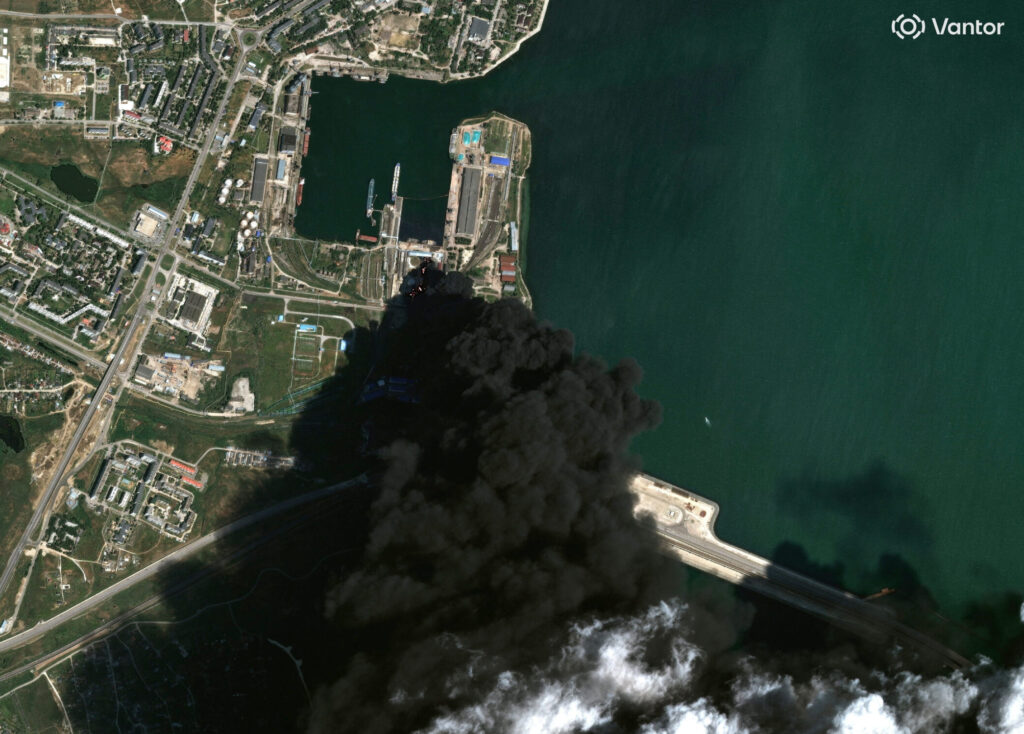
The Kremlin-installed authorities in Russian-occupied Crimea declared a state of emergency last week amid energy blackouts and fuel shortages caused by Ukraine’s intensifying blockade of the Black Sea peninsula. The deteriorating situation in Crimea is creating major practical challenges for the Russian war effort in Ukraine. Crucially, it also poses a direct threat to the carefully crafted Kremlin mythology portraying Vladimir Putin as the great restorer of the Russian Empire.
Ukraine’s strategic bombing campaign in and around Crimea has been unfolding since early 2026 and relies heavily on a new generation of strike drones capable of operating deep behind enemy lines. These mid-range drones have made it possible to target access routes in and out of the peninsula, along with high-value targets in Crimea itself. A key focus has been the so-called “land bridge” across occupied southern Ukraine that serves as a lifeline linking Crimea to the Russian Federation.
This militarily unprecedented drone-led blockade has proved highly effective. The Crimean occupation authorities have been forced to impose restrictions on public transport, street lighting, and electricity supplies, while the sale of gasoline to civilians is now tightly controlled and was stopped altogether for a period in late June. Many residents have resorted to traveling across the Crimean Bridge to search for petrol in Russia’s Krasnodar and Rostov regions, but some report that fuel stations have refused service to Crimean vehicles due to local shortages. With gasoline largely unavailable and power cuts now a daily fact of life, reservations in Crimean tourist resorts reportedly plummeted by 79 percent in June.
Stay updated
As the world watches the Russian invasion of Ukraine unfold, UkraineAlert delivers the best Atlantic Council expert insight and analysis on Ukraine twice a week directly to your inbox.
The blockade of Crimea has serious military implications for Russia. Since 2022, the peninsula has served as a key staging post and supply route for the hundreds of thousands of Russian troops based in southern Ukraine. While it is unlikely that Kyiv currently has sufficient manpower to launch a land offensive capable of liberating Crimea, Ukraine’s innovative drone tactics could plausibly make the peninsula untenable as a large-scale base for military operations. This would undermine the Russian occupation of southern Ukraine, while also reducing Moscow’s ability to bomb Ukrainian cities.
The psychological importance of Ukraine’s Crimean blockade is arguably even more significant and cannot be overstated. When Russia seized Crimea from Ukraine in spring 2014, it sparked a wave of jubilation among the Russian public that sent national pride soaring and thrust Putin’s approval rating to record highs. This euphoric response reflected the romantic image of Crimea in the Russian popular imagination as a symbol of empire, a site of historic Russian glory, and a holiday location enjoyed by generations of Russians. Following the Soviet collapse, many never came to terms with the fact that the peninsula was part of independent Ukraine.
Putin understood this emotional attachment and has taken full advantage of it. As the military seizure of Crimea unfolded in 2014, he initially denied all knowledge and insisted Russia was not involved. Instead, Putin famously claimed that the thousands of well-armed Russian servicemen without insignia engaged in the takeover of the peninsula were in fact groups of disgruntled locals. However, once it became abundantly clear that the international community had no intention of intervening or imposing significant penalties, he was soon taking full credit for the invasion and providing embellished accounts of how he personally coordinated the entire campaign.
The stunning success of the Crimean operation clearly emboldened Putin and convinced him of the West’s fundamental weakness. This set the stage for all that has followed. Within weeks, the Russian invasion of mainland Ukraine was underway, with Kremlin-coordinated attempts to spark “separatist” uprisings throughout southern and eastern Ukraine. This led to a grinding, undeclared war in eastern Ukraine’s Donbas region, which in turn paved the way for the full-scale invasion of 2022.
As the invasion of Ukraine has escalated over the past twelve years, Crimea has become the centerpiece of the Putin regime’s imperial propaganda and a byword for Russia’s return to great power status. In late 2014, Putin himself declared that the peninsula was Russia’s “Temple Mount.” The anniversary of the occupation was celebrated each year with much fanfare, while the construction of a bridge linking Crimea to mainland Russia became the Kremlin’s flagship construction project. When the bridge opened in 2018, Putin was on hand to drive a truck across the new structure.
Eurasia Center events

All this makes the current state of emergency in Crimea a huge personal embarrassment for Putin. Having built up his image as the heroic leader who returned the peninsula to its “native harbor,” he is now unable to prevent Ukrainian airstrikes or ensure the provision of basic amenities. This is already a very significant blow to his prestige. If conditions continue to deteriorate and the current trickle of evacuations becomes a full-blown exodus, the crisis will take on far greater proportions and could destabilize the situation inside Russia itself.
Some have speculated that Putin will respond to the unfolding disaster in Crimea by escalating his attacks on Ukrainian civilians or threatening Europe. This certainly cannot be ruled out. But the experience of the past four years suggests that when faced with humiliating setbacks, Putin is much more inclined to retreat in silence. In September 2022, he announced his readiness to use nuclear weapons in defense of Russia’s Ukrainian conquests and warned that he was “not bluffing.” However, when Ukraine called his bluff weeks later and liberated the Russian-occupied city of Kherson, there was no nuclear response.
Likewise, Putin frequently warned of dire retribution if Ukraine dared to attack naval bases in Crimea, but when Ukrainian drone forces ignored him and proceeded to sink or damage dozens of Russian warships, Putin quietly withdrew the remainder of his fleet from occupied Crimea to the relative safety of Russia. The retreat of Russia’s Black Sea Fleet from Crimea was a stunning victory for Ukraine that would have been unthinkable on the eve of the full-scale invasion. And yet this landmark event has been almost completely ignored by the Kremlin-controlled Russian media.
This Kremlin censorship of Russia’s defeat in the Battle of the Black Sea is perhaps the best indicator of how Putin will react if his grip on Crimea continues to weaken. Rather than going nuclear, he may instruct his propaganda machine to downplay the importance of the peninsula while seeking to change the subject entirely. Crimea has long been seen as Putin’s greatest victory, but it is now in danger of becoming a symbol of his disastrous imperial overreach.
Peter Dickinson is editor of the Atlantic Council’s UkraineAlert service.
Further reading


The views expressed in UkraineAlert are solely those of the authors and do not necessarily reflect the views of the Atlantic Council, its staff, or its supporters.

The Eurasia Center’s mission is to enhance transatlantic cooperation in promoting stability, democratic values, and prosperity in Eurasia, from Eastern Europe and Turkey in the West to the Caucasus, Russia, and Central Asia in the East.
Follow us on social media
and support our work
Image: A satellite image shows burning storage tanks and heavy smoke after an attack, in Kerch, Crimea, June 20, 2026. Vantor/Handout via REUTERS.