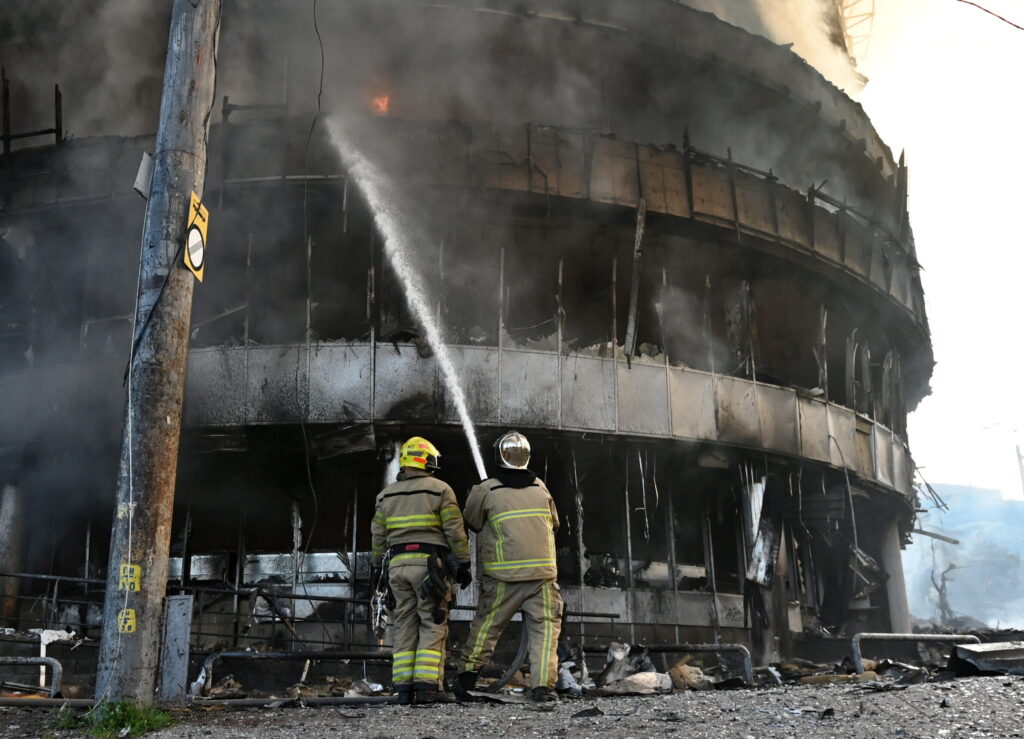
As the Russian army struggles to advance in Ukraine, Vladimir Putin is increasingly relying on ballistic missiles to maintain the momentum of his faltering invasion. While Ukraine’s air defenses have dramatically improved since the start of the full-scale invasion in February 2022, the only platform in Kyiv’s arsenal that is capable of consistently intercepting ballistic missiles is the US-made Patriot system. However, due to limited US production and growing demand for interceptors in the Middle East, there is simply not enough ammunition available to protect Ukraine’s cities and civilian infrastructure.
Putin is now taking full advantage of this shortage. On 19 July, Russia launched 41 ballistic missiles at Kyiv in one of the largest barrages of the war. This was part of a pattern that has seen a sharp rise in Russia’s use of ballistic missiles against Ukraine during the past two months. The recent spate of ballistic strikes has left hundreds of Ukrainian civilians dead and injured, underlining the scale of the threat posed by this latest phase in the air war.
Stay updated
As the world watches the Russian invasion of Ukraine unfold, UkraineAlert delivers the best Atlantic Council expert insight and analysis on Ukraine twice a week directly to your inbox.
Ukrainian officials recognize the need to prioritize this aerial threat and have sought to emphasize the urgency of the issue in dialogue with the country’s partners. “Ballistic missiles are Russia’s last remaining argument in its war against Ukraine,” Ukrainian President Volodymyr Zelenskyy commented recently. “We must find sufficient countermeasures.”
Efforts to counter Russia’s ballistic missile barrages are now gaining pace. On 13 July, Ukraine and nine European partners established an anti-ballistic coalition centered on a new air defense platform dubbed FREYJA that currently under development. This is a Ukrainian-developed system combining Ukraine’s interceptor technologies with European radars, command-and-control systems, and manufacturing capacity. The stated ambition is to achieve initial operational capability within twelve months.
This followed on from the NATO summit in Ankara one week earlier, which saw US President Donald Trump announce plans to grant Ukraine a license to produce Patriot interceptors. While Trump’s decision was widely welcomed in Kyiv, Ukrainian policymakers are well aware that establishing domestic Patriot missile production will take time and is not therefore a realistic short-term solution. The European coalition is part of efforts to close the gap.
Eurasia Center events

Russia’s bet on ballistic missiles is a warning to all of Europe. The Kremlin is cranking up production in preparation for a further escalation in strikes across Ukraine, and is clearly counting on its ability to manufacture missiles at a faster rate than Kyiv’s allies can provide interceptor ammunition. The goal is to break civilian morale while also degrading Ukraine’s core infrastructure and rendering much of the country unlivable. As winter approaches, Moscow is expected to weaponize plummeting temperatures once again by focusing on the destruction of energy and heating networks across Ukraine.
Ballistic missiles are the instrument that makes this bombing campaign possible. They are fast, difficult to intercept, and expensive to defend against at scale. Every interceptor Ukraine expends on a ballistic missile is one it cannot use elsewhere. Every strike that gets through means more civilian deaths or damage to infrastructure that takes months to repair.
The current shortage of interceptor missiles to defend Ukraine has underlined the dangers of continued European dependence on US production capacity to cover its air defense requirements. FREYJA offers a route out of that dependency. This initiative is not intended to fully replace the Patriot system, but could help reduce reliance on a single supplier.
The division of labor among anti-ballistic coalition members is already starting to emerge. Ukraine is set to provide interceptor missiles, with Germany leading efforts to develop radar capabilities. However, rapid progress will only be possible if all participating countries shift away from peacetime thinking and act with a sense of wartime urgency.
The FREYJA project represents a strategic opportunity that Europe cannot afford to waste. Ukraine claims to have developed the interceptor technologies that European defense industries have struggled to produce for decades. Europe’s role now is not to rescue Ukraine, but to provide the radars, command systems, financing, and industrial partnerships that transform Ukrainian technological innovation into European defense capability. In a very real sense, this new anti-ballistic coalition is a major test of Europe’s commitment to the strategic autonomy that is so often championed by the continent’s leaders.
Maksym Beznosiuk is an analyst whose work focuses on Ukraine, Russia, and international security. He is an associate fellow at GLOBSEC. William Dixon is a senior associate fellow of the Royal United Services Institute and an associate fellow at GLOBSEC. He specializes in cyber and international security issues.
Further reading


The views expressed in UkraineAlert are solely those of the authors and do not necessarily reflect the views of the Atlantic Council, its staff, or its supporters.


The Eurasia Center’s mission is to enhance transatlantic cooperation in promoting stability, democratic values, and prosperity in Eurasia, from Eastern Europe and Turkey in the West to the Caucasus, Russia, and Central Asia in the East.
Follow us on social media
and support our work
Image: Ukrainian firefighters try to stop fire in a heavily damaged building following Russian strikes in Kyiv. A large ballistic missile attack pounded Kyiv early on May 24, authorities said. (Aleksandr Gusev / SOPA Images via Reuters Connect)
