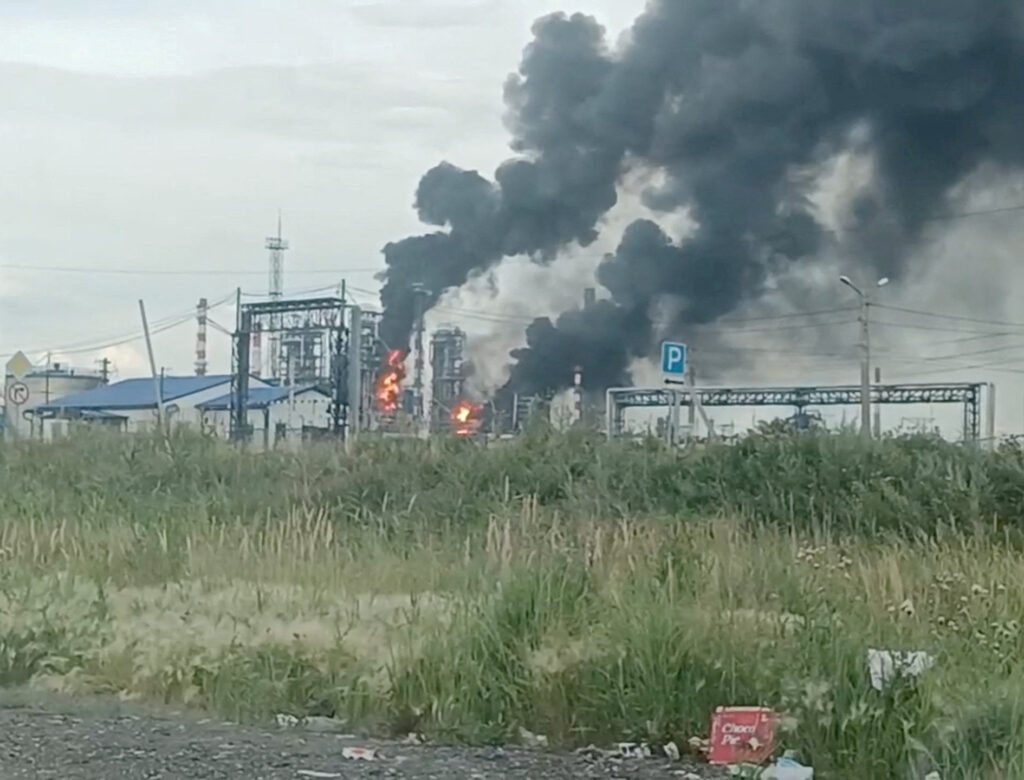
From Crimea to St. Petersburg, Ukraine’s escalating drone strike campaign is making headlines and encouraging many commentators to argue that the tide is turning in Kyiv’s favor. But while these attacks are unquestionably impacting the overall dynamics of the war, there is little sign that Russian President Vladimir Putin is any closer to ending his invasion. On the contrary, he appears more determined than ever to fight on.
With neither country able to secure any meaningful battlefield breakthroughs so far this year, the most significant development of 2026 has been the dramatic expansion of Ukraine’s drone war. The Ukrainian strategy has focused on two key areas: Long-range attacks reaching deep inside Russia, and mid-range strikes targeting Russian logistics behind the front lines of the invasion.
Ukraine’s long-range bombing campaign has increased dramatically since the start of 2026, with a record number of attacks on Russian energy infrastructure. According to Bloomberg, Russian refineries, oil tankers, and energy export sites were hit on at least thirty occasions during July, representing the second highest monthly total since the onset of Russia’s full-scale invasion more than four years ago. These attacks have sparked the biggest Russian fuel crisis since the Soviet collapse.
In addition to increased attacks on the energy infrastructure that funds the invasion, Ukraine is also targeting other key elements of Putin’s war machine. In recent months, Ukraine’s air offensive has included a series of long-range drone strikes on military production plants along with logistics hubs belonging to e-commerce giant Wildberries, which Kyiv accuses of supplying a wide range of military equipment to the Russian army in Ukraine.
The objective is not simply destruction. Ukraine aims to cause maximum disruption to the Russian war effort and force the Kremlin to make difficult decisions regarding the deployment of limited air defense capabilities. There is also an important psychological aspect to Ukraine’s deep strike campaign inside Russia, with each attack serving to bring Putin’s invasion home to Russian audiences and undermine Kremlin efforts to shield the population from wartime realities.
Stay updated
As the world watches the Russian invasion of Ukraine unfold, UkraineAlert delivers the best Atlantic Council expert insight and analysis on Ukraine twice a week directly to your inbox.
Ukraine’s mid-range bombing campaign has sought to isolate Russian-occupied Crimea by placing the peninsula under what officials in Kyiv have termed as a “logistics lockdown.” With Crimea itself facing regular bombardment and access routes via occupied regions of southern Ukraine increasingly exposed to Ukrainian drones, Moscow is struggling to keep the peninsula resupplied amid growing reports of fuel and power shortages. This is a major propaganda blow for the Kremlin, which has consistently positioned the 2014 seizure of Crimea as Putin’s greatest triumph.
Russia has responded to these setbacks by escalating attacks on Ukraine’s cities and civilian infrastructure, leading to a surge in casualties. According to data from the UN Human Rights Monitoring Mission in Ukraine, more than nine thousand Ukrainian civilians were killed or wounded as a result of Russian attacks during the first six months of 2026, representing a 37 percent increase on the same period one year earlier. Russia has also sought to capitalize on Ukraine’s shortage of air defense interceptors by launching record quantities of ballistic missiles at Kyiv and other Ukrainian cities.
Meanwhile, speculation is mounting that Putin may soon announce a new mobilization in a bid to regain the initiative on the battlefield. While any decision is not expected until after Russia’s September parliamentary elections, the current debate within Russian society over a possible mobilization reflects widespread perceptions that the Kremlin is preparing for a long war rather than a negotiated peace.
Eurasia Center events

Putin’s uncompromising posture should come as no surprise. While Ukraine’s expanding drone strike campaign is causing significant damage, it has not yet inflicted anything approaching a decisive blow. At present, Russia retains the overall military advantage in terms of manpower and firepower. Putin’s invasion force is still advancing in Ukraine, albeit at glacial pace amid heavy losses.
Nor is there any sign of major instability on the home front. Russia’s ailing wartime economy is still more than capable of funding the war for an extended period. While there are growing indications of discontent among members of the elite and throughout Russian society, the invasion of Ukraine has served to strengthen Putin’s domestic dominance. As long as he is able to continue the war, the Kremlin dictator’s grip on power will likely remain unassailable.
Crucially, Putin dare not risk any compromise peace that guarantees the continued existence of an independent Ukraine. Having positioned the invasion as an existential struggle to reclaim “historically Russian lands” and revive Russia’s superpower status, he cannot now accept terms that would place around 80 percent of Ukraine beyond Kremlin control. This would be regarded by many in Moscow as a defeat of historic proportions, with unpredictable consequences for Putin’s regime and the Russian Federation as a whole.
Ukraine’s ambitious drone offensive has given the country’s war effort new impetus and bolstered international confidence in Kyiv’s capabilities. However, if Ukraine’s partners are serious about pushing Putin toward peace, they must increase their support for Kyiv while also turning up the pressure on Russia. This means providing Ukraine with urgently needed Patriot interceptor missiles, funding the expansion of the Ukrainian defense industry, and enhancing Kyiv’s long-range strike capabilities. It also means tightening existing sanctions measures and closing loopholes that allow Moscow to bypass restrictions.
For now, Putin still believes time is on his side. Ukraine’s drone campaign is designed to challenge that assumption by making the war steadily more expensive for the Kremlin and destabilizing Putin’s home front. However, Ukrainian drone strikes alone will not bring Russia to the negotiating table. Genuine progress toward peace will only be possible when continuing the war becomes more costly for Putin than ending it. That will require significantly more Western resolve than we have witnessed since 2022.
Christopher Isajiw is an international relations analyst, commentator, and business development consultant to private, governmental, and non-governmental organizations.
Further reading

The views expressed in UkraineAlert are solely those of the authors and do not necessarily reflect the views of the Atlantic Council, its staff, or its supporters.

The Eurasia Center’s mission is to enhance transatlantic cooperation in promoting stability, democratic values, and prosperity in Eurasia, from Eastern Europe and Turkey in the West to the Caucasus, Russia, and Central Asia in the East.
Follow us on social media
and support our work
Image: Fire at Omsk oil refinery as the region's governor says the province came under attack from Ukrainian drones, in Omsk, Russia July 6, 2026, in this picture obtained from a social media video. (SOCIAL MEDIA/via REUTERS)